
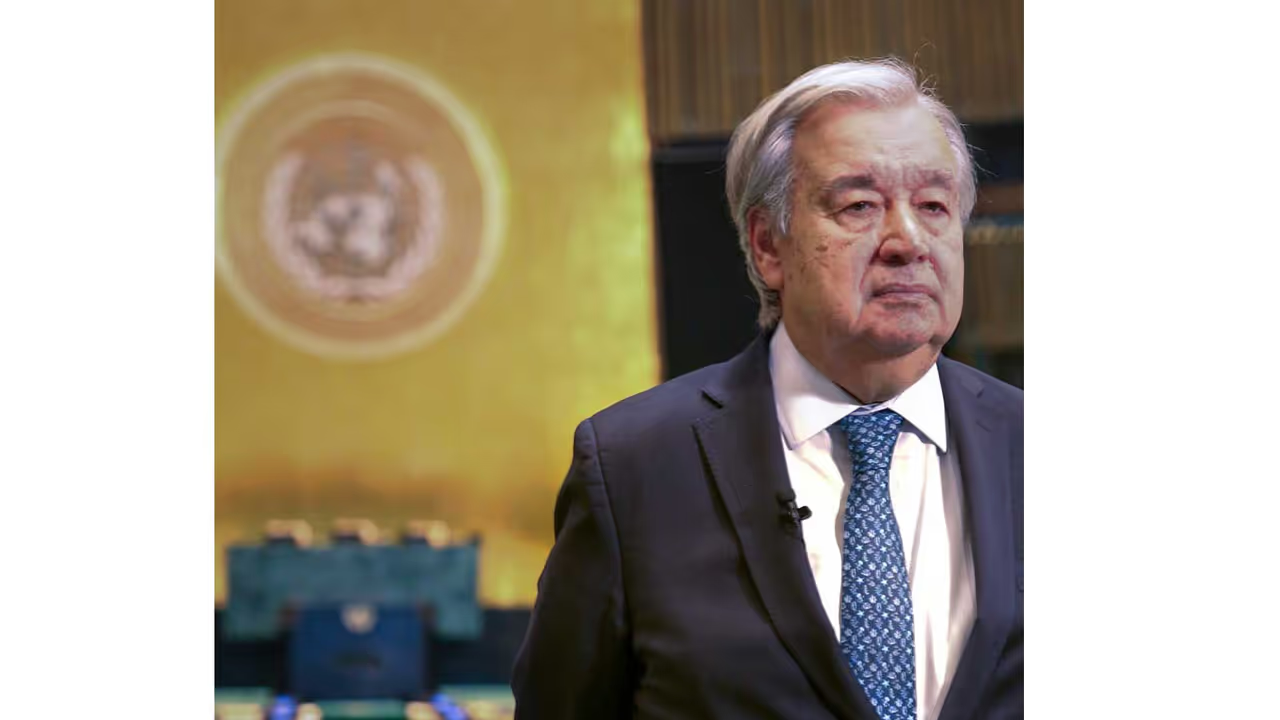
UN Chief Antonio Guterres warns the Security Council of rising conflicts and eroding international law. He stressed diplomacy's power to end crises, citing the Middle East, and called for de-escalation and a return to negotiated settlements.
Amid escalating tensions and military confrontations disrupting border peace and causing global uncertainty, UN Secretary-General Antonio Guterres on Thursday (local time) underscored the importance of diplomacy in resolving such global crises, saying that while it may not have succeeded in preventing ongoing conflicts, it still has the power to bring them to an end.
Addressing the UN Security Council's open debate on the peaceful settlement of disputes in New York, Guterres warned that conflicts are becoming more frequent, complex and prolonged while respect for international law continues to erode. "Today, conflicts are increasing in number, complexity, length and scope. We see an alarming disregard for international law. Impunity is spreading. Violations are going unanswered. Each violation unanswered becomes the next violation's precedent. Trust is eroding. And negotiated settlements are becoming harder to reach and maintain," he said.
Civilians 'pay the heaviest toll'
Highlighting the consequences of prioritising military action over dialogue, Guterres said civilians continue to bear the brunt of armed conflicts, particularly in the Middle East, referring to the growing military confrontation between the US and Iran and the border crisis surrounding Israel's military operation. "When parties prioritise military solutions over negotiated settlements, civilians pay the heaviest toll. We see this on full display in the Middle East, with devastating consequences in the region and across the globe. The situation is getting out of control. It is teetering on the edge of the unimaginable," he added.
Warning that the region is being drawn into an expanding cycle of confrontation, Guterres stressed that "one crisis feeds another" and "one escalation triggers the next". Calling for an immediate halt to hostilities, he said attacks on civilian infrastructure are unacceptable.
Diplomacy 'the only way forward'
Guterres also stressed the need to restore international navigational rights in and around the Strait of Hormuz in the Persian Gulf and the Bab al-Mandab in the Red Sea, which has since witnessed intensified blockade on commercial vessels due to the growing tensions between regional and global players. He reiterated that diplomacy remains the only viable path to resolving the crisis. "There is no military solution to the conflict. Fighting must stop everywhere in the region. International navigational rights and freedoms in and around the Strait of Hormuz and Bab al-Mandab must be fully restored. Diplomacy is the only way forward. That has been my clear and consistent message in my ongoing outreach to leaders," the UN Chief said.
Humanitarian Situation in Gaza
Referring to the humanitarian situation in Gaza, Guterres said civilians continue to suffer despite the so-called ceasefire which was brokered by the US back in October, 2025. "Meanwhile, in Gaza, despite the so-called ceasefire, civilians continue to pay a heavy price every day. People are being killed in their homes, in their communities and while carrying out ordinary acts of daily life -- as Israel increases its control of Gaza," he said.
Emphasising the continued relevance of diplomatic efforts, Guterres said, "Diplomacy may not have succeeded in preventing these conflicts. But it still holds the power to stop them."
Six Priorities to Strengthen Peaceful Settlements
Speaking on the implementation of UN Security Council Resolution 2788 (2025), Guterres outlined six priority areas to strengthen the peaceful settlement of disputes. He called for reinforcing the UN Secretariat's mediation and good offices, expanding the role of regional offices and special envoys, encouraging the Security Council to act earlier under Chapter VI of the UN Charter, increasing fact-finding efforts to build consensus, ensuring the meaningful participation of women, youth and civil society in peace processes, and urging all UN Member States to actively support diplomacy and dialogue.
'Summon the Spirit of Compromise'
"The UN Charter remains humanity's best hope for peace. But it is only as strong as the commitment of those responsible for upholding it," Guterres said, urging UNSC members to overcome geopolitical divisions and pursue compromise.
"I urge all members of this Council: Summon the spirit of compromise that is essential to peace, keep the channels of dialogue open, and spare no effort in the pursuit of peaceful settlements of disputes - a founding principle of this organisation," he added. (ANI)
(Except for the headline, this story has not been edited by Asianet Newsable English staff and is published from a syndicated feed.)