
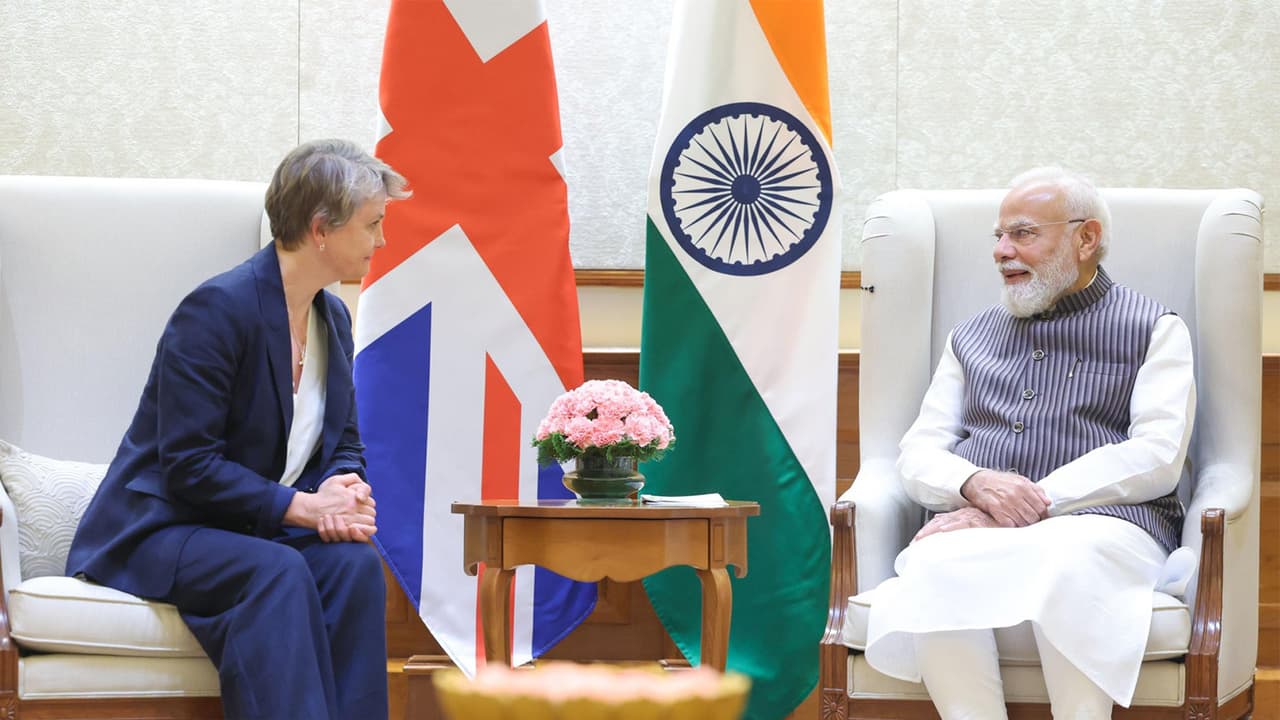
UK Foreign Secretary Yvette Cooper concluded her India and China visit, advocating for global engagement over "cancel culture." In India, she discussed maritime security and critical minerals with PM Modi, launching new joint initiatives.
UK Foreign Secretary Yvette Cooper has wrapped up her visit to India and China, a statement by the UK government said. Cooper underlined the need for the UK to be engaged with other serious players on the world stage, to make sure the UK was at the centre of dialogue and debate on the international issues that are shaping the world today.
As per the statement, she underlined that the UK cannot insulate itself from global issues through "cancel culture" on foreign policy and not engaging in vital global discussions. It must instead have conversations with key interlocutors that further the UK national interest, cooperating on areas of common ground and challenging in areas where we disagree. These conversations are rooted in the UK's international approach that strong, purposeful engagement on the world stage is the best way to deliver growth and security for the British people.
UK-India Strategic Discussions
Going onto New Delhi on Thursday, the Foreign Secretary drove forward work on issues that are vital to UK prosperity, speaking to the Indian Government about maritime security, growth and keeping supply chains secure from global economic shocks. In meetings with Prime Minister Narendra Modi and External Affairs Minister S Jaishankar, the Foreign Secretary built on the strategic direction and vision for deeper cooperation built by the Prime Minister under Vision 2035.
New Maritime Security Centre Launched
She highlighted the crucial need to work together on the Strait of Hormuz and easing the impact its closure is having on international shipping. As part of that, the Foreign Secretary co-launched a new Regional Maritime Security Centre of Excellence (RMSCE), bolstering the UK's cooperation with India on maritime security and resilience to international shocks, as per the statement.
Focus on Critical Minerals Supply Chains
Critical minerals also formed a key part of talks with Indian interlocutors. On the visit, the FS underlined the UK's commitment to working with partners to create more diverse and resilient supply chains. Critical minerals are essential to the UK's current and future prosperity, as necessary components in everything from electric vehicles and wind turbines to smartphones, the statement said.
Global Supply Chain Observatory Unveiled
During her meeting with G Kishan Reddy, India's Minister for Coal and Mines, the Foreign Secretary launched the Critical Minerals Global Supply Chain Observatory (GSCO). A flagship component of the UK-India Technology Security Initiative, this Observatory provides a groundbreaking AI tool that gives real-time information on global critical mineral flows and identifies supply chain vulnerabilities. As part of the GSCO, India will commit 1.2 million Euros of funding to establish a satellite observatory campus at the Indian Institute of Technology in Dhanbad with the University of Cambridge. (ANI)
(Except for the headline, this story has not been edited by Asianet Newsable English staff and is published from a syndicated feed.)