
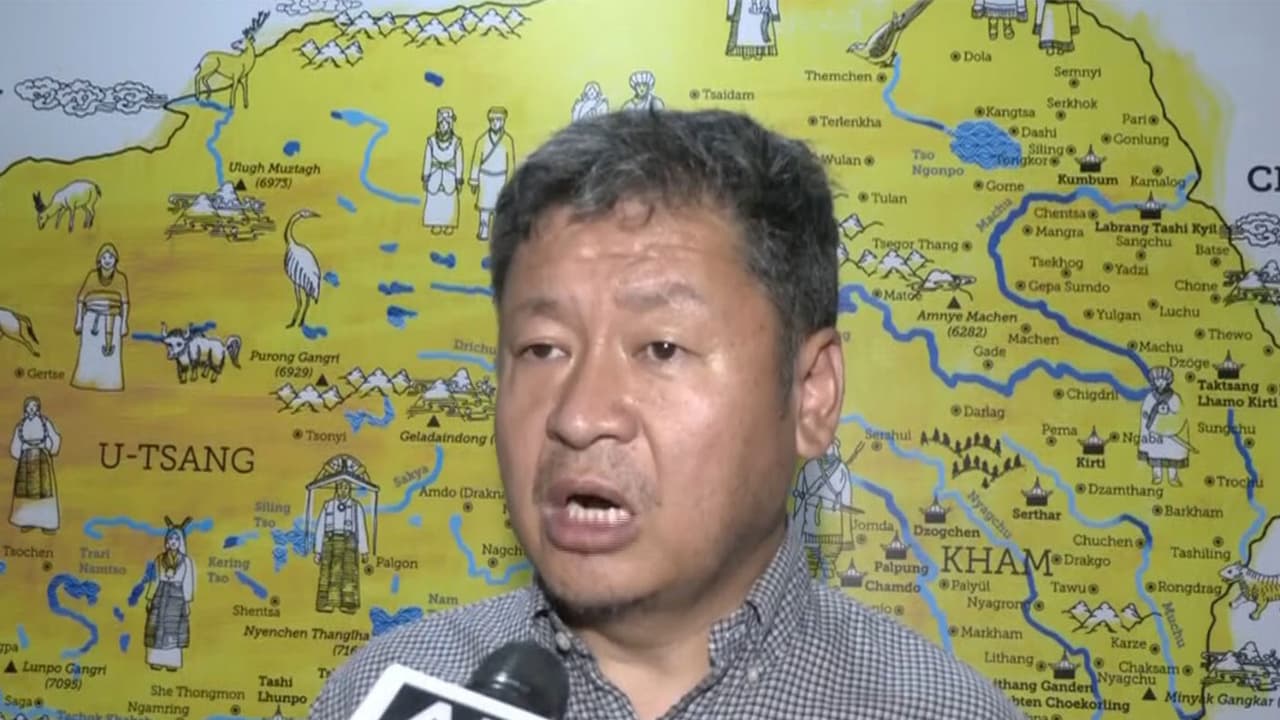
The Tibetan exile community marked the 75th anniversary of the 'Seventeen-Point Agreement' by condemning China's 'forced annexation' of Tibet. They reject the accord as illegitimate and continue to demand freedom and genuine autonomy.
The Tibetan exile community said that China has failed to fulfil the aspirations of the Tibetan people even after 75 years of what it described as the "forced annexation" of Tibet, while reiterating demands for freedom, human rights and genuine autonomy.
The remarks came on the 75th anniversary of the signing of the controversial "Seventeen-Point Agreement" signed in 1951 between representatives of Tibet and the government of the Chinese Communist Party, an accord that Tibetans-in-exile have long rejected as illegitimate.
'An Occupation, Not Liberation'
Speaking to ANI, Tenzin Lekshay, spokesperson for the Tibetan government-in-exile, said the agreement marked the beginning of China's occupation of Tibet rather than its liberation. "Today it will be the 75th year of signing of the infamous 17-point agreement, which was signed in 1951, and since then we have been saying that it is not a liberation of Tibet, but it is a very occupation of Tibet because we used to be an independent country," Lekshay said.
He added that Tibetans continue to face restrictions on freedom and autonomy despite China's claims of building a "harmonious society". "Even though they occupied Tibet, the Tibetan aspirations have to be fulfilled. They have been claiming so many things about harmonious societies or things like this, but Tibetans are not happy. Tibetans' freedom has not been granted as per the constitution they have claimed for," he said.
Lekshay further said the Tibetan exile administration continues to pursue "genuine autonomy" for Tibet and called on Chinese leaders to address the wishes of the Tibetan people. "It is very important for the Chinese leaders to understand that if they insist on the claim of dominance over the Tibetans, they should confer with the aspirations of the Tibetan people," he stated.
Highlighting international support for the Tibetan cause, Lekshay said Tibet's issue extends beyond regional politics. "We have lots of international support throughout. We have resolutions and declarations and statements coming from all over the world, but it is very important for the world to understand that it is not just for the Tibetan people, but it is for the security of the world. It is for the safety of the world. It is for humanity that the survival of Tibet is needed," he said.
Activists Allege Coercion and Forgery
Meanwhile, Tibetan activists-in-exile strongly condemned the Seventeen-Point Agreement, describing it as invalid and imposed under coercion. Tenzin Lobsang, general secretary of the Tibetan Youth Congress, alleged that the Tibetan delegation was forced to sign the agreement under military pressure.
Speaking to ANI, Lobsang said, "It's been a long 75 years, but then I personally consider that it's more like a treaty than an agreement, and Tibetan representatives had to sign that treaty under so much pressure with the military occupation, threat by the Chinese government to the Tibetan delegation."
He further alleged that Chinese authorities forged official Tibetan seals to legitimise the agreement. "They refused to give the Tibetan delegation a stamp, and they forged it, and then they stamped it on the document itself," he claimed.
Lobsang also argued that China never implemented the provisions outlined in the agreement. "China never applied the 17-point agreement itself, and none of the points has been published or implemented for the Tibetans, and it is completely showing that this agreement or treaty was a false one," he said.
Expressing hope for political change in the future, Lobsang said the Tibetan movement remains optimistic despite China's growing global influence. "We do really hope that there will be a change in the near future. Even though China seems to be very powerful and they are on the peak, we are aware that there is an internal power struggle within the Chinese Communist Party," he said. "We are looking forward for an opportunity as well. We do have so much of hope... that Tibetans have been annexed illegally or by military occupations," he added.
(Except for the headline, this story has not been edited by Asianet Newsable English staff and is published from a syndicated feed.)