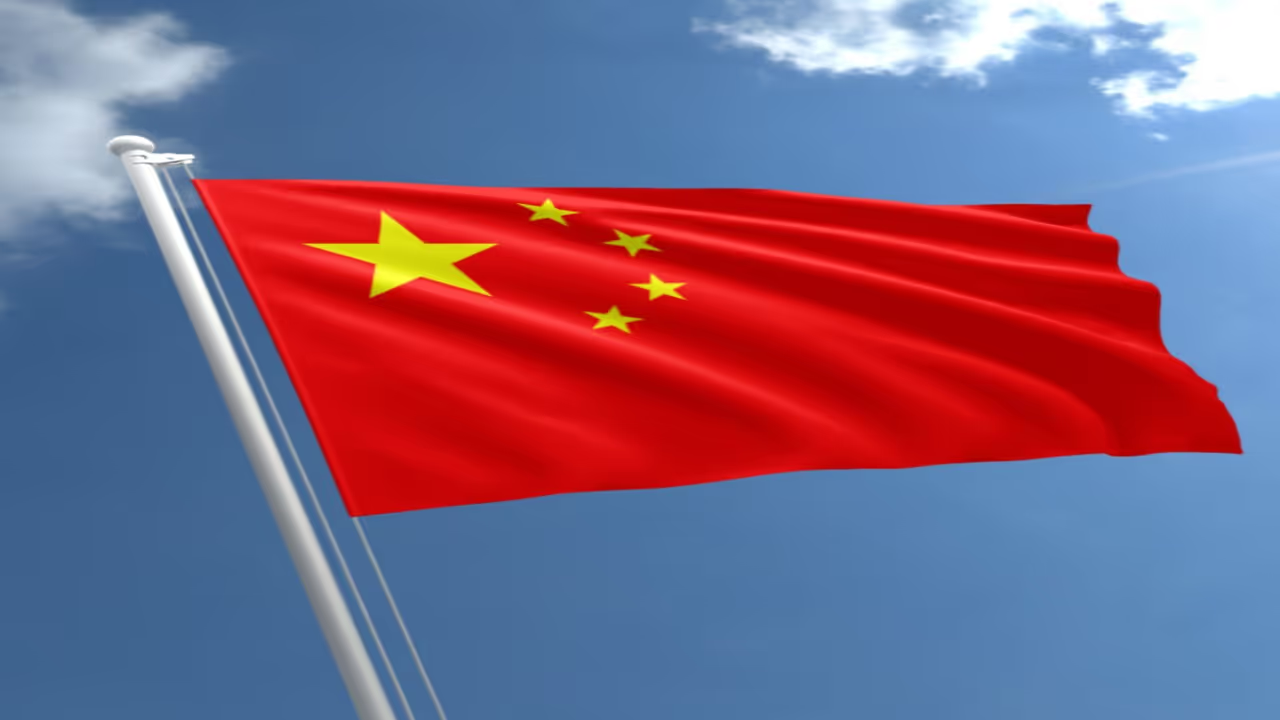
The closure of FactWire marks another major blow to Hong Kong's independent media landscape. Following the fall of Apple Daily, Stand News and CitizenNews, the shutdown highlights growing concerns over press freedom and Beijing's tightening control over journalism.
New Delhi: For decades, Hong Kong stood apart from mainland Communist China as Asia's freest media environment.
Hong Kong was a place where investigative journalists exposed corruption, scrutinised power, and challenged official narratives without fear of midnight arrests or politically motivated prosecutions.
That distinction is now disappearing with alarming speed. The closure of FactWire, following the destruction of Apple Daily, Stand News, and CitizenNews, demonstrates that the collapse of Hong Kong's independent press is not a series of isolated incidents.
Related Articles

It is a systematic dismantling of an entire journalistic ecosystem under Beijing's tightening authoritarian grip.
The demise of FactWire was especially symbolic because it represented one of the purest examples of civic-backed investigative journalism in modern Hong Kong.
Founded in 2015, the outlet emerged through a crowdfunding campaign supported by more than 3,300 citizens who collectively raised HK$4.75 million.
Unlike media organisations dependent on tycoons, advertisers, or political patrons, FactWire was built directly on public trust.
Its mission was simple yet vital: pursue investigative reporting in the public interest at a time when many traditional media houses were already becoming cautious under political pressure.
That model made FactWire uniquely threatening to authoritarian systems. Independent journalism funded by citizens rather than commercial or political interests is far harder to control.
Its accountability flows horizontally to society rather than vertically to the state. By extinguishing FactWire, Beijing's expanding political architecture in Hong Kong eliminated not merely another publication but an entire democratic principle.
Communist China destroyed the idea that ordinary citizens could sustain a press capable of investigating power without permission from the authorities.
The timing of these closures reveals a broader pattern. In less than a year, four major independent outlets disappeared from Hong Kong's media landscape.
Apple Daily was effectively crushed after police raids, asset freezes, and the arrest of its executives under the National Security Law. Stand News was dismantled after sedition charges and newsroom raids froze its operations. CitizenNews shut down preemptively, openly citing fears for staff safety amid the rapidly changing political climate. FactWire soon followed — though the outlet, in keeping with the climate of fear that had already settled over the city's press, did not publicly state its reasons for closure.
The progression is important because it illustrates Beijing's methodical approach to suppressing dissenting information spaces.
First came legal intimidation through sweeping national security legislation. Then came selective prosecutions, arrests, and financial pressure. Finally came the spread of fear itself, producing self-censorship and voluntary closure before the state even needed to intervene directly.
This strategy allows authorities to present media collapse as the result of "business decisions" or "editorial choices," even when those choices are clearly made under existential political coercion. That FactWire felt unable to explain its own shutdown is itself a measure of how thoroughly that coercion had taken hold.
The transformation of Hong Kong's media environment since 2020 is therefore not accidental. Before the imposition of the National Security Law, Hong Kong enjoyed a global reputation as a regional media hub where international correspondents, investigative reporters, and local watchdog organisations operated with freedoms unavailable in mainland China.
Global publications maintained regional headquarters there precisely because the city combined proximity to China with protections for civil liberties and press freedom.
That environment has now been hollowed out. The city that once functioned as a bridge between open societies and authoritarian China increasingly resembles the mainland's tightly managed information order.
Investigative reporting has been replaced by caution. Newsrooms now operate under the constant threat that ordinary reporting could be interpreted as subversion, collusion, or sedition. Journalists are forced to weigh legal risk against public duty, while editors calculate whether certain stories are worth the possibility of police scrutiny.
This suffocation of journalism serves a larger political objective. Authoritarian systems do not merely seek to silence criticism; they seek to erase institutional memory and prevent independent verification of reality itself.
Investigative journalism creates public records, uncovers contradictions in official narratives, and preserves accountability.
By dismantling the organisations capable of such work, Beijing reduces society's capacity to document abuses, corruption, or political repression.
The destruction of Hong Kong's independent media also carries profound international implications. Beijing has long promoted the claim that authoritarian governance can coexist with openness and economic dynamism.
Hong Kong once served as the showcase for that argument under the "one country, two systems" framework. The collapse of the city's investigative press now undermines that narrative entirely. A financial hub without press freedom may remain commercially useful, but it cannot credibly function as a genuinely open global city.
Most importantly, the closures demonstrate that the erosion of freedom often happens incrementally until suddenly an ecosystem disappears altogether.
Each newsroom shutdown becomes easier after the previous one normalises repression. Each arrest expands the boundaries of fear. Each act of self-censorship narrows the public sphere further.
By the time the final watchdog falls silent, the architecture of independent journalism has already been dismantled piece by piece.
The story of Hong Kong's press is therefore no longer simply about media economics or changing consumer habits. It is about the deliberate construction of political conformity.
FactWire's death was not a market failure. It was the silencing of a citizen-funded institution by an authoritarian system determined to ensure that no independent watchdog could challenge state power.