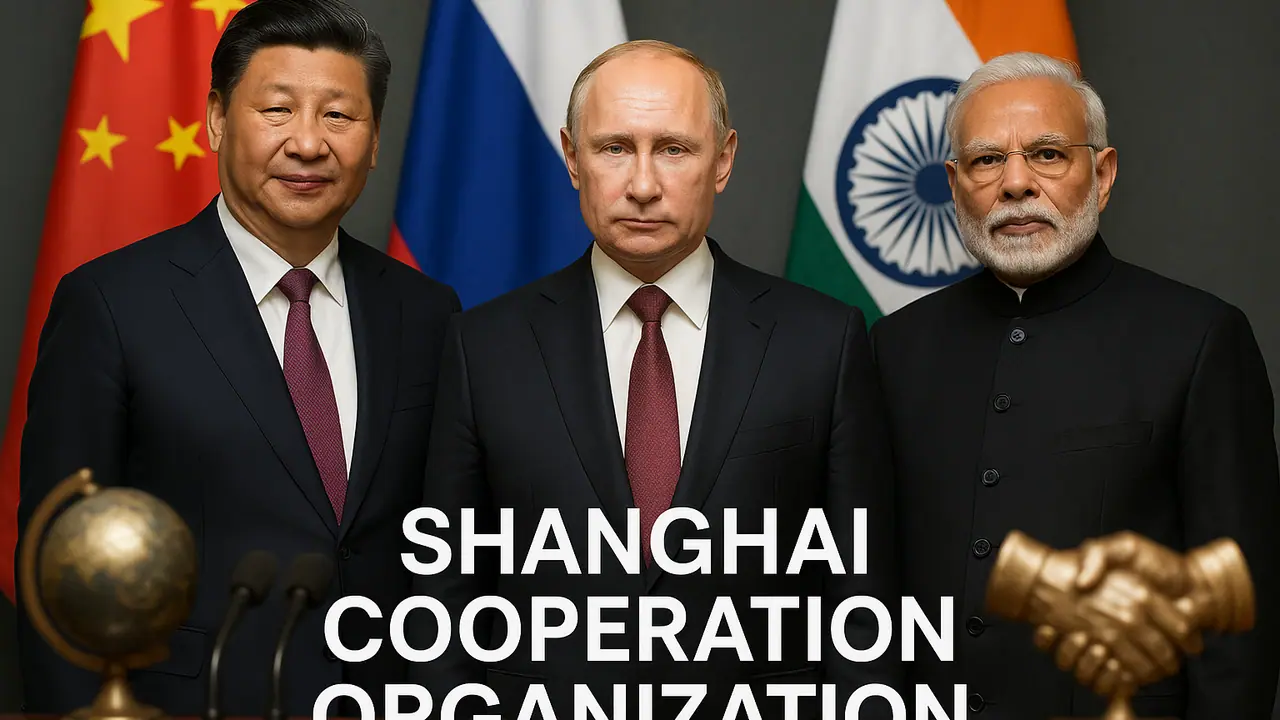
As the SCO Summit approaches in Tianjin, its role in shaping a multipolar world faces fresh scrutiny—amid terror threats, regional rivalries, and its ambitions to rival Western-led blocs
The Shanghai Cooperation Organization(SCO) heads of state summit is set to be held later next month from August 31 to September 1. The summit will be held at Tianjin in the People's Republic of China and will mark 5th times that China has held this summit.
Last month, Defence Minister Rajnath Singh held a meeting with his counterparts of the 10 member grouping. However, India did not endorse the joint statement as it failed to mention the Pahalgam attacks and only spoke of insurgency and militancy in Balochistan.
In light of this, let's take the moment to discuss SCO's relevance in a multipolar world order.
Related Articles

SCO traces it's origins to the Sanghai Five which was an initiative by China, Russia, Kazakhstan, Kyrgyzstan and Tajikistan to resolve border tensions. In 2001, with the inclusion of Uzbekistan, SCO formally came to be with a shared commitment to combat the three evils of terrorism, separatism and extremism.
The architecture included consensus based decisions, annual heads of state council and the RATS anti-terrorism body with it's headquarter in Taskent.
Entry of India and Pakistan
India and Pakistan formally joined the forum in the year 2017. It was on the aftermath of the Pathankot terror attack. The forum provided a multilateral platform for the two countries to engage in dialogue without any political fallout. This year's SCO summit comes 4 months after the ghastly attack at Pahalgam and India is expected to make full use of the platform to call out Pakistan's involvement as part of the summit. Yesterday at a conclave of foreign ministers of SCO in Tianjin, EAM S. Jaishankar asked member states to maintain and uncompromising position on the question of terrorism.
It should be noted that this was Jaishankar's first visit to China in 5 years after the clashes at Galwan in June 2020. External Affairs Minister S Jaishankar also remarked that the terror attack at Pahalgam was conducted to undermine the growing tourist economy of Kashmir and was intended to sow religious discord between two religious communities.
Further expansion of SCO
It was in 2023 that Iran and in 2024 that Belarus joined as full members. This expanded the SCO into a south and west into Central Asian core while signaling that the SCO is positioning itself as a Global multilateral forum and not just a regional forum.
Economic Integration & Geoeconomics
Beijing emphasizes on it's Belt and Road initiative (BRI) while trying to integrate the China Pakistan Economic Corridor (CPEC) as part of BRI and One Belt One Road (OBOR) initiative. India continues to oppose China's inclusion of CPEC into OBOR project as the proposed path passes through Pakistan Occupied Kashmir (POK) which has been a long standing geopolitical concern for India.
last year, other than India all the member states expressed their backing for OBOR except for India.
However, India continues to promote it's own connectivity programs like the Chabahar port and the Chabahar-Zahedan railway project as part of the broader International North South transport corridor (INSTC).
Energy interdependence is a key dimension—SCO members hold over 25% of oil reserves, 50% of gas, 35% coal, and half the world’s uranium—a resource base with significant strategic leverage.
Another important aspect of a successful SCO would include the use of local currencies for bilateral and multilateral trade.
Internal Tensions & Constraints
Thus, despite having huge possibility, SCO has some systematic limitations.
- Consensus Decision-Making
As per SCO's requirement for unanimity, any member states can veto which can paralyze diplomacy. In a grouping which includes India, Pakistan and China together, this veto option can cripple any possibility that the forum might provide.
SCO’s Global Role in a Multipolar Reality
The SCO typifies the new multipolar landscape—balancing universality with pragmatism:
- Messaging vs. Substance
Leaders such as Xi Jinping and Vladimir Putin have presented the SCO as a building block for a non-Western order combating interference, promoting economic sovereignty, and challenging U.S. dominance. Moscow signaled use of SCO to bypass SWIFT and develop local currency trade systems.
- Coordination with BRICS & Global Fora
The SCO has converged with BRICS objectives—both champion non-West multilateralism, challenge dollar dominance, and set up alternative financial bodies. Together, they embody an anti-hegemonic axis—with informal alignment accruing diplomatic weight.
- Outreach to the Wider World
Observer and Dialogue states include Turkey, Egypt, Saudi Arabia, Qatar, and Sri Lanka—signaling ambition to reshape global governance chains beyond Eurasia .
The SCO stands at an inflection point. It is both a product and driver of the emerging multipolar world—oscillating between rhetorical defiance and fledgling structural resilience. In the face of fragile Western-led institutions, it presents an alternative: a sprawling Eurasian bloc sharing insurgent economic ambitions, hybrid security frameworks, and an expanding diplomatic footprint.
But its future relevance depends on whether it can institutionalize power—overcoming consensus paralysis, language of solidarity, and symbolic expansion. As the world tilts toward complexity, resource competition, and strategic rivalry, the SCO offers a window into how newly empowered nations may reimagine collective power.