
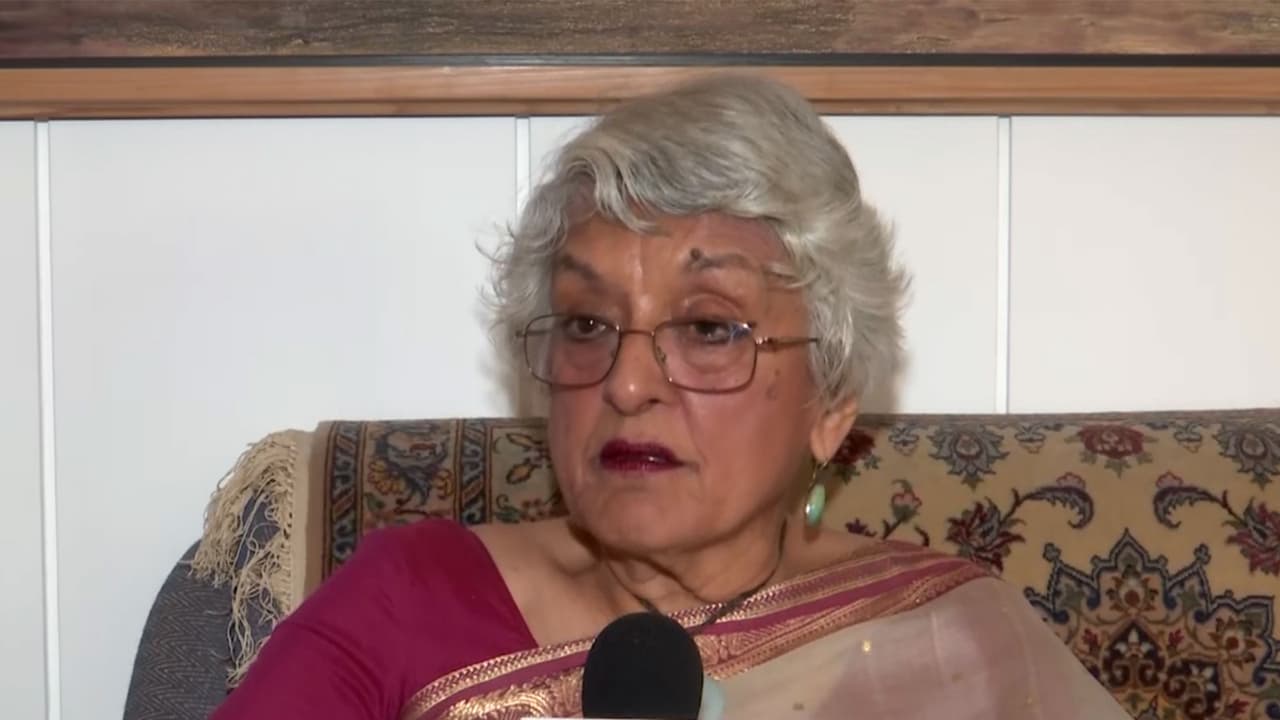
Former Diplomat Veena Sikri questioned the protocol of PM Modi's invite to the White House, calling it speculative. She said the US's revived interest in the Quad, including a potential summit, came immediately after Trump's visit to Beijing.
Former Diplomat Veena Sikri said that the invitation extended to Prime Minister Narendra Modi did not follow the proper protocol. Sikri, in a conversation with ANI, said that the status of the invite is under speculation. "PM Modi has reportedly received an invitation to visit the White House. When Secretary Marco Rubio called on Prime Minister Modi yesterday, he mentioned conveying an invitation from President Trump. However, that invitation has not come in the form of a formal letter or a specific direct invitation. We do not know the exact status yet. There is the possibility they may meet on the sidelines of the G7 next month, or perhaps at the end of the year when President Trump hosts the G20 summit at the Mar-a-Lago resort in Florida. This is currently in the realm of speculation," she said.
Renewed American Interest in Quad
She said that it is interesting that the Quad meeting was agreed to immediately after President Trump's visit to Beijing. "The important aspect of Secretary of State Marco Rubio's visit to India is his talks today with External Affairs Minister Jaishankar, where hardcore subjects will be discussed, alongside the Quad Foreign Minister meeting. It is interesting that the Quad meeting was agreed to immediately after President Trump's visit to Beijing. The summit with President Xi Jinping did not result in a joint statement or a big economic deal. Following that, America is again talking about the Quad. There is a hint from Secretary Rubio that a Quad Summit could take place in the USA during or after the G20 Summit. This shows a revived American interest in the Quad process," she said.
Maritime Security Vital for Quad
She further said that Maritime security is a vital issue for the Quad, particularly in the South China Sea and the Strait of Hormuz. "Maritime security is a vital issue for the Quad, particularly in the South China Sea and the Strait of Hormuz. The Strait of Hormuz is vital because 20% of the world's oil and gas supply passes through it. In the South China Sea, China is trying to impose more control and stop the free movement of shipping. This is vital for India, and we are focused on maritime security in the Indo-Pacific, having discussions with Japan and Australia. Without the Quad, international maritime security and sea lanes of communication in the South China Sea are at risk," she said.
Energy Security and Strategic Autonomy
"Secretary Rubio also mentioned that the new Green Card rules are not targeted at India and that US energy products can help India reduce dependence on other countries. Energy security will surely be discussed between Dr. Jaishankar and Secretary Rubio. India has a policy of strategic autonomy and multi-alignment. We are happy to have discussions on buying more energy supplies from America, which we have already increased. However, American shipments take more time and are more expensive, so we are also talking to Russia, Venezuela, and others. For example, we have the Chennai-Vladivostok maritime corridor. India is also an observer in the Arctic Council, looking at possibilities for energy security and free lanes of communication as Arctic areas open up due to melting ice," she added.
US Visa and Immigration System Changes
She said that the important issue between External Affairs Minister S Jaishankar and Secretary of State Marco Rubio is the people-to-people connection and the recent changes to the American visa and immigration systems. "Another important issue between Dr. Jaishankar and Secretary Rubio is the people-to-people connection and the recent changes to the American visa and immigration systems. While India understands issues regarding illegal immigration--as we do not support it and have our own stringent controls--we are in favour of clear, non-discriminatory immigration processes. Secretary Rubio is clarifying that the newly announced visa and Green Card processes are not India-specific but apply to all countries," she said.
"However, since India is among the largest beneficiaries of H1B visas and Green Cards, the new rules have caused the number of applications from India to go down sharply, in some cases by 38 to 40 per cent. The answer to this is to encourage more international companies to invest in India. There is already a move for global data centres to come to India; the government of Andhra Pradesh just signed agreements for centres in Visakhapatnam. We are also interested in small modular nuclear reactors to provide the huge amounts of electricity these centres need. India is aware of the situation and happy to talk to America, but we will continue to insist that the process remains non-discriminatory. Thank you," she added.
(Except for the headline, this story has not been edited by Asianet Newsable English staff and is published from a syndicated feed.)