
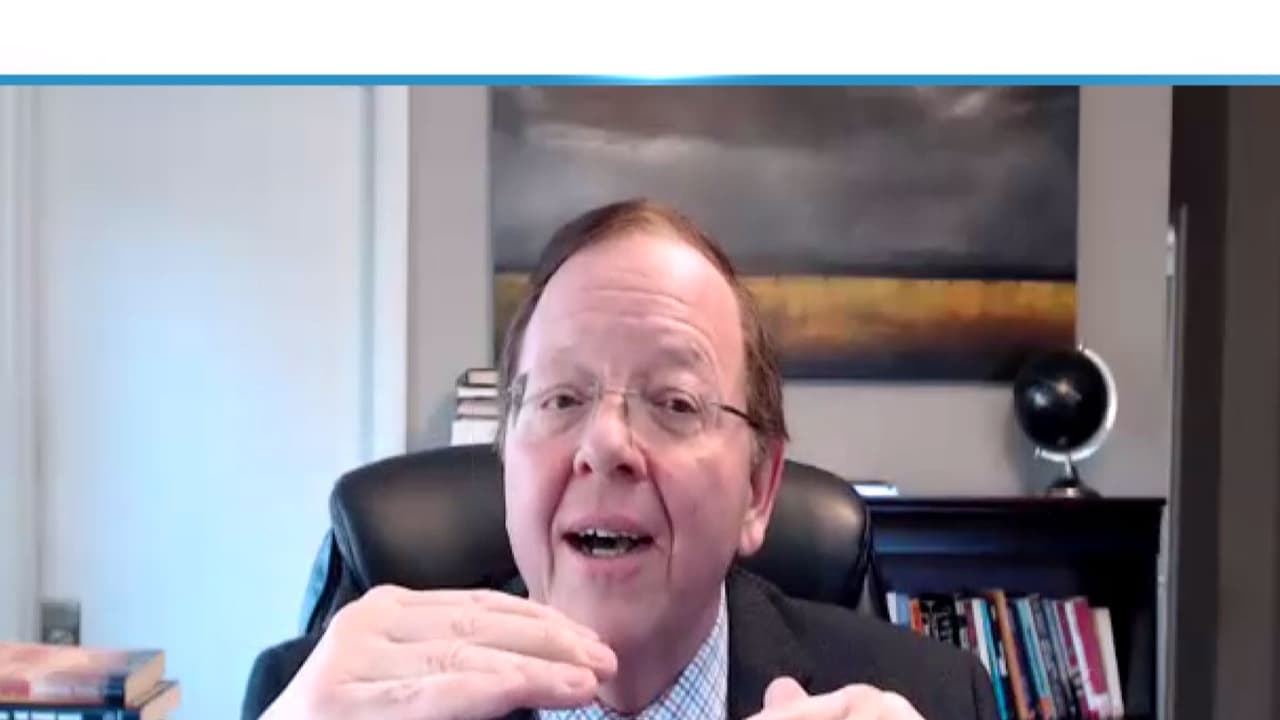
Political scientist Robert Pape discusses Pakistan's historical support for Iran's nuclear program, providing 600-900 centrifuges. He explains how this made Iran's program unstoppable by 2002, influencing the Bush administration's decisions.
Pakistan's Role in Iran's Early Nuclear Program
Even as the West Asia conflict enters its fourth week, political scientist Professor Robert Pape has underlined the close relationship shared by Pakistan and Iran, highlighting how Pakistan had given Iran between 600 and 900 centrifuges between 1990 to early 2000, when Iran was just starting to develop its own program.
In an exclusive interview with ANI, Pape was asked, since there weren't many military options in 2002 to take out the Iranian nuclear facility that was being built, about any options to interdict the country that was smuggling in that nuclear technology know-how. "Oh, the Pakistan. Oh, yes. Yes, you could try. So at that time, just to, and I was analysing this at that time, I didn't start the official modeling till 2005, just to be very clear. But keep in mind, I'm giving advice here to the White House, the top levels of the Pentagon. So you don't do this without doing a 360 and actually understand what you're talking about. So here's the problem. What happened was, just to go back to the details, is that Pakistan gave Iran somewhere between 600 and 900 centrifuges from its nuclear program," he said.
Iran's 'Unstoppable' Development
Pape told ANI that these centrifuges were carefully dismantled by Iran and studied. The Iranians then made their own centrifuges. "These are called P-1s. They're about as big as you or I are, and they spin, they spin gas. This is the centrifuge part of the enrichment of the uranium and the Iranians hadn't produced any of their own at that point in time. But they got the 600 to 900 centrifuges and then right away they started to take them apart, not just use them, but study them, take them apart. And Iran, it's not as rich as the United States, it wasn't as capable at the time as Pakistan, but Iran is not a poor country. It's not Afghanistan. So we need to understand where Iran is in the general wealth of countries. So it then started to produce its own centrifuges," he said.
Why Military and Intelligence Options Failed
Pape then said that at that point, no one could kill people who were involved in the research because Iran's program was unstoppable. He said, "We didn't know where they were. They're called P2. So if your listeners are Googling, they might have to do the Wayback Machine, but this was all public knowledge. Nothing classified I'm giving you here. So this is why those military options you're describing. Well, can't we just bomb some of the throughput here? Or there's a smuggler over there. Let's go kill that group and that person. Well, you could. No, you could definitely kill the people. But it became evident right away that that's not even slowing down the program in this way because you don't know the full details."
Pape said that by this time, the US and Israel had thousands of agents that would percolate Iran's program, but Iran remained unstoppable. "You had at that point had thousands of Mossad agents and thousands of CIA or hundreds, I guess I would say, you know, sort of percolate here. Because, again, this what happened in 2002 was we went from having an antagonistic political relationship with Iran. Now it's a military negative relationship here. Well, that brings on a lot more commitment, a lot more, and Iran was ahead. So Iran was able to keep going, keep developing, and it just never, the Bush administration kept looking for the, I don't know if it's every few months, but quite often, to see was there a military scenario that would nip all this in the bud?"
Bush Administration's 'Regime Change' Strategy
But the administration of Former US President George W Bush realised that in 2002, by the time Iran was far ahead in its mission, it was necessary to conquer Iraq first. "And the problem is that it wasn't exactly, it's not they didn't want to, it's that by the time they knew it was a real thing, let's say 2002, Iran was already so far ahead that even the Bush administration, remember, the Bush administration conquered Iraq; Even they realized that they didn't have a good military option unless they would first conquer Iraq. Then they were going to do regime change. And I do believe they thought they could take six divisions and go to Tehran," he said.
The 'Axis of Evil'
In 2002, Bush had branded three countries -- North Korea, Iran and Iraq -- as rogue states which he claimed 'harboured, financed and aided terrorists'. Speaking less than five months after al-Qaida-linked terrorists attacked New York and Washington, the president said these three countries constituted an "axis of evil" -- a phrase that became a hallmark of his administration's foreign policy.
"States like these, and their terrorist allies, constitute an axis of evil, arming to threaten the peace of the world. By seeking weapons of mass destruction, these regimes pose a grave and growing danger. They could provide these arms to terrorists, giving them the means to match their hatred. They could attack our allies or attempt to blackmail the United States. In any of these cases, the price of indifference would be catastrophic," Bush had said, according to Politico.
Pape is a professor of political science at the University of Chicago with a specialisation in security affairs. Professor Pape has a popular substack named the escalation trap, which informs the reader when conflicts are changing phases and the various dimensions that happens at each stage. (ANI)
(Except for the headline, this story has not been edited by Asianet Newsable English staff and is published from a syndicated feed.)