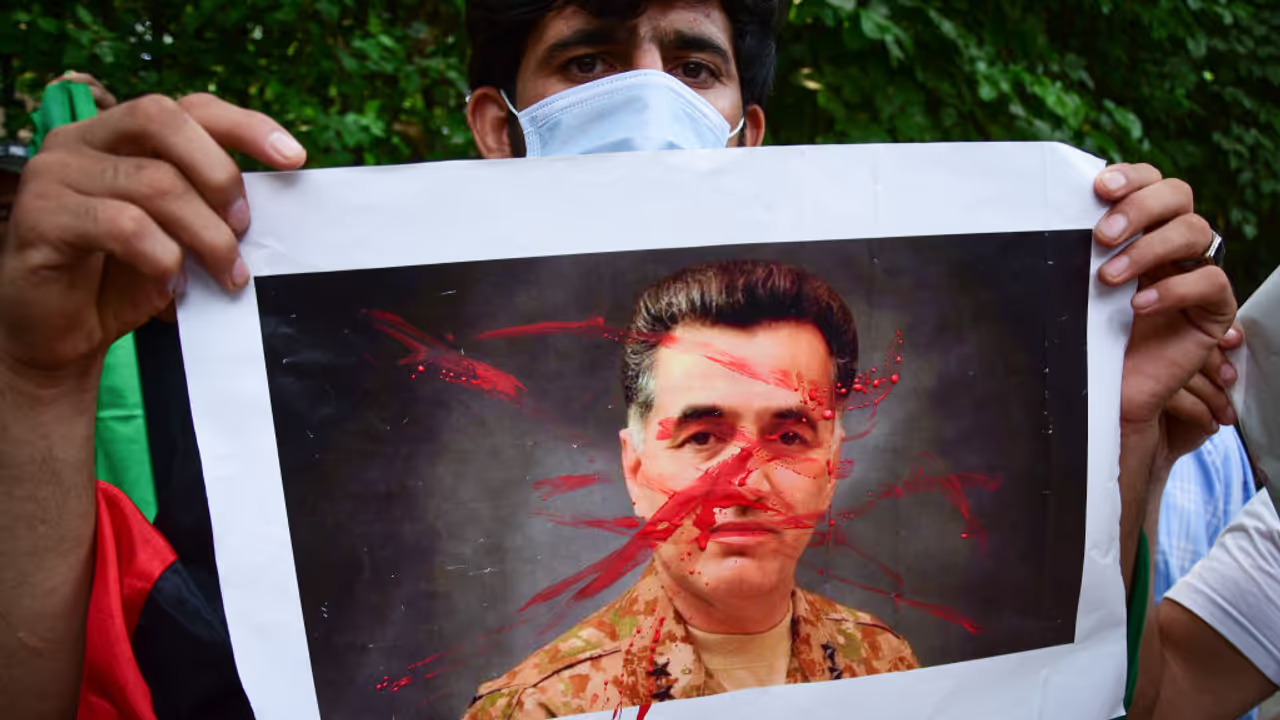
Former ISI chief Faiz Hameed’s 14-year sentence exposes fierce power struggles inside Pakistan’s military, raising questions over whether his loyalty to Imran Khan triggered Asim Munir’s crackdown.
Pakistan’s power corridors have always been defined by shadows — the kind cast by men in uniform, who decide the rise and fall of political leaders with quiet nods or whispered orders. On Thursday, one of those powerful men, former ISI chief Lt Gen Faiz Hameed, found himself on the receiving end of an institution that rarely forgives dissent within its own ranks.
The Pakistan Army announced that a military court has sentenced Hameed to 14 years of rigorous imprisonment for violating state secrets and abusing his authority. Yet, in the echoing silence of Islamabad’s political circles, a louder question lingers: Was this truly about “abuse of power”, or was it about his perceived loyalty to Imran Khan — the man the current military chief, Field Marshal Asim Munir, has relentlessly sought to crush?
A Dramatic Verdict in a Country Ruled by Its Army
In a sparse and cold official statement released by the army’s publicity wing, Hameed was accused of “violating state secrets”, “engaging in political activities”, and causing “wrongful loss to persons”. The court, the army claimed, handed down the sentence “after lengthy and laborious legal proceedings”.
Related Articles

But the same statement conspicuously failed to explain what exactly he had done.
It only added that an accusation of “fomenting vested political agitation and instability in cohorts with political elements... is separately being dealt with”.
That vague phrase — “political agitation” — is perhaps the real heart of the matter. In Pakistan, where the military reigns supreme, “political agitation” is code for “challenging the chosen narrative”.
And Hameed, once seen as the powerful enabler of Imran Khan’s ascent, had done precisely that.
The Rise and Ruin of a Once-Feared General
Faiz Hameed served as ISI chief during Khan’s government and was widely viewed as one of his closest allies within the army. His early retirement in December 2022 came months after Khan was ousted in a no-confidence vote, following what experts describe as a withdrawal of support by the top brass.
Hameed’s fall was swift. He was detained in August 2024 over allegations that he raided the businesses of a real estate developer — claims mentioned in Supreme Court documents published back in 2023. Even then, many in Islamabad whispered that the case was merely a pretext.
The ISI chief has long been considered the second most powerful figure in Pakistan’s military hierarchy. Taking down someone of his stature is not a disciplinary measure — it is a signal.
And that signal, analysts say, comes directly from Field Marshal Asim Munir, the most powerful man in Pakistan today.
Imran Khan—Asim Munir Rivalry at the Core
If Pakistan’s recent political history could be condensed into a single sentence, it might read: Imran Khan challenged the military, and Asim Munir never forgave him for it.
Khan has repeatedly accused Pakistan’s military leadership — especially Munir, whom Khan had once dismissed — of engineering his downfall. This month, Khan wrote: "My wife and I have been imprisoned on fabricated charges at his command."
The army’s spokesman hit back sharply, branding Khan a “delusional person” who had become a “national security threat”.
Against this backdrop, Hameed’s sentencing looks less like justice and more like retaliation in a protracted internal war.
His closeness to Imran Khan has always been an open secret. Within the power structure of Rawalpindi GHQ, that bond became a liability.
‘Interfering with Politics’—or Challenging Munir’s Control?
Pakistan’s information minister, Attaullah Tarar, celebrated the verdict, posting on X that Hameed’s “violations of the Official Secrets Act, the illegitimate use of authority, misusing one’s office to harm people, and getting involved in politics to spread chaos -- these things were all proven.”
He went a step further, accusing Hameed of “interfering with politics” by advising Khan’s PTI even after his retirement.
But in Pakistan, where retired generals routinely influence politics from comfortable drawing rooms in Islamabad and Rawalpindi, the sudden establishment outrage over “political interference” feels selective.
The only real difference here is which political figure he was supporting — and whether that figure aligns with Asim Munir’s ambitions.
The Army’s Own Unease Is Showing
The military’s messaging around Hameed’s case has been strangely incomplete — no details of what state secrets were violated, no list of victims, no description of the political activities he allegedly engaged in.
Such ambiguity is typical of Pakistan’s military justice system. Yet, the targeting of a former ISI chief—an unprecedented step—suggests internal fractures.
Once considered a contender for the top job, Hameed’s early retirement in 2022 signaled that the tide had turned. And with Asim Munir now firmly in control, the military establishment appears determined to bury anyone still associated with Khan’s legacy.
A Military Purge Disguised as Accountability
Pakistan has always sold the world a narrative of civilian politics gone wrong. But those watching closely know the truth: it is the military that decides who rises, who falls, and who is forgotten.
Faiz Hameed’s sentencing is not just a legal punishment — it is a message. A warning to the fractured remnants of PTI, to dissidents within the army, and most importantly to Imran Khan’s supporters.
Those who align themselves against Asim Munir will be erased.
And as Pakistan’s institutions crumble under the weight of personal vendettas disguised as national security, one thing becomes painfully clear: the country is not being run by courts or governments. It is being micromanaged by a single man in uniform who fears any shadow that falls near his throne.
Faiz Hameed may have been powerful once, but in today’s Pakistan, loyalty to Imran Khan is the crime that carries the harshest sentence.