
The Lahore Resolution of 1940, when the dream of a Muslim homeland was first formally put into words, and the constitution of 1956, which gave that homeland its official name — the Islamic Republic of Pakistan.
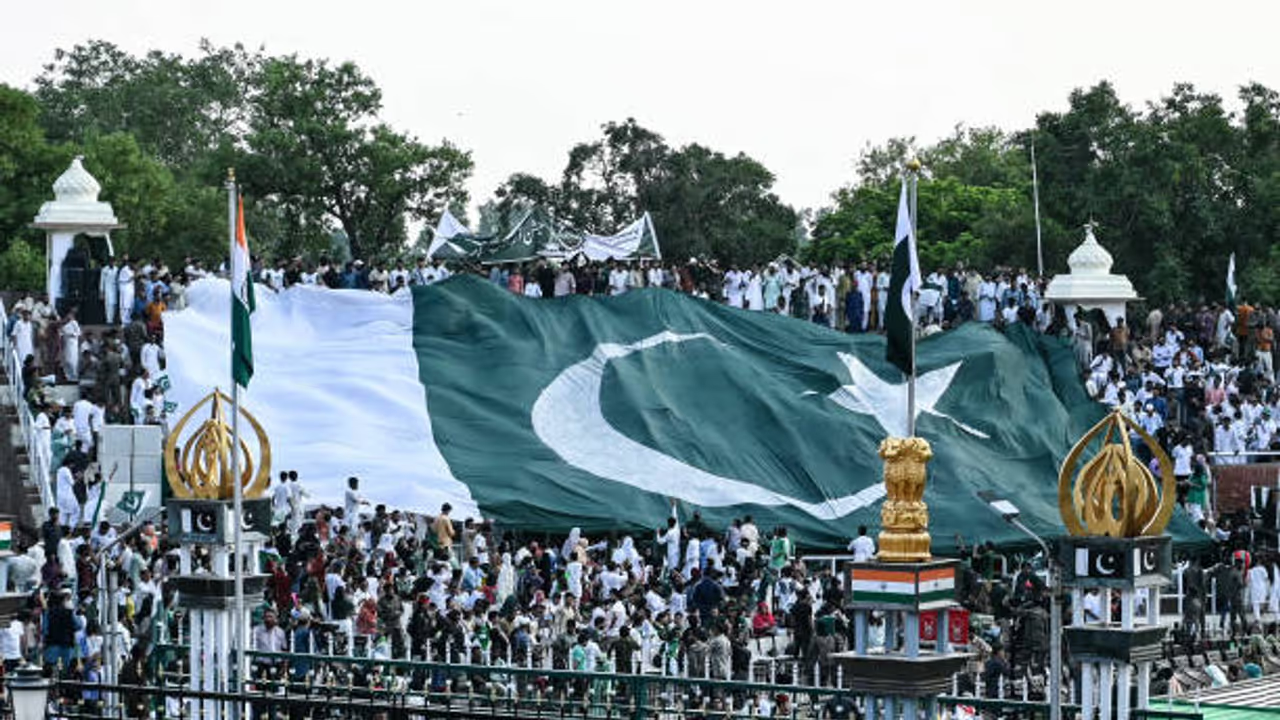
Every year on 23 March, Pakistan puts on a show. Military boots march in perfect formation through Islamabad. Speeches ring out about destiny and sacrifice. Flags wave. Anthems play. And for a few hours, at least, the country wraps itself in the comforting story of who it is and why it exists.
The date itself carries real weight. It marks two moments that shaped modern Pakistan: the Lahore Resolution of 1940, when the dream of a Muslim homeland was first formally put into words, and the constitution of 1956, which gave that homeland its official name — the Islamic Republic of Pakistan.
But when the parade ends and the speeches fade, a harder question lingers. One that no amount of pageantry has managed to silence: has Pakistan actually become what it set out to be?
What the Lahore Resolution Actually Said
It is worth going back to the beginning, because the beginning is often misremembered.
The Lahore Resolution was not a blueprint for a religious state. It was not a call for clerics to run governments or for Islamic law to replace civil order.
At its core, it was asking for something more straightforward — regions where Muslims were in the majority and where they had real political protection and the freedom to live as they chose, culturally and socially.
Muhammad Ali Jinnah, the man who made it all happen, did not sound like a man building a theocracy. In the speech he gave to Pakistan's Constituent Assembly on 11 August 1947 — just days before independence — he said something that many Pakistanis still find themselves returning to: that religion is a personal matter, that it belongs to the individual, not the state.
That distinction — a homeland for Muslims versus a state run by Islam — seems subtle. But it turned out to be everything. It became the fault line that Pakistan has been trying to straddle ever since.
Stephen P. Cohen, one of the most careful observers of Pakistani politics, put it simply when he described Pakistan as "a state searching for an identity." It is a phrase that has aged, unfortunately, rather well.
How the State Changed Shape
The 1956 constitution did something that would echo through every decade that followed. It declared Pakistan an Islamic Republic. Religion was no longer just a cultural backdrop — it was now part of the architecture of the state.
Then came Zia-ul-Haq.
If the 1956 constitution opened a door, Zia walked through it and knocked down the walls. His Islamisation project — carried out during years of military rule — touched almost everything: the courts, the schools, the political parties, the way people were allowed to talk about faith in public. He handed religious institutions a kind of authority they had never quite held before. He let sectarian thinking settle into the state like damp into old stone.
It is important to understand that none of this happened because ordinary Pakistanis woke up one day demanding it. It was, in large part, imposed from above — driven by the calculations of military rulers and the ambitions of clerical institutions.
But the consequences fell on everyone.
Today, Pakistan is one of the most sectarian societies in the Muslim world. Sunni and Shia communities have been turned against each other.
Ahmadi Pakistanis live under laws that effectively criminalise their faith. Religious minorities — Christians, Hindus, others — live with fear that can erupt into violence with very little warning. These are not abstractions. These are people's lives.
The Wound Within
Here is the part of Pakistan's story that carries the most bitter irony.
A country that was created specifically in the name of Muslim unity is now being torn apart from within — by its own Muslim population.
In Balochistan, armed groups like the Balochistan Liberation Army are fighting the Pakistani state. Their grievance is not about religion. It is about being ignored, exploited, and left behind — about feeling like Islamabad rules over them rather than for them. In the tribal regions, the Tehreek-e-Taliban Pakistan wages its own war — not because it rejects Islam, but because it wants a version of Islam that is harsher and more total than what the Pakistani state offers.
Think about that for a moment. A state founded to protect Muslim political identity is now fighting Muslim militants who say the state is not Islamic enough.
Historian Ayesha Jalal has written about the unresolved contradictions buried inside Pakistan's founding story — the tensions between nationalism, religion, and raw state power that were never properly worked through at the beginning and have never stopped creating damage since. Reading the news today, it is hard to argue with her.
The Dream of Leading the Muslim World
Pakistan has always carried a certain idea of itself on the world stage — that it is not just another country, but something more significant. A country born in the name of Islam, uniquely placed to speak for and lead the Muslim world.
It is a grand idea. And early 2026 has been particularly unkind to it.
The United States and Israel launched joint strikes on Iran, killing its Supreme Leader and setting off a regional war that has spread fear and fire across the Middle East.
Oil has crossed $100 a barrel. Missile and drone strikes have hit Gulf states. Civilians are dying in numbers that grow harder to count.
And Pakistan? Pakistan is stuck.
While Islamabad publicly called for calm and expressed concern — the diplomatic language of a country that does not want to pick a side — its military was doing something rather different. Pakistan's army chief sat down with Saudi defence officials to discuss security coordination. Talk has circulated of a deepening Saudi-Pakistan alignment, sometimes described as an "Islamic NATO."
A defence pact between the two countries, one that apparently commits each to treating an attack on the other as an attack on itself, has suddenly become very relevant — because Iran is now hitting Saudi infrastructure.
This puts Pakistan in an almost impossible position. It is moving closer to Saudi Arabia. It shares a long, sensitive, complicated border with Iran. And it has a significant Shia population at home that is watching all of this very closely.
When news spread of Iran's Supreme Leader being killed in the American-Israeli strikes, Pakistanis took to the streets — particularly Shia communities who felt something between grief and fury.
Outside the US Consulate in Karachi, protests turned violent. People died. Dozens more were injured. The sectarian fault lines that Pakistan's leaders have spent years managing — or ignoring — cracked open in full public view.
And then there is Afghanistan.
On 22 February 2026, Pakistani aircraft crossed into Afghan airspace and struck what the military described as militant camps in the east of the country — camps belonging to the Tehreek-e-Taliban Pakistan. Afghan authorities said the strikes killed civilians. Women. Children. They called it a violation of their sovereignty. Fighting broke out along the border.
This is the same Afghanistan that Pakistan once treated as a brother — a relationship built, or so it was claimed, on shared Islamic values and mutual interest. That relationship has now collapsed into open hostility.
So here is where Pakistan stands today. It is bound by a defence pact to Saudi Arabia while trying not to provoke Iran on its doorstep.
It is managing protests at home from communities who feel their government has chosen the wrong side in a war they care about deeply. And it is bombing a neighbouring Muslim country.
Pakistan wanted to lead the Muslim world. Instead, it finds itself caught inside the Muslim world's most painful fault lines, pulled in directions that no single country can sustain all at once.
Three Visions, No Winner
Stephen P. Cohen, in his book The Idea of Pakistan, laid out what he saw as Pakistan's three competing personalities — three visions that have been fighting for control of the country since the beginning:
A democratic nation where Muslims make up the majority. An ideological Islamic state. A national security state shaped and steered by its military.
More than seventy years have passed. None of these three has won. Pakistan is not quite any of them and cannot entirely escape any of them either. It exists in the uncomfortable space between — making compromises, absorbing contradictions, and somehow continuing.
What Pakistan Day Should Ask of Us
There is nothing wrong with national celebration. Countries need those moments. They need to come together, to remember, to feel proud of what they have come through.
But the best national days are also honest ones. They make room for the harder questions alongside the anthems and the pride.
For Pakistan, the anniversary of the Lahore Resolution is a chance to sit with a question that has never really been answered: what was this country actually meant to be? A safe place for Muslims to live freely?
An experiment in building a state on Islamic principles? Or something more complicated — a political project shaped by the fear and violence of partition, still trying to figure itself out?
Seventy-five years later, Pakistan is still asking.
And until it finds an answer, it can live with one that holds the country together rather than pulling it apart--the idea of Pakistan will remain unfinished.
