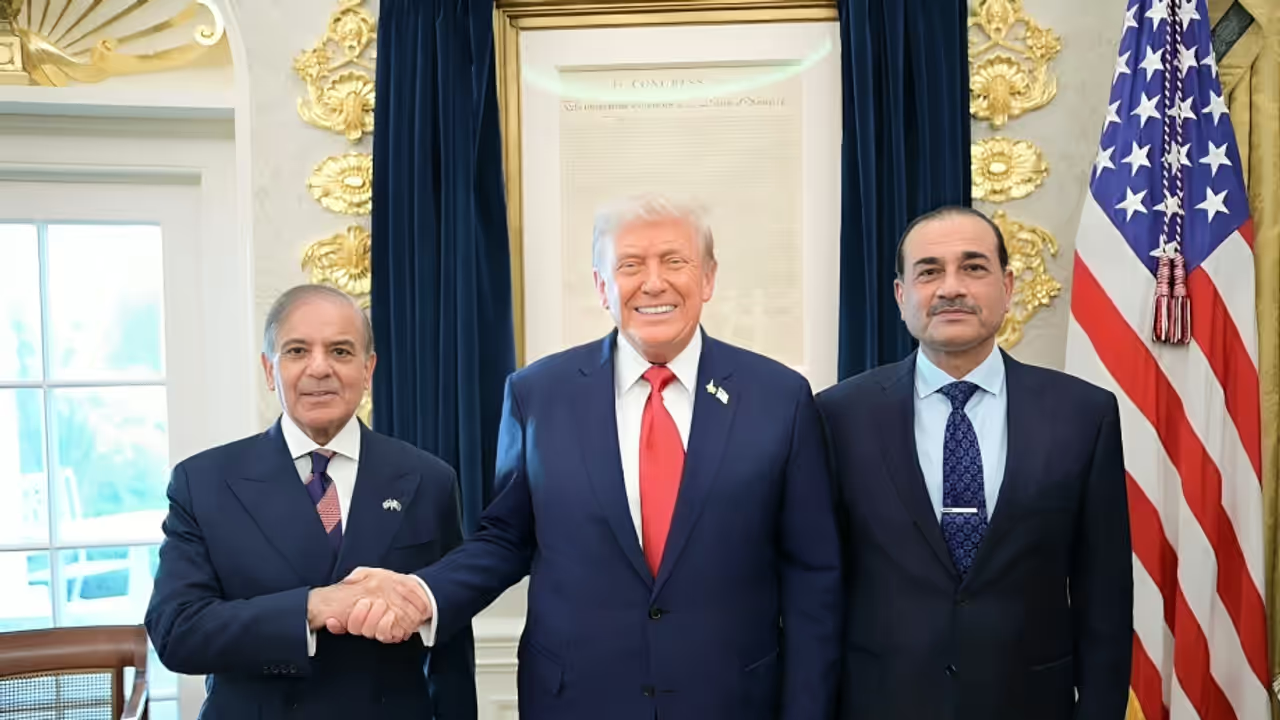
Documents reveal Pakistan lobbied US after Operation Sindoor, praising US support and seeking deeper bilateral ties, including a critical minerals agreement. They show Pakistan's outreach as India struck terror camps after Pahalgam attack.
Newly released documents filed under the United States’ Foreign Agents Registration Act (FARA) have revealed how Pakistan intensified lobbying efforts in Washington immediately after India’s Operation Sindoor. The documents show that Pakistan, through a US-based lobbying firm, sought American support as India carried out precision strikes against terrorist infrastructure across Pakistan and Pakistan-occupied Kashmir (PoJK).
The filings indicate that Pakistan not only praised the United States’ role but also offered deeper economic and strategic cooperation, including access to critical minerals, in an effort to strengthen bilateral ties.
What the FARA documents say
The documents were distributed by Squire Patton Boggs (US), a prominent lobbying firm, on behalf of its foreign principal, the Government of the Islamic Republic of Pakistan. One document states that 'Pakistan appreciates the constructive role played by the United States'.
It also says that “Pakistan appreciates President Trump’s expressed willingness to support efforts aimed at the resolution of Jammu and Kashmir.”
Related Articles

A second document outlines Pakistan’s desire to build a bilateral relationship with the US that stands on its own merit, and is not dependent on America’s relations with Pakistan’s neighbours. The filing also mentions Pakistan’s interest in a bilateral critical minerals agreement with the United States.
Timing linked directly to Operation Sindoor
These documents were released immediately after Operation Sindoor, India’s major counter-terror military action. Operation Sindoor was launched by India following the April 22 terror attack in Pahalgam, Jammu and Kashmir, where 26 civilians were killed. Indian authorities said the attack was sponsored by Pakistan-backed terror groups.
On the night of May 6 and 7, the Indian Armed Forces struck nine terror camps inside Pakistan and PoJK.
How India carried out Operation Sindoor
India used a range of advanced and indigenous military systems during the operation. These included precision-guided missiles, long-range stand-off weapons, AI-enabled intelligence and targeting systems, real-time satellite and drone surveillance, and a strong air-defence and counter-drone network.
These technologies allowed India to hit terror targets accurately without crossing the border.
The strikes destroyed or severely damaged multiple terror infrastructure sites, including training camps, launch pads, command centres and logistics hubs linked to groups such as Jaish-e-Mohammed and Lashkar-e-Taiba.
Key locations targeted included Bahawalpur, Muridke, Muzaffarabad and Kotli.
India stressed that the strikes were focused, intelligence-driven, and limited strictly to terrorist infrastructure, avoiding civilian areas and general military installations.
Pakistan's outreach to US officials and media
According to documents accessed by News18, Pakistani diplomats and defence officials contacted US officials and intermediaries more than 50 times during the period of Operation Sindoor.
These contacts included emails, phone calls, in-person meetings, and outreach to US media organisations.
An earlier investigation by The New York Times had also reported that Pakistan sharply increased its spending on lobbying in April and May, coinciding with the India-Pakistan military escalation.
Following India’s strikes, Pakistan retaliated with border shelling on the Indian side.
India then struck 11 Pakistani military and air bases, causing significant damage to Pakistan’s military installations.
After four days of conflict, both sides announced a ceasefire on May 10, following a hotline conversation between the Directors General of Military Operations (DGMOs) of India and Pakistan.
US mediation claims and India's response
US President Donald Trump has repeatedly claimed that he played a key role in de-escalating the conflict and that trade offers helped prevent further escalation. India has firmly rejected these claims on several occasions.
India has stated that the ceasefire was achieved bilaterally, through direct communication between the DGMOs, without any third-party mediation. India has also reiterated its long-standing position that all issues with Pakistan, including Jammu and Kashmir, must be resolved bilaterally.
The FARA filings add a new layer to understanding Pakistan’s diplomatic strategy during the crisis. They show that while India focused on military action against terror infrastructure, Pakistan turned to Washington, offering trade, investments and strategic cooperation, even as it sought US support on Kashmir.
The disclosures highlight how global diplomacy, lobbying, and security issues intersect during moments of regional conflict.