
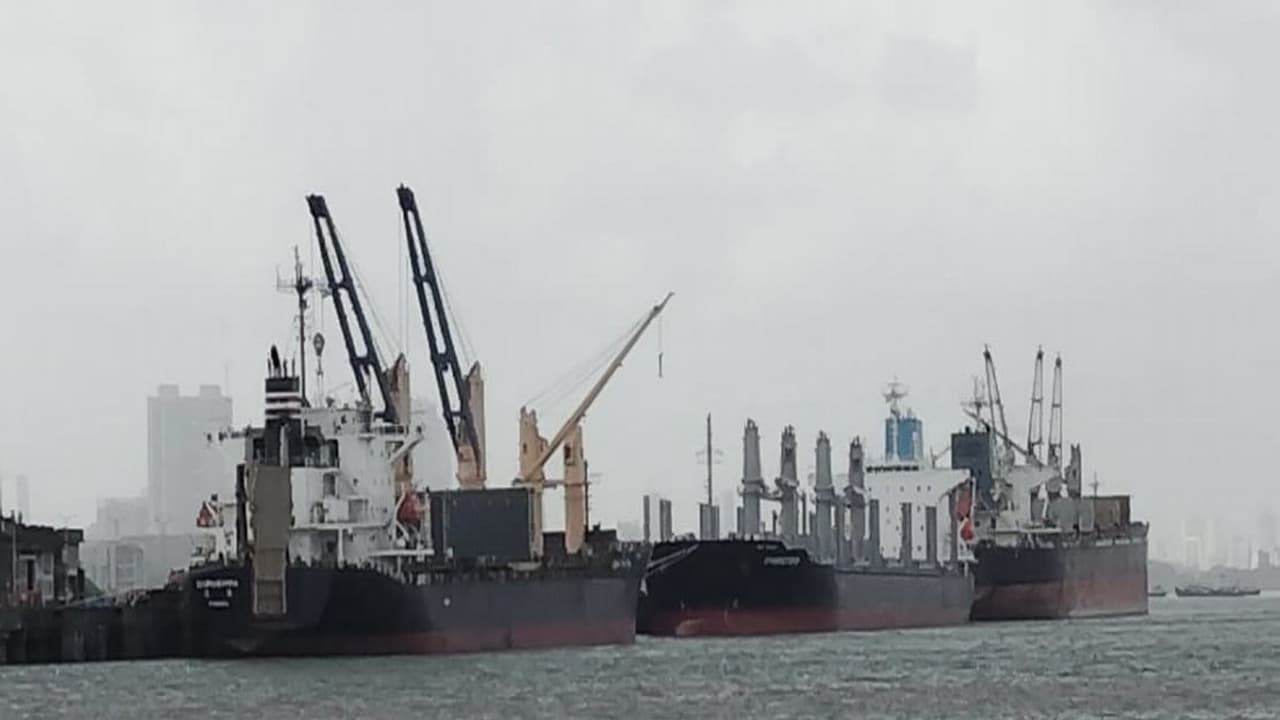
A Liberian-flagged crude oil tanker with an Indian captain, the 'Shenlong Suezmax', has arrived in Mumbai. The vessel received clearance from Iran to transit the Strait of Hormuz, where Tehran is reportedly allowing Indian ships safe passage.
A Liberian-flagged ship captained by an Indian and loaded with crude oil from the Saudi port of Ras Tanura has arrived at the port of Mumbai, via the Strait of Hormuz, Mumbai Port Trust has informed.
The tanker 'Shenlong Suezmax' reached Mumbai port on Wednesday, after Iran cleared the vessel to transit through the strategic waterway, authorities said. The development comes even as sources said that Iranian authorities have decided to allow Indian flagged ships to pass safely through the Strait, where maritime traffic has all but halted since the US and Israel attacked Iran. In retaliation, Tehran targeted other West Asian nations, spilling over the conflict.
The Liberia-flagged Shenlong Suezmax loaded crude had departed from the Saudi port Ras Tanura on March 1.
Iran's Stance on Hormuz Transit
Earlier, the commander of Iran's Islamic Revolutionary Guards Corps' (IRGC) Naval Force said that vessels seeking to sail through the strategically critical Strait of Hormuz must obtain Iran's approval; otherwise, they could become targets of Iranian attacks.
Rear Admiral Alireza Tangsiri said that two ships that had ignored Iran's warnings were targeted in the Strait on Wednesday. "Were the ships assured of safe passage through the Strait of Hormuz? This should be asked of the crews of the vessels Express Rome and Mayuree Naree, who today, trusting in empty promises, ignored the warnings and intended to cross the Strait, but were caught. Any vessel intending to pass must obtain permission from Iran," the Iranian general said in a post on X.
According to Iranian state media, Iran intensified its restrictions on the passage of ships through the Strait of Hormuz and Tehran has said that vessels not serving the interests of the United States and Israel can sail through the strait safely.
Strait of Hormuz: A Vital Waterway
More than 20 million barrels of crude oil pass daily through the narrow channel separating the Iranian coast from Oman. That volume represents roughly a fifth of global oil consumption and nearly a quarter of all seaborne oil trade.
A significant share of the world's liquefied natural gas also moves through the same passage. When that flow falters even briefly, the consequences cascade across financial markets, supply chains and household budgets around the world.
India Monitors Safety of its Vessels, Seafarers
Meanwhile, India's Shipping Ministry on Wednesday said that at present, 28 Indian-flagged vessels are operating in the Persian Gulf region. Of these, 24 vessels are located west of the Strait of Hormuz carrying 677 Indian seafarers, while four vessels are east of the Strait with 101 Indian seafarers onboard. The Ministry said that their safety and security are being actively monitored.
A 24-hour control room has been operational in the Ministry and the Directorate General of Shipping since 28 February 2026 to monitor developments and coordinate assistance. Authorities, ship managers and recruitment agencies are coordinating closely with Indian embassies and local authorities to ensure safety and provide assistance to Indian seafarers wherever required.
The Ministry said it is closely monitoring the evolving maritime situation in the Persian Gulf region with a focus on the safety of Indian seafarers and Indian-flagged vessels.
The Ministry further stated that the Government remains committed to ensuring the safety and welfare of Indian seafarers and protecting India's maritime interests. (ANI)
(Except for the headline, this story has not been edited by Asianet Newsable English staff and is published from a syndicated feed.)