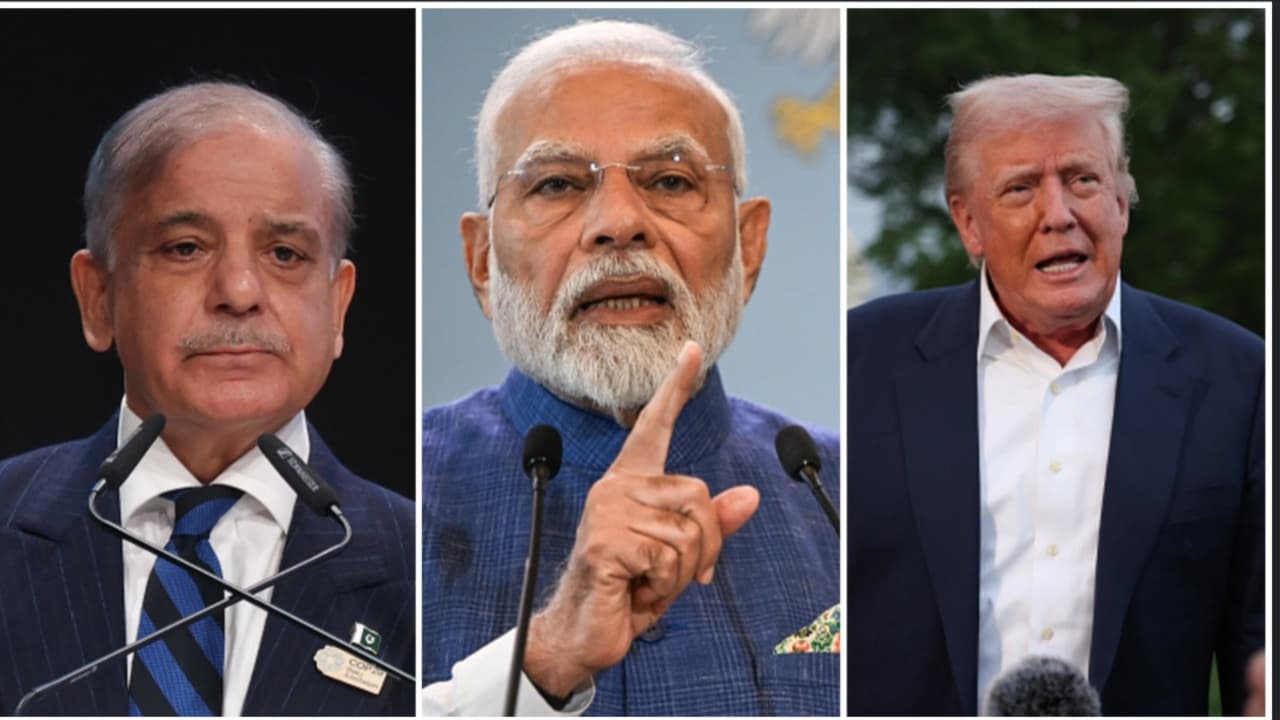
Even before India or Pakistan confirmed the military understanding and details of the talks, US President Trump claimed it was the result of US-mediated discussions between the two nations.
Even before India or Pakistan confirmed the military understanding and details of the talks, US President Trump claimed it was the result of US-mediated discussions between the two nations.
"After a long night of talks mediated by the United States, I am pleased to announce that India and Pakistan have agreed to a FULL AND IMMEDIATE CEASEFIRE. Congratulations to both Countries on using Common Sense and Great Intelligence. Thank you for your attention to this matter!," Trump wrote on Truth Social minutes before official announcement from India and Pakistan.
Related Articles

Claiming US mediation played a key role, Trump praised the leadership of both countries for choosing "common sense and great intelligence" to de-escalate the crisis, marking a moment of cautious relief in a volatile regional standoff.
Even JD Vance, Vice President of the United States, confirmed the development and wrote, “Great work from the President’s team, especially Secretary Rubio. And my gratitude to the leaders of India and Pakistan for their hard work and willingness to engage in this ceasefire.”
Similarly, US Secretary of State Marco Rubio confirmed that India and Pakistan have agreed to an immediate ceasefire and to begin comprehensive talks at a neutral location.
Rubio further said that he and Vice President JD Vance had been in close contact with senior Indian and Pakistani officials over the past 48 hours, including PM Modi and Shehbaz Sharif.
But did Trump really play a role in India-Pakistan understanding?
According to MEA sources, it was a bilateral understanding, not ceasefire. No third country was involved.
Pakistan’s director general military operation (DGMO) called his Indian counterpart. It was a bilateral understanding, not ceasefire. No third country was involved. No pre-condition and no post-condition for understanding. Indus Water Treaty remain in abeyance, MEA sources have said in contrast with the statement by US President Trump and US Sec State.
Pakistan reached out to India, and the two countries negotiated and agreed to a military understanding, the government said on Saturday.
"The Director General of Military Operations (DGMO) of Pakistan called the DGMO of India at 15.30 hours (3.30 pm) this afternoon. It was agreed between them that both sides would cease all firing and military action on land, in the air, and at sea with effect from 1700 hours (5 pm)," Foreign Secretary Vikram Misri said.
US role amid India-Pak tensions
A day earlier, White House Press Secretary Karoline Leavitt, while speaking on US efforts to mediate the conflict between India and Pakistan, said that the US intends to de-escalate the tensions between both countries.
Leavitt said that US Secretary of State Marco Rubio had been in talks with the leaders of both nations to de-escalate.
"This is something that the secretary of state, and now our national security adviser, Marco Rubio, has been very much involved in. The President wants to see this de-escalate as quickly as possible," she said.
Leavitt said that the conflict between the nations is old, and talks are being held to prevent further escalations.
"He understands these two countries have been at odds with one another for decades, long before President Trump was here in the Oval Office. However, he has good relationships with the leaders of both countries and the Secretary of State Marco Rubio, I spoke to him just yesterday. He has been in constant communication with the leaders of both countries, trying to bring this conflict to an end," she said.
When asked if US President Donald Trump would personally contact the leaders of those countries to try to de-escalate this situation, Leavitt had said, "If and when that happens, we will certainly let you know."
Meanwhile, Trump had also expressed his concern over the escalating situation between India and Pakistan and stated that he would offer any possible help to de-escalate tensions along the India-Pakistan border.
Internet reacts