
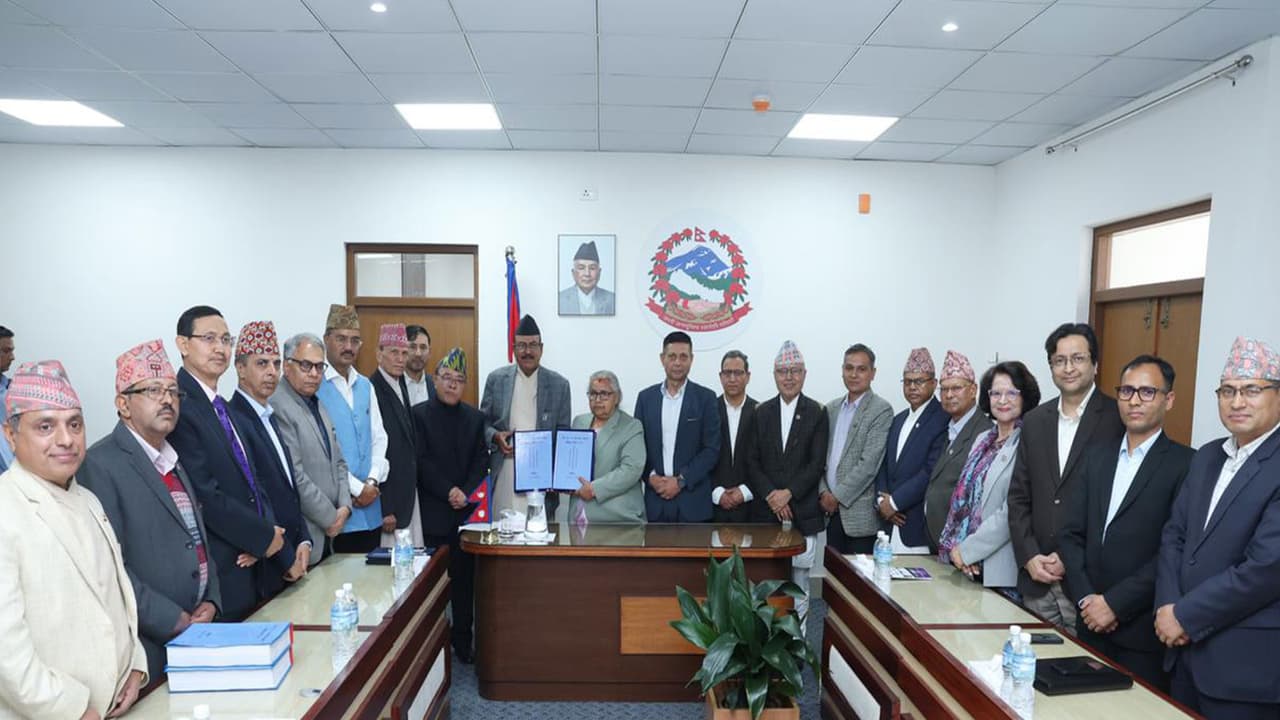
A high-level committee in Nepal found security lapses during last year's Gen-Z unrest. The report, handed to interim PM Sushila Karki, notes irregularities in setting up barriers at the federal parliament during the deadly protests.
A high-level committee in Nepal formed to investigate the violence during last year's Gen-Z unrest in the country, between September 8 and September 9, has recorded security lapses in its final report.
According to Bigyanraj Sharma, a member of the high-level commission formed to investigate the atrocities, confirmed the lapses without further elaborating on the contents of the report. He noted that irregularities were observed while setting up barriers around the federal parliament. "There have been some security lapses. In the parliament premises, at the beginning of the protest, irregularities were recorded while setting up the barriers," Sharma said while briefing mediapersons after handing over the report to the interim Prime Minister Sushila Karki
Background of the Gen-Z Unrest
The Gen-Z protests in September last year, which called for transparency, accountability of the then government under former Prime Minister KP Sharma Oli and an end to the social media ban across the country, turned violent near the federal parliament. In response, police forces used water cannons, tear gas, and live ammunition. Security personnel reportedly fired from within the parliament building after protesters breached the gates and set the entrance ablaze. At least 77 people have been confirmed dead in the protests, while nearly two dozen protesters were shot by security forces on a single day. The day after the escalating violence and protests, Oli, who had been adamant about staying in power, resigned. He was succeeded by former Chief Justice of Nepal Sushila Karki as interim Prime Minister. Oli has publicly denied accusations of ordering a crackdown on protesters, but his administration has been heavily criticised for its handling of the unrest.
Investigation Report Submitted to Interim PM
When asked about the role of the former PM and others in power at the time of the unrest, the committee member declined to provide details but said that more than 200 people were interrogated to prepare the report. "We have interrogated over two hundred people and had them sign their statements after recording them. There are also accounts from witnesses, victims, and experts who worked extensively to prepare this report," Sharma said.
On Sunday afternoon, commission chair Gauri Bahadur Karki, along with other members of the commission, reached the Office of the Prime Minister and Council of Ministers and handed over the report to interim PM Karki.
Receiving the report, interim PM Karki said that she and the home minister would study it before presenting it to the Cabinet. "You have worked very hard. Initially, the time we set was insufficient due to resource constraints, and later we had to extend it. We appointed you, knowing your expertise and credibility. I trust that the report fairly distinguishes facts from falsehoods," the prime minister's secretariat quoted her as saying. "We will move forward with studying and implementing it. We will also discuss what to make public and, if we cannot release the full document immediately, we will publish at least the summary," she added.
Report Exceeds 900 Pages
Originally given a three-month mandate, the commission's term was extended multiple times, with the report initially expected before the March 5 elections. "The report is over nine hundred pages long, including subsections. If we combine all the documents and evidence, the total will reach between eight and ten thousand pages. The incidents of September 8 and 9 have been analysed in detail," Sharma said.
Separate Panel Assessed Physical Damages
Nepal had also separately formed a panel to assess the physical damage caused during the Gen-Z movement, which submitted its report on December 11 last year. It put the total death toll at 77 and said that 2,429 people were injured, of whom 17 were under 13 years of age, while 1,433 were between 13 and 28. The report estimated the total physical damage at NPR 84.45 billion.
A total of 2,168 government and public bodies were affected, with 2,671 buildings damaged, resulting in losses of around NPR 39.31 billion. According to the report, 12,659 vehicles were damaged, causing losses worth NPR 12.93 billion. Overall, losses in the government and public sector amounted to NPR 44.93 billion, the private sector NPR 33.54 billion, and the community and other sectors NPR 5.97 billion. (ANI)
(Except for the headline, this story has not been edited by Asianet Newsable English staff and is published from a syndicated feed.)