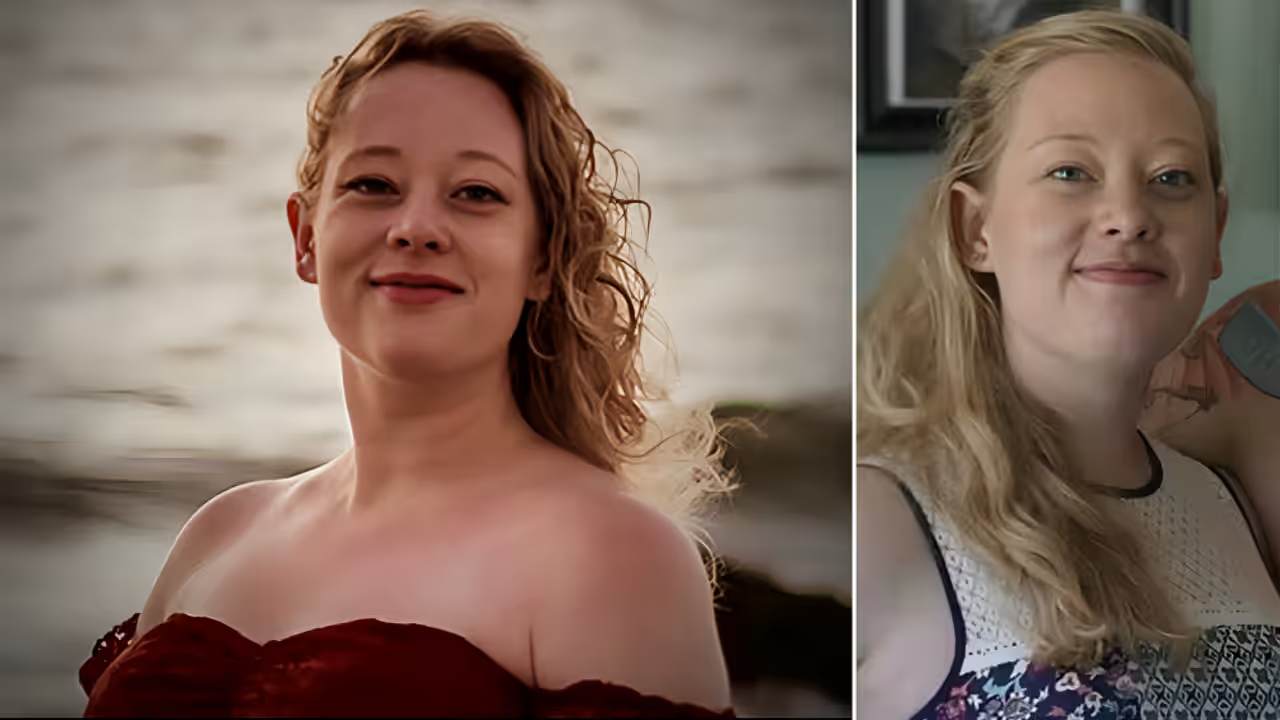
A newly released video shows an ICE officer fatally shooting Renee Nicole Good in Minneapolis. The footage, filmed by the officer, captures a tense encounter before shots are fired as Good attempts to drive away.
A newly released video showing the moments leading up to the fatal shooting of Renee Nicole Good by a US Immigration and Customs Enforcement (ICE) officer in Minneapolis has ignited fresh scrutiny, public outcry, and debate over law enforcement tactics in federal immigration operations. The 47-second clip, first posted online by Alpha News and later reshared via official accounts including Vice President JD Vance’s social media, captures the tense encounter from the perspective of the ICE agent who ultimately fired the shots.
The video begins with the ICE agent -- later identified as Jonathan Ross, a 43-year-old veteran of ICE and its enforcement operations -- approaching Good’s SUV in a residential Minneapolis street. Good, 37, remains inside her vehicle, while her wife, Becca Good, stands outside holding a cellphone camera. At one point, Good calmly says, “That’s fine, dude. I’m not mad at you,” seemingly responding to the agent’s presence and filming.
Becca Good can be heard in the footage confronting the officer, saying, “US citizen, former f---ing veteran … You wanna come at us? You wanna come at us? I say go get yourself some lunch big boy.” Her tone is defiant yet unarmed, and she repeatedly holds up her mobile phone toward the agent as he films and walks around the SUV.
Related Articles

At multiple moments, other officers are visible or audible, shouting commands such as “Get out of the car, get out of the f---ing car.” Good briefly reverses her vehicle and then drives forward, turning the steering wheel as she attempts to leave the scene. At this point in the video, shots are fired and the camera motion becomes erratic. Seconds later, a voice on the recording is heard saying “F---ing b---h,” believed to be uttered by one of the officers immediately after the fatal shots. The SUV continues moving until crashing into parked cars.
Good was pronounced dead later that day from gunshot wounds. Her killing on January 7, 2026 occurred during a large federal immigration enforcement operation in the Twin Cities -- described by the Department of Homeland Security as the largest such crackdown in Minneapolis history, involving thousands of officers.
Federal officials, including Vice President Vance, have defended the agent’s actions, saying the video supports the assertion that he fired in self-defence because Good’s vehicle posed a threat. Vance wrote that although difficult to watch, the footage shows the officer acting to protect his life.
However, state and local authorities have dismissed this narrative, calling for independent investigation and accountability. Hennepin County Attorney Mary Moriarty has publicly said that state prosecutors have legal jurisdiction and that federal directives barring state involvement in the probe are inappropriate. She also urged the public to share any recordings and evidence to support a comprehensive investigation.
The killing has revived intense debate in Minneapolis -- a city still grappling with the legacy of George Floyd’s death at the hands of police in 2020 -- and has triggered large protests, school closures, and community vigils. Demonstrators have formed makeshift barriers, declaring parts of the neighbourhood as “no ICE zones,” and people across multiple US cities have taken to the streets calling for justice for Good. Critics argue that the video raises more questions than answers about why deadly force was used in this situation.
Good’s family has sharply contradicted the federal narrative. In a public statement, Becca Good described her wife as a loving mother who believed in compassion and community, writing, “On Wednesday, January 7th, we stopped to support our neighbours. We had whistles. They had guns…” She prayed that her son would carry forward the values Good held dear.
The footage has also drawn criticism from policing experts who have said that the fact the officer was holding a cellphone rather than a body-worn camera may complicate interpretation of the incident and raises questions about whether proper procedure was followed. Some experts argue that focusing on recording may divert attention and create unnecessary danger in such volatile encounters.
The controversy extends beyond Minneapolis. A separate immigration enforcement incident in Portland saw Border Patrol agents shoot two Venezuelan nationals, intensifying nationwide scrutiny of federal enforcement tactics. Congressional Democrats have threatened to withhold funding from the Department of Homeland Security if use-of-force and accountability reforms are not pursued.
As both sides present sharply divergent versions of what took place, the new ICE agent’s video has become a central piece of evidence in the broader national conversation about policing, civil liberties, transparency, and the scope of federal immigration enforcement. Ongoing investigations and public pressure are expected to keep the issue in the spotlight in the coming weeks.
(With inputs from agency)