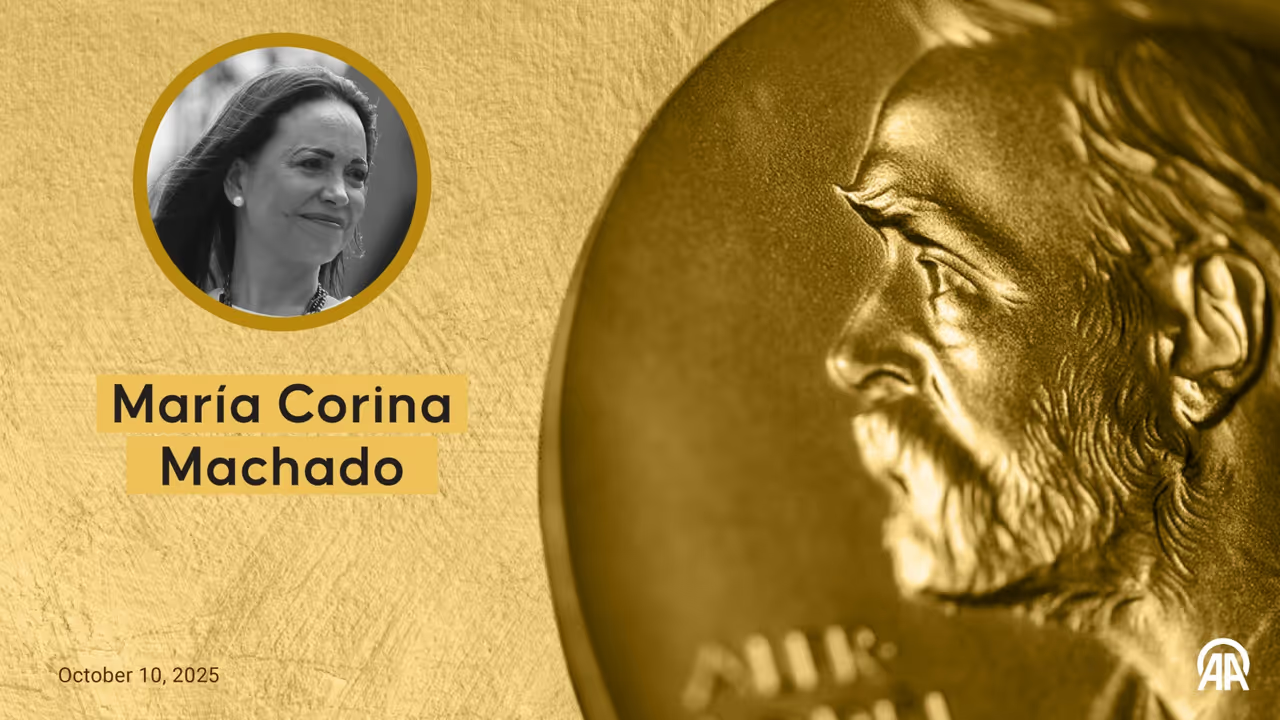
Several Nobel Peace Prize winners were unable to collect their awards due to imprisonment, political repression, or fear of not being allowed to return home. Iran's Narges Mohammadi, China's Liu Xiaobo and Myanmar's Aung San Suu Kyi are amongst them.
Venezuelan opposition leader Maria Corina Machado, who lives in hiding, is not the first Nobel Peace Prize winner who could not pick up their prize. Here are other notable absentees at the Oslo awards ceremony:
2023: Narges Mohammadi
The Iranian activist had to celebrate her Nobel Prize from a cell in Tehran's Evin prison.
Mohammadi, who has campaigned against the compulsory wearing of the hijab and the death penalty in Iran, was represented by her 17-year-old twins, both living in exile in France, who read a speech she managed to smuggle out of her cell.
Related Articles

She had been in prison since 2021 but was released in December 2024 for a limited period on medical leave.
2022: Ales Bialiatski
The Belarusian human rights campaigner was in jail. He was represented by his wife Natalia Pinchuk.
Bialiatski, the founder of Viasna -- the main human rights defence organisation in Belarus -- was sentenced in 2023 to 10 years in prison for "foreign currency trafficking".
2010: Liu Xiaobo
The Chinese dissident was in prison serving an 11 year jail term for "subversion". His chair remained symbolically empty, where the prize was placed.
His wife, Liu Xia, was placed under house arrest after the prize was announced and his three brothers were blocked from leaving China.
A veteran of the 1989 Tiananmen Square protests. Liu died in 2017 of liver cancer in a Chinese hospital at the age of 61, after being transferred there from prison.
1991: Aung San Suu Kyi
Myanmar's democracy champion won the 1991 Nobel Peace Prize when she was under house arrest as part of a crackdown by the military leadership on the pro-democracy opposition.
Though given permission to travel, she declined due to fears of potentially not being able to return to her country.
Aung San Suu Kyi was represented at the ceremony by her two sons and her husband, who accepted the award on her behalf. Symbolically, an empty chair was again placed on the stage.
1983: Lech Walesa
The Polish trade union activist who forced authorities to recognise the communist bloc's first and only free trade union, Solidarity (Solidarnosc) feared he would not be allowed back into Poland if he travelled to Oslo for the ceremony. His wife Danuta and his son represented him.
1975: Andrei Sakharov
The Soviet dissident and physicist was honoured by the Nobel committee for his "fearless personal commitment in upholding the fundamental principles for peace between men". Sakharov was barred by Soviet authorities from traveling to Norway and was represented by his wife Elena Bonner, also a rights activist.
1973: Henry Kissinger and Le Duc Tho
The 1973 award, one of the most controversial in the history of the peace prize, was given in the absence of the two recipients, who had reached a Vietnam ceasefire agreement that soon failed.
Le Duc Tho turned down the prize, saying that the ceasefire was not respected. Kissinger did not go to Oslo for fear of demonstrations.
1935: Carl von Ossietzky
German journalist and pacifist Carl von Ossietzky was imprisoned in a Nazi concentration camp when he won the 1935 Nobel Peace Prize.
Von Ossietzky had been arrested three years earlier in a raid on opponents of Adolf Hitler following the Reichstag fire.
A German lawyer tricked his family into allowing him to pocket the prize money and was sentenced to two years of hard labour. Ossietzky died in captivity in 1938.
(Except for the headline, this story has not been edited by Asianet Newsable English staff and is published from a syndicated feed)