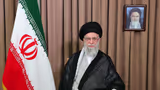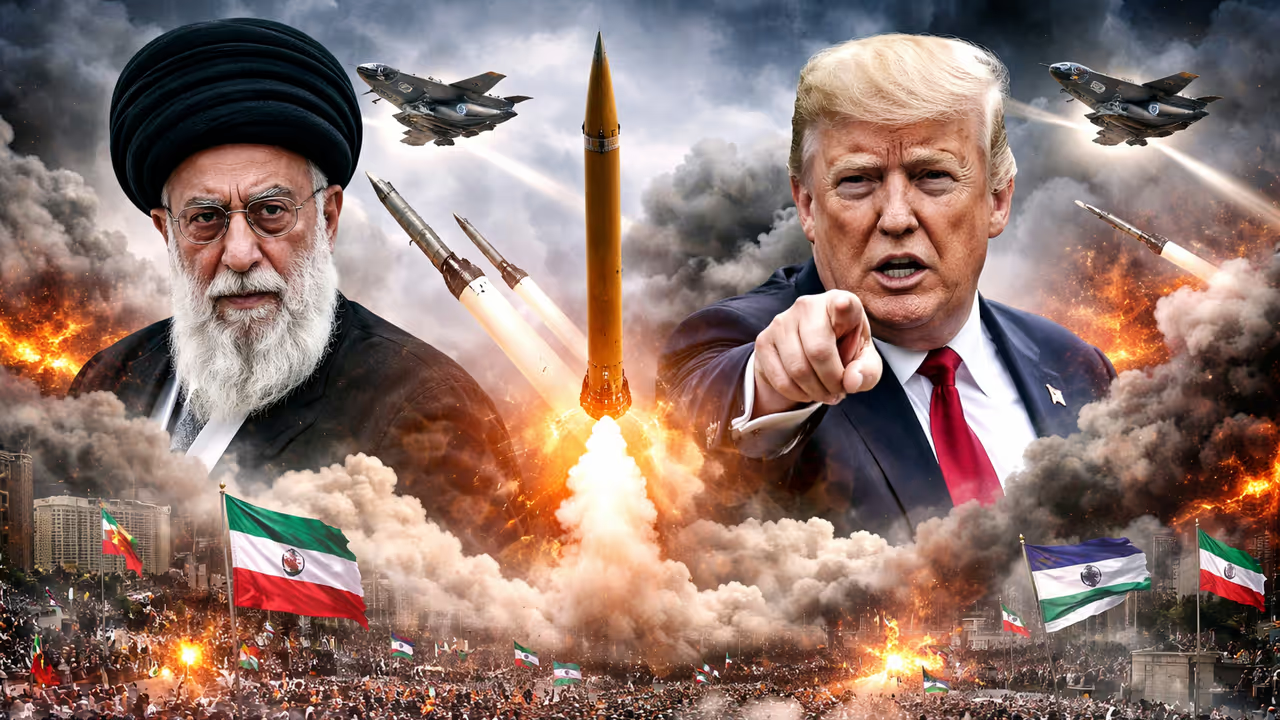
Iranians celebrate in Tehran after reports claim Ayatollah Ali Khamenei killed in US-Israel strikes that also targeted top Iranian leaders, while Netanyahu and Trump reportedly shown a photo.
Amidst escalating tensions in the Middle East, reports on Saturday night indicated that Iran's Supreme Leader, Ayatollah Ali Khamenei, may have been killed in a large-scale US-Israel military operation targeting the heart of Iran’s leadership. While no official word has come from Iran, witnesses in Tehran described scenes of spontaneous celebrations across the city late at night, highlighting deep divisions within Iranian society.
Photo of Body Shown to Trump
Two Israeli television networks reported that Khamenei was killed in US-Israeli attacks on Iran, while there was no confirmation from Tehran.
Related Articles

"Ali Khamenei is dead," reported public broadcaster Kan on its X account.
Israel's Channel 12, citing a source, said: "Khamenei is dead."
Reports further claimed that a photograph of Khamenei’s body had been shown to US President Donald Trump and Israel PM Benjamin Netanyahu.
Public broadcaster Kan added: "Senior Israeli officials were informed of Khamenei's elimination. His body was recovered from the rubble of his compound."
Trump also said that he believes multiple reports that Iran's supreme leader Ayatollah Ali Khamenei has been killed in air strikes are true -- but stopped short of directly confirming the news.
"We feel that that is a correct story," he was quoted as saying by NBC News.
Tehran, however, has so far not released any official confirmation, leaving the situation shrouded in uncertainty.
The news surfaced moments after Prime Minister Netanyahu described the joint operation with US as a decisive blow to Iran’s leadership.
“This morning, in a powerful surprise strike, the compound of the tyrant Ali Khamenei was destroyed in the heart of Tehran. For more than three and a half decades, this cruel tyrant has spread terror across the world while oppressing his own people, while working tirelessly and without pause on a plan to destroy Israel,” he said.
"That plan is no more -- and there are many signs that this tyrant is no longer alive."
Netanyahu also warned that the campaign was far from over: "This morning we eliminated senior figures in the ayatollahs' regime -- commanders in the Revolutionary Guards and senior officials in the nuclear programme -- and we will continue. In the coming days, we will strike thousands of targets of the terror regime."
Tehran Erupts in Celebration
Late Saturday, eyewitnesses described scenes of jubilation in Tehran: residents leaned out of windows, clapped, and played celebratory music after news of Khamenei’s reported death. Audio recordings and videos circulating online captured cheers and applause echoing across the city.
The spontaneous celebrations suggest that a significant segment of the Iranian population sees the reported strikes as a turning point after decades of clerical rule.
Several Top Iranian Leaders Eliminated
The IDF confirmed killing several members of Iran’s security leadership, including top defence official Ali Shamkhani and the commander of the Islamic Revolutionary Guard Corps.
- Ali Shamkhani – Former IRGC Navy chief and Iranian army chief, top adviser to Supreme Leader Ayatollah Ali Khamenei, targeted by Israel in last June’s war and initially believed killed.
- Mohammad Pakpour – Commander of the IRGC, allegedly led Iran’s “plan to destroy Israel,” responsible for missile and drone attacks on Israel, supported Iran’s proxy groups, and oversaw violent suppression of Iranian protesters.
- Salah Asadi – Chief of intelligence in Iran’s military emergency headquarters and senior intelligence officer of Iran’s armed forces’ general staff, involved in Iran’s “plan to destroy Israel.”
- Mohammad Shirazi – Chief of Khamenei’s military bureau since 1989, acted as liaison between senior armed forces commanders and the Supreme Leader, central figure in top ranks of Iran’s military leadership.
- Aziz Nasirzadeh – Iran’s Minister of Defense, former chief of Iranian Air Force and deputy chief of staff, oversaw industries producing long-range missiles and weapons for proxies, linked to SPND organization’s work on nuclear, biological, and chemical weapons.
- Hossein Jabal-Amelian – Chairman of SPND, developed advanced technologies and weapons for Iran, advanced nuclear, biological, and chemical weapons projects.
- Reza Mozafari-Nia – Former chairman of SPND, advanced efforts to develop nuclear weapons.
Speaking to ABC News from Palm Beach, Trump stated that the operation severely disrupted Iran’s command structure. "A lot of it is," Trump said when asked if key figures in Iran’s leadership were killed. "We have a very good idea of who will fill the positions of power in Tehran."
Trump described the strikes as “incapacitating” the Islamic Republic’s leadership and security network.
A Conflict That Could Last Weeks
Military analysts warn the current operation is more complex than previous US-Israel strikes targeting Iranian nuclear sites.
"This is an all-out decapitation campaign and an effort to wear down Iran's capabilities," said David Khalfa, co-founder of the Atlantic Middle East Forum research centre.
Sanam Vakil, director of the Middle East and North Africa program at Chatham House, described the strikes as “existential” for Iran:
"This new stage of conflict is existential and clearly about regime survival. It is also unlikely to end quickly."
Iran’s Foreign Minister Abbas Araghchi warned that US and Israeli installations involved in the operation were “legitimate targets” and confirmed missile strikes on US bases in the Gulf.
At the same time, he sought to dampen further escalation:
"If the Americans want to talk to us, they know how they can contact me," Araghchi said, adding he was "clearly interested in de-escalation."
Despite escalating strikes, the possibility of diplomacy remains uncertain, as regional powers brace for potential spillover.