
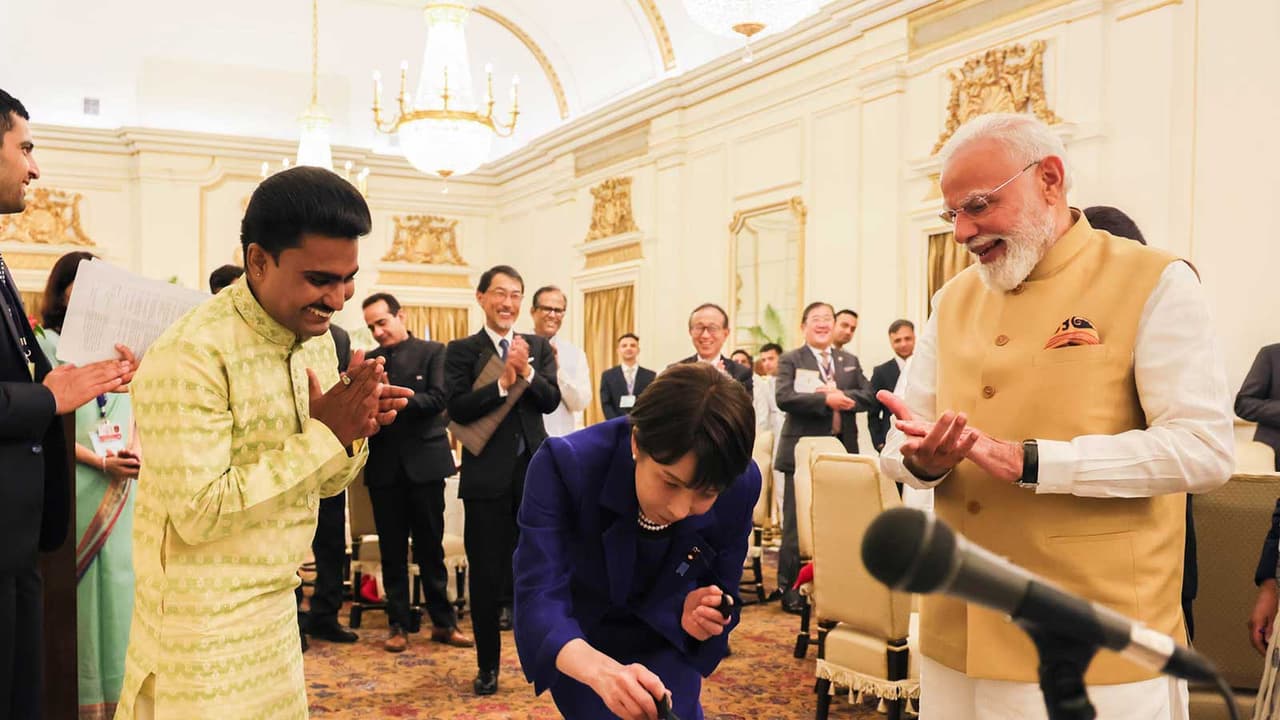
Following Japanese PM Sanae Takaichi's performance of the Santoor with PM Modi, the Indian Embassy in Tokyo highlighted the instrument's rich history. The Santoor, a 100-stringed dulcimer, has Persian origins and a unique evolution in Kashmir.
Indian Embassy in Tokyo on Monday shared the history and cultural allure of the Santoor after Japanese Prime Minister Sanae Takaichi performed the instrument alongside Prime Minister Narendra Modi. Takaichi's act drew the attention of millions to this instrument that has been passed down through centuries in Indian culture.
"Prime Minister Sanae Takaichi's performance of the Santoor with Indian Prime Minister Narendra Modi has deeply moved audiences around the world. However, this fascinating instrument has remained a part of India's cultural heritage for centuries," the Embassy said.
Global Roots, Indian Identity
The Santoor has global roots and an Indian identity. The Embassy noted, "A type of hammered string instrument, it belongs to the hammered dulcimer (trapezoidal zither) family, which is thought to have originated in Persia. It has about 100 strings and is played with two light wooden mallets (mezrab). Similar instruments are found in Asia and various parts of Europe, but the Indian santur has undergone its own unique evolution in Kashmir. Ancient Sanskrit texts describe it as a 'hundred-stringed veena,' indicating the tradition of this instrument in India."
#PrimeMinisterTakaichi'sVisitToIndia #AnnualSummit 🎶🎶🎶 Prime Minister Takaichi's performance of the Santoor with Prime Minister Modi during her visit to New Delhi has brought this instrument, which has been passed down through Indian culture for centuries, to the attention of millions. Swipe to see the history and cultural allure of the Santoor.… https://t.co/E2s4NxuRY2 pic.twitter.com/SfAoWGu24Z — Indian Embassy || India in Japan 🇮🇳 (@IndianEmbTokyo) July 13, 2026
Popularized on the Global Stage
Pandit Shivkumar Sharma popularized the Santoor, taking it to the global stage. "In the 20th century, Pandit Shivkumar Sharma reconstructed the santur, a Hindustani classical music instrument, introducing it to audiences worldwide and spreading it globally, making it one of India's most recognized classical instruments," the embassy noted.
Kashmiri Craftsmanship and Tradition
The Santoor is crafted from walnut wood and played with a light and flexible wooden mallet. "From Kashmir to the Concert Stage: The santoor, traditionally used in the Sufi music of the Kashmir region, "Sfiana Mausikyi," has been a beloved accompaniment instrument for religious and folk music for centuries. It is characterized by being carefully crafted from walnut wood and played with a light and flexible wooden mallet (mezrab) made of walnut wood. Similar instruments can be found in various parts of Asia and Europe, but the Kashmiri santur has developed uniquely, inheriting the finest of Kashmiri craftsmanship," the embassy noted.
A Moment at the Luncheon
On July 2, at the luncheon hosted by Prime Minister Modi, there was entertainment with performances on traditional instruments.
A scene from the luncheon hosted by Prime Minister Modi. At the luncheon, there was entertainment with performances on traditional instruments. Towards the end, Prime Minister Takaichi, after expressing thanks to all the performers, was invited by one of the musicians to try playing the traditional instrument Santoor... Prime Minister Modi also smiled and applauded👏 pic.twitter.com/0JdiqOtHge — Cabinet Public Relations Secretary (trying various posts) (@PressSec_JP) July 2, 2026
Takaichi, after expressing thanks to all the performers, was invited by one of the musicians to try playing the traditional instrument. She tried her hand at it and earned applause from everyone there.
(Except for the headline, this story has not been edited by Asianet Newsable English staff and is published from a syndicated feed.)