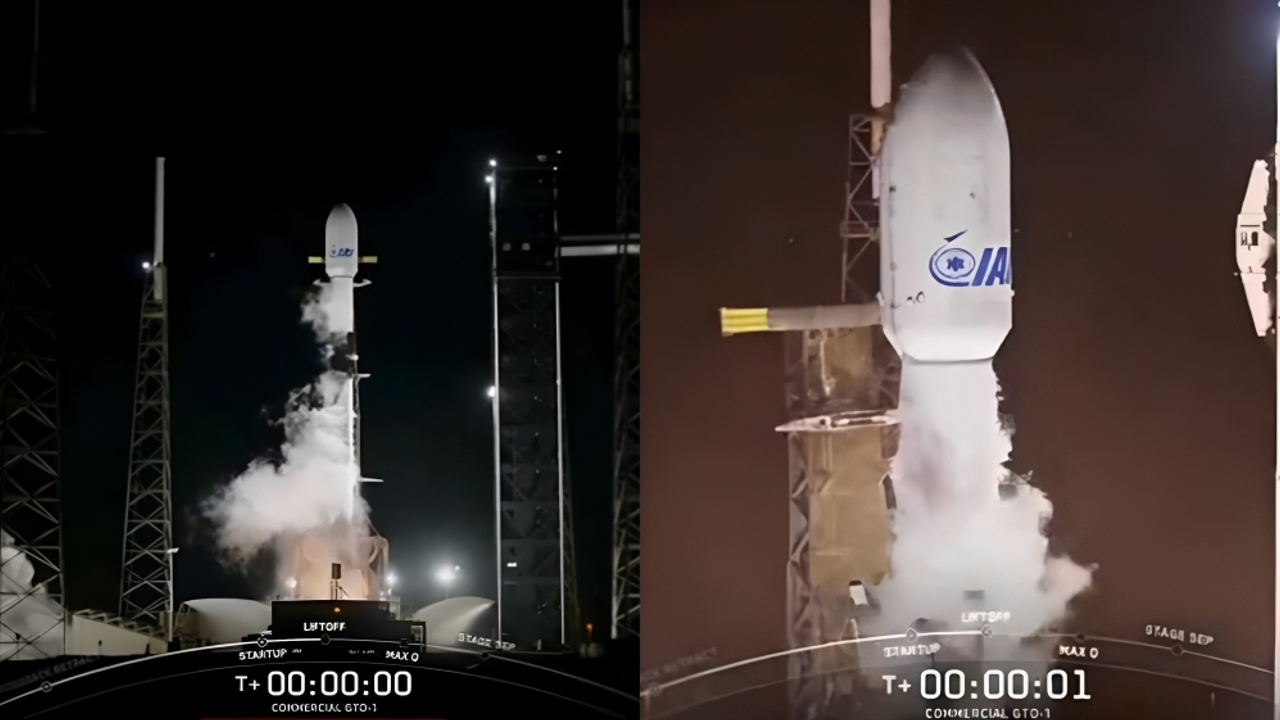
Israel successfully launched Dror-1, its advanced national communications satellite, aboard a SpaceX Falcon 9 rocket. Built by Israel Aerospace Industries, Dror-1 will enhance communication network and demonstrate its independent space capabilities.
Israel marked a big achievement in its space journey with the successful launch of Dror-1, the country’s new national communications satellite.
The satellite was launched aboard a SpaceX Falcon 9 rocket from Cape Canaveral, Florida, early on Sunday morning. Built by Israel Aerospace Industries (IAI), Dror-1 will play a key role in strengthening Israel’s communication network for many years to come.
Related Articles

First signal received after launch
Soon after reaching space, Dror-1 sent its first signals to the control station back in Israel. This confirmed that the satellite was stable and functioning.
Over the next few weeks, IAI engineers will carry out a series of technical checks to ensure the satellite is working exactly as planned.
What makes Dror-1 special
Dror-1 is not just any satellite. Weighing 4.5 tonnes and measuring 17.8 meters across, it is the largest communication satellite ever developed in Israel. It has powerful antennas for both sending and receiving signals, the biggest Israel has ever built.
The satellite also carries a digital communication system and several smart features, often described as “a smartphone in space.” These features allow Dror-1 to adjust and improve how it handles data during its mission, making it one of the most advanced communication satellites in the world.
Importantly, most of its technology was developed in Israel, proving the country’s growing capability in space technology.
Launched aboard SpaceX Falcon 9
Dror-1 was launched using the trusted Falcon 9 two-stage rocket by Elon Musk's SpaceX.
The rocket's first-stage booster completed its 13th flight and made a perfect landing on a drone ship in the Atlantic Ocean, avoiding a sonic boom over Florida. Meanwhile, the second stage carried the satellite into a geostationary transfer orbit (GTO), a path that will help it reach a fixed position above Earth.
This mission was marked as 'Commercial GTO 1' by SpaceX, a naming style not seen before.
Satellite to reach final position in two weeks
In the coming days, the satellite will begin to unfold its solar panels and antennas. It will then move into its final geostationary orbit, about 36,000 km above the Earth. This process will take around two weeks.
Once in position, Dror-1 will stay fixed over a single point on Earth, which is ideal for uninterrupted communication services.
A milestone for Israel's space ambitions
IAI called the Dror-1 mission a major moment in Israel’s space journey. It proves that Israel can develop, launch, and operate high-end satellite systems largely using its own resources. The mission is also a signal to the world that Israel is serious about advancing its space program.
This was also SpaceX’s 519th launch overall, and its 85th of the year 2025, showing how rapidly private space missions are increasing.
What Dror-1 will do
Dror-1 is expected to:
- Boost Israel’s communication infrastructure
- Improve data transfer across government, defence and commercial sectors
- Support secure communication for national needs
- Reduce dependence on foreign satellite services
Dror-1 is more than just a satellite. It's a symbol of national achievement, scientific progress and international cooperation. With its launch, Israel has taken another step toward becoming a strong and self-reliant space power.