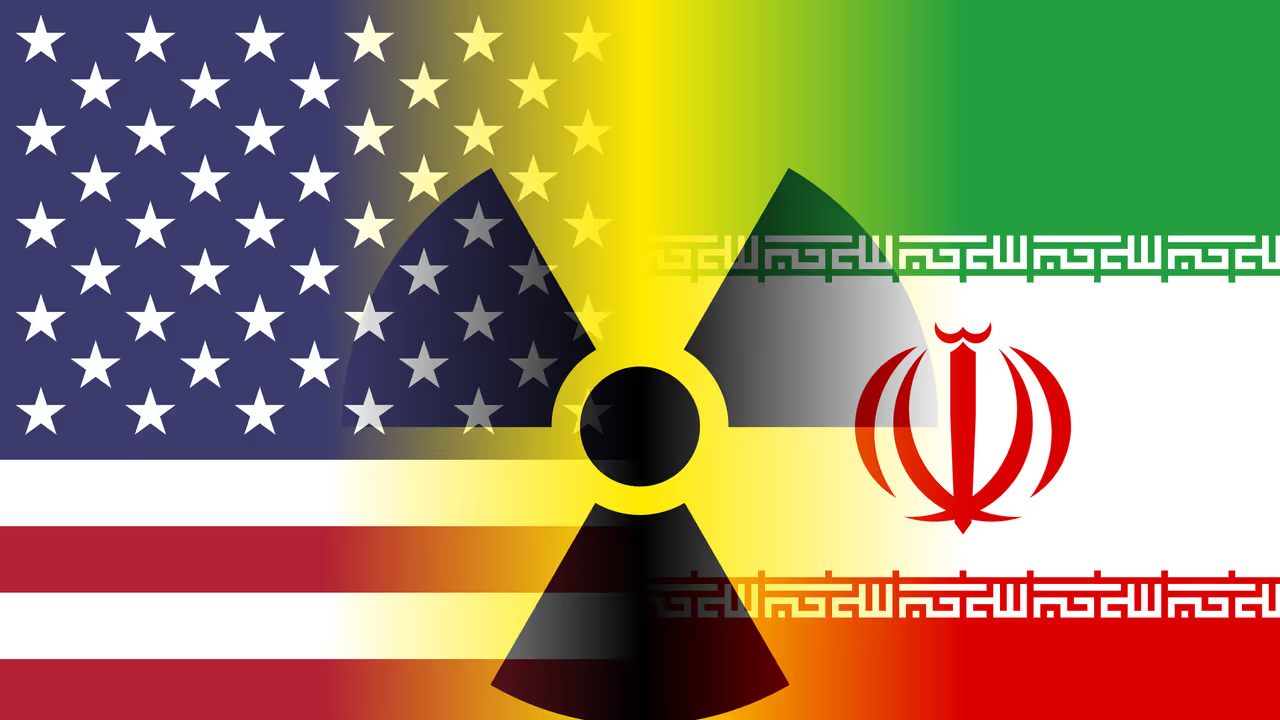
Iranian President Masoud Pezeshkian has ordered the start of nuclear talks with the United States, the news agency Fars reported on Monday, after US President Donald Trump said he was hopeful of a deal to avert military action.
Iranian President Masoud Pezeshkian has ordered the start of nuclear talks with the United States, Iranian news agency Fars reported on Monday, amid rising regional tensions and renewed warnings of military action from US President Donald Trump.
“President Pezeshkian has ordered the opening of talks with the United States,” Fars said, citing an unnamed government source.
According to the report, “Iran and the United States will hold talks on the nuclear file,” though no date was specified. The development was also reported by the government newspaper Iran and the reformist daily Shargh.
Related Articles

Framework for Talks Expected Soon
Earlier on Monday, Iran indicated that a framework for negotiations with Washington could be finalised in the coming days, even as Trump continues to warn of possible military action against Tehran.
“Countries of the region are acting as mediators in the exchange of messages,” Iranian foreign ministry spokesman Esmaeil Baqaei said, without providing details on which nations were involved.
“Several points have been addressed and we are examining and finalising the details of each stage in the diplomatic process, which we hope to conclude in the coming days. This concerns the method and framework,” Baqaei added.
Trump Says He Is Hopeful of a Deal
US President Donald Trump on Sunday said he remained hopeful of reaching an agreement with Iran, responding to warnings from Tehran that any US attack would trigger a wider regional conflict.
“Hopefully we'll make a deal. If we don't make a deal, then we'll find out whether or not he was right,” Trump told reporters.
Trump’s remarks came after Iran’s Supreme Leader Ayatollah Ali Khamenei warned that any military action against Iran would not remain limited.
“The Americans should know that if they start a war, this time it will be a regional war,” Khamenei said, adding that Iranians “should not be scared” of Trump’s rhetoric.
Iran Signals Openness, Warns Against Miscalculation
Iran’s Foreign Minister Abbas Araghchi said on Sunday that he was concerned about possible “miscalculations” but expressed cautious optimism about diplomacy.
He said Iran had lost trust in the United States as a negotiating partner, but noted that regional intermediaries were working to rebuild confidence.
“So I see the possibility of another talk if the US negotiation team follows what President Trump said: to come to a fair and equitable deal to ensure that there is no nuclear weapons,” Araghchi said in an interview with CNN.
Iran has repeatedly stressed that it is prepared for nuclear talks only if its missile and defence capabilities are excluded from negotiations.
Protests, Crackdown and Rising Tensions
Tensions between Tehran and Washington have intensified following Iran’s deadly response to anti-government protests that peaked last month. Trump has cited the unrest while threatening military action and ordering the deployment of an aircraft carrier group to the Middle East.
Khamenei dismissed the protests as externally driven, saying they resembled a coordinated attempt to destabilise the country.
“They (rioters) attacked the police, government centres, IRGC centres, banks, and mosques, and burned the Koran... It was like a coup,” he said, adding that “the coup was suppressed.”
The demonstrations initially began over the high cost of living but later evolved into a broader anti-government movement. Iranian leaders have repeatedly accused the United States and Israel of stoking the unrest.
Death Toll Disputed, Sanctions Escalate
Iranian authorities have acknowledged thousands of deaths during the protests. On Sunday, the presidency released a list of 2,986 names, out of the 3,117 deaths it said occurred during the unrest, adding that 131 victims have yet to be identified.
Officials maintain that most of those killed were security personnel or innocent bystanders, blaming the violence on what they describe as “terrorist acts.”
However, the US-based Human Rights Activists News Agency has reported a significantly higher toll, saying it has confirmed 6,842 deaths, most of them protesters.
The crackdown prompted the European Union to designate the Islamic Revolutionary Guard Corps (IRGC) as a terrorist organisation. Iranian lawmakers retaliated by applying the same label to European armies.
During a parliamentary session, lawmakers wore green IRGC uniforms and chanted “Death to America,” “Death to Israel,” and “Shame on you, Europe,” according to state television footage.