
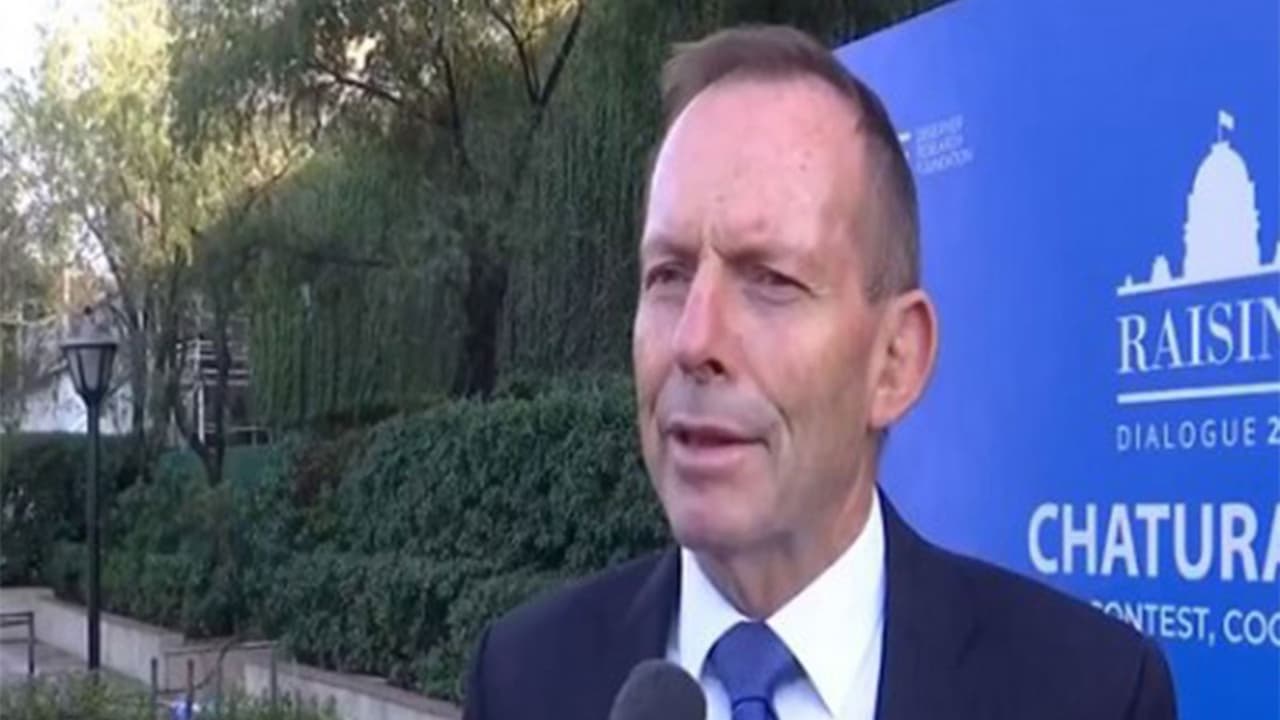
Former Australian PM Tony Abbott hailed the Raisina Dialogue as a 'brainchild' of S Jaishankar, praising it as a more dynamic and robust forum for debate than Davos or China's Boao Forum, and lauding the engagement of Indian leadership.
Former Australian Prime Minister Tony Abbott described the annual Raisina Dialogue in New Delhi as one of the most dynamic global forums for international discussion, calling it as a "brainchild" of External Affairs Minister S Jaishankar. he highlighted that it has emerged as a key platform bringing together political leaders, military officials, business figures, journalists, and think tank representatives to debate pressing geopolitical issues. In an open letter reflecting on his participation in the forum, Abbott noted that the conference had grown into a prominent gathering in global diplomacy.
A Cut Above Davos and Boao
Abbott said the dialogue compares favourably with established international meetings such as the World Economic Forum Annual Meeting in Switzerland and the Boao Forum in China. According to Abbott, the Raisina Dialogue stands out because discussions are not dominated by what he described as politically correct narratives or excessive deference to host governments. Instead, he said the conference allows diverse views and robust debate.
"Like other global gatherings, it brings together political leaders, senior military commanders, prominent business people, leading journalists, and think tank chiefs to discuss key issues; but it's better than Davos because it's not so dominated by politically correct plutocrats; and better than the longer-running Chinese Boao Forum, because it not essentially an exercise in homage to the host government," he said
"Because it's India, there's a lot of emphasis on the "global south"; but equally, because it's India, there's a recognition that fine sentiment shouldn't be taken too seriously, especially if it's masking grievance and rent-seeking; and that, in the end, noble aspirations have to take into account hard power and economic strength," he added.
Praise for Indian Leadership's Engagement
The former Australian leader also commended Jaishankar's engagement at the event, noting that the minister frequently participates in multiple sessions, sometimes speaking, sometimes listening from the audience, and engages with other panellists in a respectful exchange of ideas.
"To his credit, Jaishankar invariably attends numerous sessions, sometimes simply sitting in the audience, sometimes as a key note speaker, and sometimes as one of up to a half-dozen discussants on any particular topic; politely agreeing or taking issue with his fellow panelists, as the debate goes. Remarkably for someone of such accomplishment (successively India's ambassador to China, the United States, and head of the Ministry of External Affairs, before becoming the Foreign Minister), Jai doesn't talk down, and is on 'receive' far more often than 'transmit'," he said
"Indeed, at this conference, rank has no privileges; it might get you onto the stage as a speaker or panelist, but it's the quality of the contribution that counts. After all, no one has a monopoly on knowledge or wisdom and everyone should be there to justify ideas and to learn from the discussion," he added.
Abbott also highlighted the role played by Prime Minister Narendra Modi at the opening of the conference. He pointed out that PM Modi traditionally attends the inaugural session to listen to the keynote address delivered by a visiting world leader; this year, the President of Finland, rather than delivering a speech himself.
"At every dialogue so far, Prime Minister Modi has set the example, attending the opening session, to hear the principal guest - last year the Prime Minister of New Zealand; this year the President of Finland - but not speaking himself. After the US and Chinese presidents, he's probably the most immediately powerful person in the world, yet he's not too proud to listen as well as to lead. Despite over a decade in office, perhaps because of his youth as a kind of Hindu monk, Modi has thus far managed to resist the hubris of power," he said.
Refuting Claims of Authoritarianism
Addressing criticism from some quarters about India's political trajectory, Abbott rejected suggestions that the country has become authoritarian under the Bharatiya Janata Party.
"And as for this notion that India, under the BJP, has somehow become an authoritarian state -- that's total BS. No country with free and fair elections, a riotously free media, and a robustly independent judiciary is in serious danger of dictatorship. And no dictatorship would host a global conference where nothing is off-limits and no one is shouted down. This year's dialogue, after all, heard from both the Israeli foreign minister (virtually) and the Iranian deputy foreign minister," he said.
Abott further outlined three major takeaways from the discussions, saying many global forums appear overly focused on consensus-driven diplomacy rather than tangible action.
The Raisina Dialogue is India's premier conference on geopolitics and geoeconomics, held annually in New Delhi since 2016. Organised by the Observer Research Foundation in partnership with the Ministry of External Affairs, this three-day event convenes global leaders, policymakers, academics, industry experts, and journalists to discuss critical international issues, ORF website states. (ANI)
(Except for the headline, this story has not been edited by Asianet Newsable English staff and is published from a syndicated feed.)