
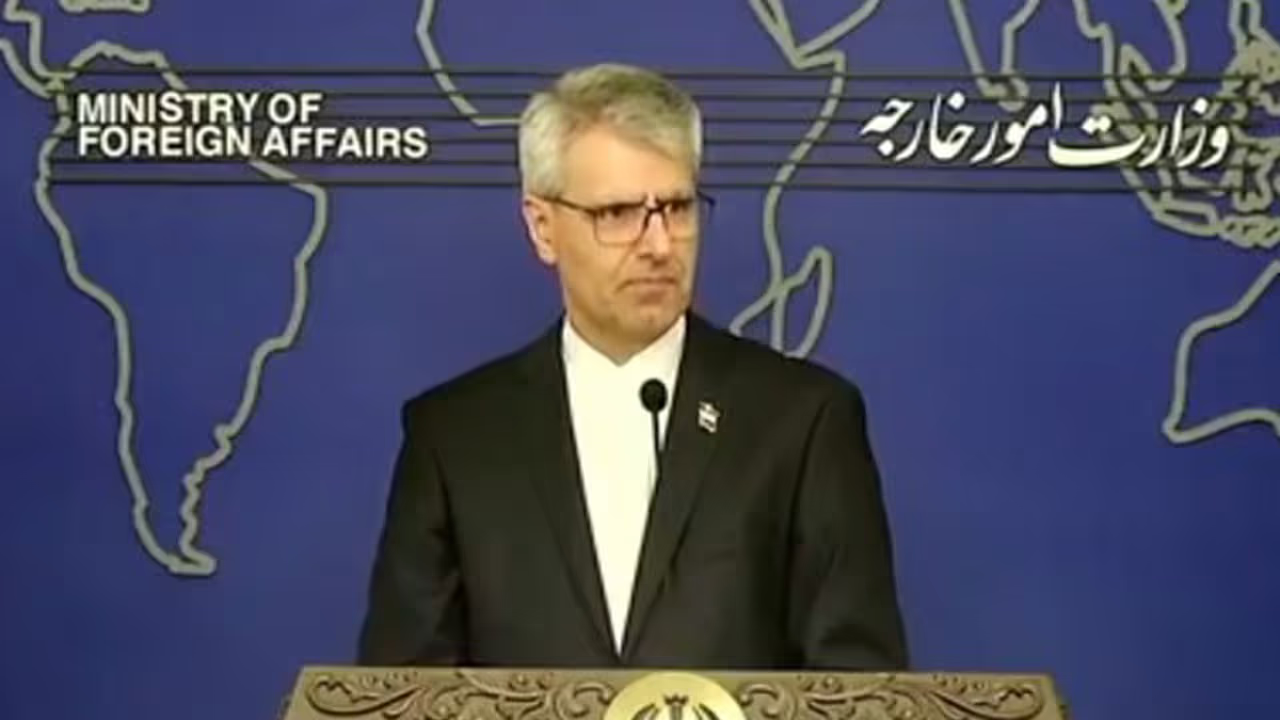
Iran's Foreign Ministry stated the new Pakistan-Turkiye-Saudi Arabia defence pact shows a regional shift, proving security can't be bought. Spokesperson Esmaeil Baghaei said Iran is not threatened and that Israel is the region's main threat.
A 'Fundamental Shift' in Regional Perception
Addressing the newly formed trilateral defence pact between Pakistan, Turkiye, and Saudi Arabia, Iranian Foreign Ministry Spokesperson Esmaeil Baghaei on Monday stated that the agreement signals a fundamental shift in regional perception, proving that Middle Eastern nations have realised "security is not a commodity that can be purchased from false security brokers".
Addressing reporters during a press briefing, Baghaei fielded a series of comprehensive questions regarding the regional implications of the Mecca defence agreement, potential threats, and Tehran's stance on regional security coalitions. Responding to questions about whether the trilateral pact signals an endogenous shift away from the United States or a coalition to confront regional players, Baghaei emphasised that the agreement reflects a fundamental evolution in how Middle Eastern countries perceive their safety. "At a glance, we can say that this development is a sign of a change in the perception of the countries of the region. Considering the developments of the last two or three years, the countries of the region have realized that security is not a commodity that can be purchased from false security brokers," he stated.
Israel and US Blamed for Regional Instability
The spokesperson reiterated that Iran's principled policy has consistently championed cooperative security built on mutual trust and free from extra-regional meddling. Linking this shift directly to recent geopolitical conflicts, Baghaei underscored that regional actors increasingly view Israel as the primary source of instability. "Another point is that after the developments of October three years ago, the beginning of the plans to eliminate colonialism in occupied Palestine, the genocide in Gaza, and the attacks of the occupying regime on Lebanon and the rest of the countries of the region, the countries of the region have increasingly come to the conclusion that the greatest threat to the stability, security, and cooperation of the countries in the region is the Zionist regime; not only for our region, but for the entire international community," he added.
Baghaei also placed blame on Washington, stating that "the United States itself has been part of the cause of insecurity in the region" through its comprehensive support and protection of Israel. He added that any effective security framework must be comprehensive, inclusive, and accurately identify these threats.
Iran Not Threatened by Pact, Cites 'Deep Ties'
Addressing whether Iran felt threatened by the pact, given that Turkey and Pakistan are close allies of Iran and that the Islamic Republic was reportedly informed of the agreement, Baghaei dismissed fears of hostility, highlighting deep civilisational bonds. "I will briefly answer the first part of your question; yes, more or less. But regarding the second part of your question, there is no reason for the two countries of Turkey and Pakistan, as well as Saudi Arabia, three countries with which we have deep religious, historical, and civilizational ties, to worry that this treaty is against Iran," Baghaei clarified.
Highlighting the long-standing friendly ties uniting Iran, Pakistan, and Turkey, Baghaei reiterated that the trilateral arrangement demonstrates that these nations are seeking independent methods "by relying on their own capabilities and perspectives, independent of foreign interventions and parties, and destructive interventions by foreign parties."
Iran's Position on Joining and Past Proposals
When asked about the possibility of Iran joining the pact, sometimes referred to in media circles as an "Islamic NATO", and the status of past Iranian proposals like the Hormuz Peace Plan, Baghaei underscored Tehran's historical leadership in regional diplomacy. "You mentioned the history of these issues. I said that the Islamic Republic of Iran itself has been a pioneer, always emphasising the pursuit of security mechanisms based on cooperation between the countries of the region; security that is endogenous and free from the influence and destructive intervention of actors outside the region," the spokesperson affirmed.
Baghaei further affirmed that these past proposals "still exist and can certainly be updated in light of developments." He added that Iran remains in close contact with neighbouring countries, expressing hope that all regional states will learn from recent years to strengthen collective security.
Turkiye: Alliance is Defensive, Not Against Iran
Earlier, Turkish Foreign Minister Hakan Fidan also said that the recently signed Mecca Joint Defence Agreement between Turkiye, Saudi Arabia and Pakistan is not directed against Iran, stressing that the alliance is defensive in nature and is not intended to attack or eliminate any country.
During an interview with Anadolu Agency on Saturday, Fidan said Saudi Arabia had no strategy to attack or eliminate Iran and instead wanted an end to the violence surrounding the Strait of Hormuz. Pakistan, Saudi Arabia and Turkiye signed the Mecca Joint Defence Agreement on Friday amid escalating tensions and conflict across West Asia. (ANI)
(Except for the headline, this story has not been edited by Asianet Newsable English staff and is published from a syndicated feed.)