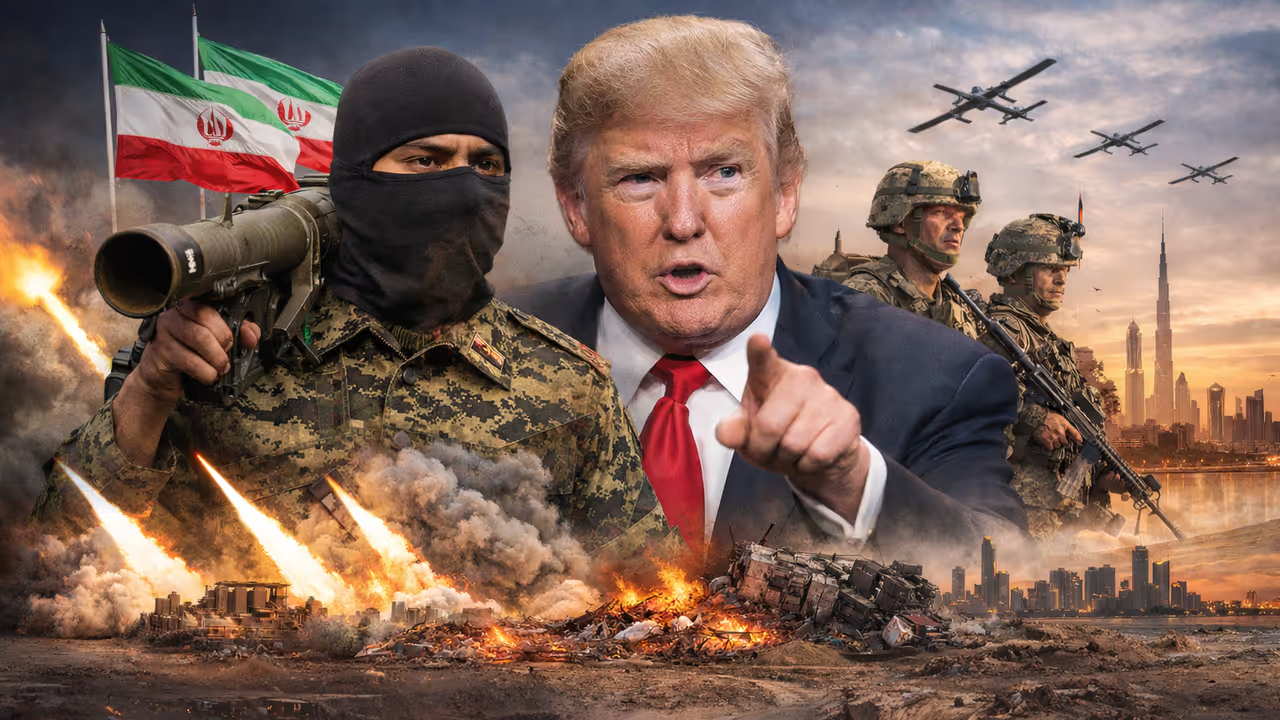
Amid escalating regional conflict, Iran says it has “no hostility” toward Gulf states even as strikes hit hundreds of US and Israeli-linked targets, while Donald Trump signals ground troops remain an option.
As the conflict triggered by US-Israeli strikes on Iran continues to widen across the Middle East, Iran on Monday has attempted to reassure neighbouring Gulf countries that it does not view them as enemies, even as retaliatory attacks intensify across the region.
Iran’s Foreign Minister Abbas Araghchi said that Tehran seeks stable relations with countries around the Persian Gulf despite the escalating military exchanges.
Speaking during a phone call with Chinese Foreign Minister Wang Yi, Araghchi stressed that Iran’s actions were aimed at US military targets rather than regional governments.
Related Articles

"Iran harbours no hostility towards the Persian Gulf countries and is determined to pursue good neighbourly relations with them," Abbas Araghchi said.
According to Iran’s foreign ministry, he also clarified Tehran’s position on its military response.
Iran's "defensive response against US military bases... should not be seen as an Iranian attack against these countries".
The statement comes as tensions across West Asia continue to spiral after the joint US-Israeli military campaign against Iran began over the weekend.
Revolutionary Guards Claim Hundreds of Targets Hit
Iran’s Islamic Revolutionary Guard Corps said on the third day of fighting that its retaliatory operations have already struck hundreds of targets linked to the United States and Israel across the Middle East.
In a statement released Monday, the Guards outlined the scale of the attacks.
"Since the start of the conflict, the brave soldiers of the Iranian armed forces have attacked 60 strategic targets and 500 American military targets and targets of the Zionist regime (Israel)," the Guards said.
The statement added that Iran had deployed a large wave of aerial assaults.
According to the Guards, more than 700 drones and hundreds of missiles have been launched since the conflict began.
Trump Does Not Rule Out Ground Troops
Meanwhile, US President Donald Trump signalled that Washington could escalate further if required.
In an interview with the New York Post, Trump said he would not completely rule out deploying troops inside Iran.
"I don't have the yips with respect to boots on the ground -- like every president says, 'There will be no boots on the ground.' I don't say it," Trump told the Post in one of several brief interviews he has given since launching the Iran operation on Saturday.
He suggested such a move might not be necessary but remained an option.
"I say 'probably don't need them,' [or] 'if they were necessary,'" he said.
War Spreads Across the Middle East
The conflict, which intensified after the killing of Iran’s supreme leader Ali Khamenei, is rapidly expanding across multiple countries.
Explosions were reported in Tehran as Israeli forces launched new strikes, while clashes spread to Lebanon after the Iran-backed militant group Hezbollah entered the confrontation.
Blasts were also heard in Beirut, as the Israeli military continued operations targeting Hezbollah positions.
Gulf states warned they could retaliate after key energy infrastructure came under attack. A Saudi oil refinery caught fire, Qatar halted LNG production, and several tankers were attacked off Oman — developments that have rattled global energy markets.
Washington’s senior military leadership said the US had gained an advantage in the air campaign.
Chairman of the Joint Chiefs of Staff Dan Caine told reporters that US forces had achieved air superiority over Iran to “allow them to continue the work”.
At the same time, smoke was seen rising from the US embassy complex in Kuwait as Iranian retaliatory strikes continued. A US base and a power station in Kuwait were also targeted.
During the intense fighting, three US United States Air Force F-15E Strike Eagle jets were accidentally shot down by Kuwaiti air defences.
"During active combat -- that included attacks from Iranian aircraft, ballistic missiles, and drones -- the US Air Force fighter jets were mistakenly shot down by Kuwaiti air defences," CENTCOM said.
The pilots and weapons officers survived the incident.
Defiance From Tehran
Iran’s leadership has struck a defiant tone despite the scale of the assault.
Ali Larijani, head of Iran’s Supreme National Security Council, said the country would continue to resist.
He vowed that Iran would defend itself "regardless of the costs and will make the enemies sorry for their miscalculation".
At the same time, the US administration signalled that its military campaign would continue.
US Defence Secretary Pete Hegseth said no American troops were currently on the ground inside Iran but made it clear Washington was prepared to go further if needed.
"We'll go as far as we need to go."
Fear and Uncertainty in Tehran
On the ground in Tehran, daily life has been disrupted by air strikes and uncertainty.
Many residents have left the city, and large parts of the capital appeared unusually quiet. AFP journalists reported deserted roads, with food delivery vehicles among the few still operating.
At the Tajrish bazaar, some shops remained open as people rushed to buy essentials such as fruit and bread before leaving.
Near the headquarters of Iranian state television — which was hit by air strikes — the smell of burning still lingered more than 12 hours later.
Residents described living with the constant sound of explosions.
"When we hear the noises, depending on how close it hit, we feel shaking in the windows and doors," said 31-year-old Saghar, in a voice message to her relatives in Europe.
Some Iranians expressed mixed emotions — fear of the attacks but also a sense that change might be approaching.
"Every time we hear the noises, we get scared for just a second. But we experience some joy and excitement every time we hear a hit," a 45-year-old lawyer said, also in a voice message to Europe.
Also read: Who Was Mansoureh Khojasteh? Inside The Life Of Khamenei's Wife
Attacks Reach Cyprus and Regional Tensions Grow
The conflict has also spilled beyond the immediate theatre of war.
An Iranian drone struck the runway of a British air force base in Akrotiri in Cyprus, prompting evacuations near the facility and at the airport in Paphos.
Authorities said additional drones targeting the base were intercepted in time. Greece later announced it was deploying frigates and jets to help protect Cyprus.
Explosions were reported across several cities in the region — including Dubai, Bahrain and parts of Iraq — as the war continued to spread.
International travel has been severely affected, with flights through major regional hubs cancelled. Dubai, however, announced that its airports would partially reopen later Monday.
Lebanon Drawn Into the Conflict
In Lebanon, the confrontation between Israel and Hezbollah intensified sharply.
Israel’s military chief Eyal Zamir warned that the campaign would not only target Iran but also Hezbollah leadership.
"We will end this campaign with not just Iran being struck but with Hezbollah suffering a devastating blow," Israel's army chief Eyal Zamir said.
He added: "Our message is clear and resonates throughout the Middle East: We will strike all terrorist leaders and factions who rise to harm us. We have proven this and will continue to prove it."
As the situation escalated, Lebanese Prime Minister Nawaf Salam announced a major move against the armed group.
He declared "the immediate ban of all Hezbollah security and military activities", calling them "illegal".
Israeli strikes in Lebanon have killed at least 31 people, according to Lebanese authorities.
In southern Lebanon, families fled their homes as bombardment intensified. AFP journalists reported roads packed with cars, some carrying mattresses tied to their roofs as residents attempted to escape the violence.
Attacks on Ships and Rising Global Concerns
The conflict is also threatening key global shipping routes.
In the Strait of Hormuz — a critical corridor for oil shipments — three ships were attacked on Sunday after Iran warned vessels against crossing the waterway.
With strikes spreading rapidly across multiple countries and major infrastructure under threat, there are growing fears that the war could expand even further in the coming days.
Both Donald Trump and Israeli Prime Minister Benjamin Netanyahu have urged Iranians to rise up against the government in Tehran — a regime that has been a sworn enemy of both the United States and Israel since the 1979 Islamic Revolution overthrew the pro-Western shah.
For now, however, the conflict shows little sign of slowing.