
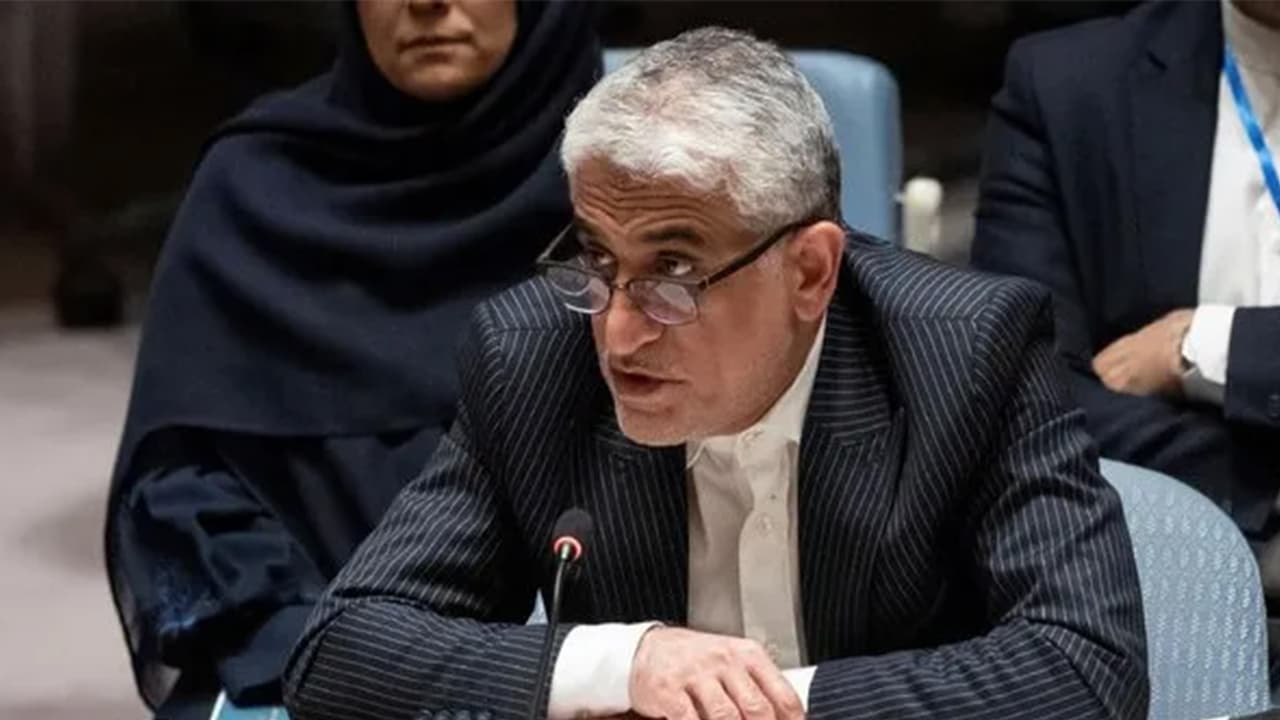
Iran's UN envoy slams Arab states for aiding US-Israeli aggression, defending Tehran's military response as self-defense. The US administration claims a ceasefire pauses the War Powers Act deadline, a legal interpretation disputed by Democrats.
Iran Hits Back at UN, Accuses Arab States of Complicity
Iran's Permanent Representative to the United Nations, Amir Saeid Iravani, has formally responded to a joint letter sent by six Arab states to the UN and the UN Security Council regarding the ongoing regional tensions. The Iranian envoy hit back at the signatory states, alleging their complicity in military actions against Tehran. Iravani stated that those countries have participated in the aggression against Iran by "placing at the disposal of the US-Israeli enemy the military bases located on their soil, from which airstrikes were launched against Iran."
Tehran Cites 'Legitimate Right to Self-Defense'
Defending Tehran's military responses, the diplomat asserted that the Islamic Republic's actions were consistent with global legal standards. Iravani says Iran has used its "legitimate right to self-defense, as stipulated in the UN Charter, in response to the aggression."
Iravani further cautioned that any nation facilitating strikes against Iranian territory would face repercussions under international accountability. He adds that the countries that have participated in the aggression against Iran or "allowed the use of their bases, airspace, territorial waters, or soil to attack Iran are responsible and must be held accountable."
The Permanent Representative sought to distance Tehran from the initial spark of the current hostilities, emphasising the reactive nature of their military posture. Regarding the onset of the violence, Iravani remarked, "Iran was not the initiator of the conflict and war."
US War Powers Act Debate Amid Ceasefire
This diplomatic friction at the UN coincides with assertions from the Donald Trump administration that the United States is "not at war" with Iran, even as the deadlock continues to push global oil prices to a historic high. The remarks from Washington come as a critical legal deadline approaches under the US War Powers Act, which mandates congressional consent for sustained military operations.
White House Claims 'Pause' on 60-Day Clock
White House officials maintain that the current ceasefire with Tehran effectively "pauses" the 60-day legal clock for seeking such authorisation.
Supporting this stance, US House Speaker Mike Johnson told NBC News, "I don't think we have an active, kinetic military bombing, firing or anything like that. Right now, we are trying to broker a peace." Johnson added that he would be "very reluctant to get in front of the administration" during sensitive negotiations.
Similarly, US Secretary of War Pete Hegseth informed lawmakers that the cessation of hostilities "pauses" the 60-day clock. When questioned by Democratic Senator Tim Kaine regarding the May 1 deadline, Hegseth remarked, "Ultimately, I would defer to the White House and White House counsel on that. However, we are in a ceasefire right now, which, in our understanding, means the 60-day clock pauses or stops in a ceasefire."
Conflict Origins and Democratic Challenge
The conflict originally commenced on February 28 following joint US-Israeli strikes that killed Iran's then Supreme Leader Ali Khamenei and other high-ranking officials. President Trump formally notified Congress of the campaign on March 2, establishing May 1 as the milestone for the War Powers Act.
However, Democratic lawmakers have challenged this legal interpretation, with Senator Kaine stating, "I do not believe the statute would support that." Despite these challenges and a failed Senate resolution to limit executive authority, Republican control of the House and the threat of a presidential veto continue to hamper efforts to conclude the hostilities. Senator Adam Schiff, noting the loss of thirteen service members, declared that with the 60-day mark arriving, "the price we have paid is already too high." (ANI)
(Except for the headline, this story has not been edited by Asianet Newsable English staff and is published from a syndicated feed.)