
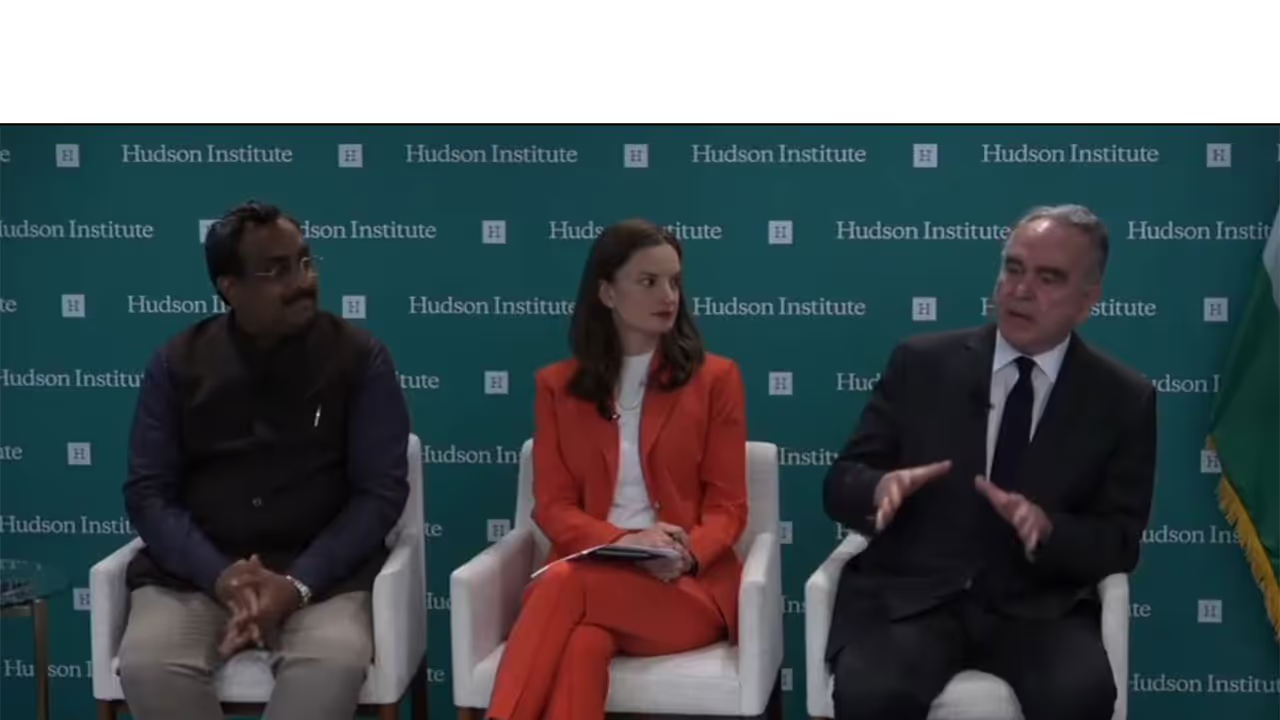
Former US Deputy Secretary of State Kurt M Campbell reveals India was the 'leading force' behind the Quad, noting President Biden persuaded a reluctant PM Modi to join. He also expressed concern over the current state of US-India ties.
Former United States Deputy Secretary of State Kurt M Campbell on Thursday (local time) said that India was the leading force behind the Quad grouping, highlighting its key role in shaping the partnership among the four countries.
Speaking at the Hudson Institute, Campbell said, "... We have to acknowledge during the first Trump administration, it was the decision by key players in the administration to provide on an urgent basis information, intelligence, and others to Indian friends at a moment of real peril along the line of actual control."
"I was there, despite whatever reports I watched, President Biden persuaded, over an hour, a very reluctant Prime Minister Modi to join the Quad at the leader level. Like literally fought him to an agreement to the point where he said, 'I promise I will do this if you just stop haranguing me'... The leading nation behind the scenes in the Quad was not the United States. It was not Australia. It was not Japan. It was India," he said.
Concerns Over US-India Ties
He expressed concern over the current state of US-India ties, stressing that mutual respect remains a fundamental principle for the relationship going forward.
"It is troubling on some level that we have to have a reminder around mutual respect. I wouldn't have thought that the US -India relationship would ever come to this point, but I acknowledge that we are here, and I do believe that, as a foundational principle, it is of critical importance," he further said.
Strong Interest in Quad's Education Initiative
He further highlighted a strong interest in the Quad's education initiative, noting that thousands of students, especially from India, have applied for limited spots in a STEM programme at top universities.
"...When we started the educational initiative as part of the Quad, we immediately recruited money from the technology and other communities that Elizabeth described. We were able to go out and recruit and use resources... We had about 150 applicants for 25 spaces. This is two years of full education, STEM, with the best people in the world to study at our finest universities. Good numbers from Australia and Japan, a couple of hundred, several hundred from the United States, and 6,000 candidates for 2025 from India. That is the ambition, that is the possibility," Campbell said. (ANI)
(Except for the headline, this story has not been edited by Asianet Newsable English staff and is published from a syndicated feed.)