
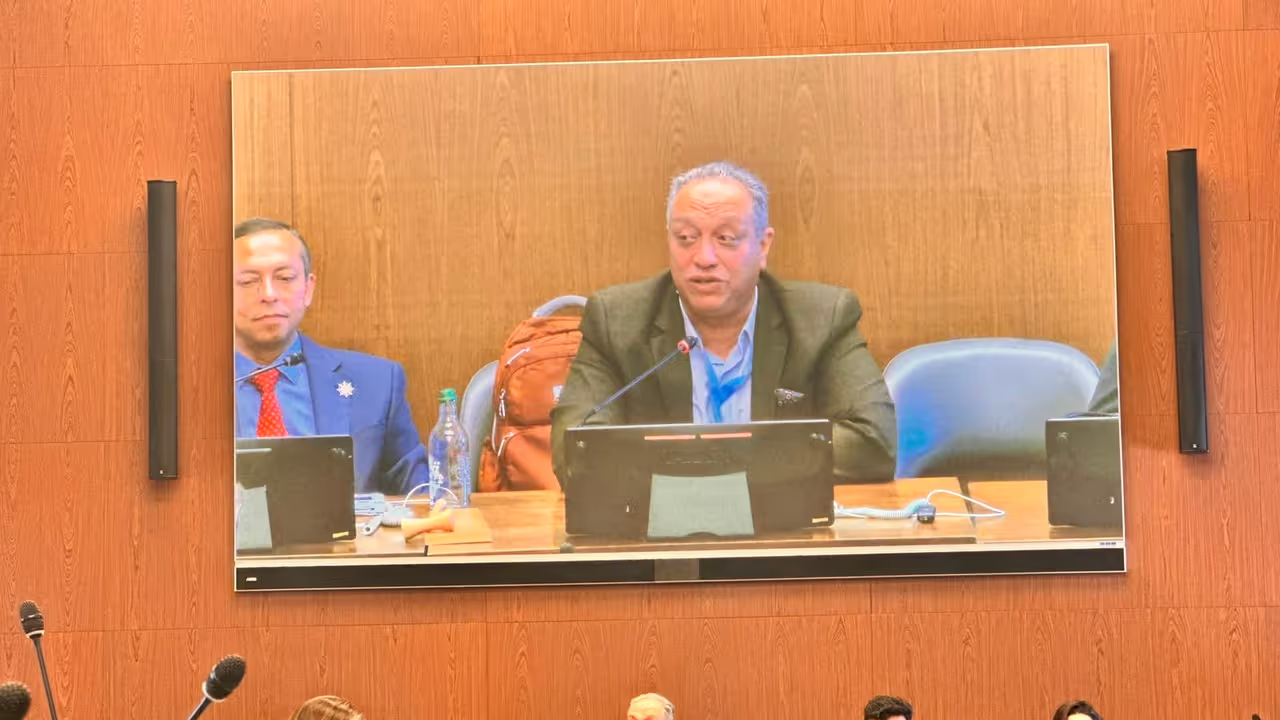
India’s initiatives like the Jal Jeevan Mission and Namami Gange to combat water scarcity were highlighted at a UN Human Rights Council event. Experts cited India's experience in managing transboundary rivers and its focus on cooperation.
India’s efforts to address water scarcity through initiatives such as the Jal Jeevan Mission, Atal Bhujal Yojana and Namami Gange programme were highlighted at a side event of the 63rd Session of the United Nations Human Rights Council here on Monday.
The discussion on “Water Scarcity, Human Rights and Transboundary Water Governance” brought together experts, civil society representatives and youth voices to examine water scarcity, human rights, sustainable development and cooperation over shared water resources.
India's Water Management Models Highlighted
Hansraj Singh of Sambhali Trust highlighted India’s experience of managing rivers across state boundaries, saying the country had built institutions aimed at promoting cooperation rather than competition among states. He cited the Bhakra Beas Management Board, which manages the Bhakra and Pong dams as shared assets for Punjab, Haryana, Rajasthan and Himachal Pradesh, and the Cauvery Water Management Authority, which oversees water releases among riparian states.
The Indira Gandhi Canal, which carries water more than 650 kilometres from Punjab into the Thar Desert, and the Ken-Betwa river-linking project were also cited as examples of India’s efforts to address water distribution and access.
Singh said coverage under the Jal Jeevan Mission had risen from 32.3 million rural households in 2019 to 158.2 million by March 2026.
The Ken-Betwa project is expected to provide drinking water to around 6.2 million people across 13 districts of Bundelkhand, according to the presentation.
Hitansh Singala, Chair of the International Centre for Sustainability, also cited India as a reference case while discussing governance challenges linked to water scarcity. He pointed to the Jal Jeevan Mission, Atal Bhujal Yojana and Namami Gange as major programmes addressing access to water, groundwater management and restoration of the Ganga river system.
Global Context and Call for Cooperation
The broader discussion stressed that water scarcity is not determined by natural availability alone and can be aggravated by poor governance, pollution, inefficient water use, infrastructure gaps and environmental degradation.
Tobias Schmitz, Editor of The Water Diplomat, introduced the concept of “water bankruptcy”, warning that some societies are consuming natural water reserves and ecosystems at a rate that could undermine future water security.
The panel also discussed transboundary river basins, including the Indus and Nile, and stressed the need for data sharing, joint monitoring, technical cooperation, transparent governance and peaceful mechanisms to resolve disagreements.
Participants called for equitable allocation of water, modern infrastructure and irrigation, protection of downstream communities and meaningful participation of affected populations.
The event, convened by the Global Institute for Water, Environment and Health (GIWEH) and co-hosted by the Youth Parliament for SDG and International Eurasia Press Fund, concluded that stronger cooperation over shared water resources is essential for protecting human dignity, livelihoods, food security, health and sustainable development.
(Except for the headline, this story has not been edited by Asianetnews Editorial staff and is published from a syndicated feed.)