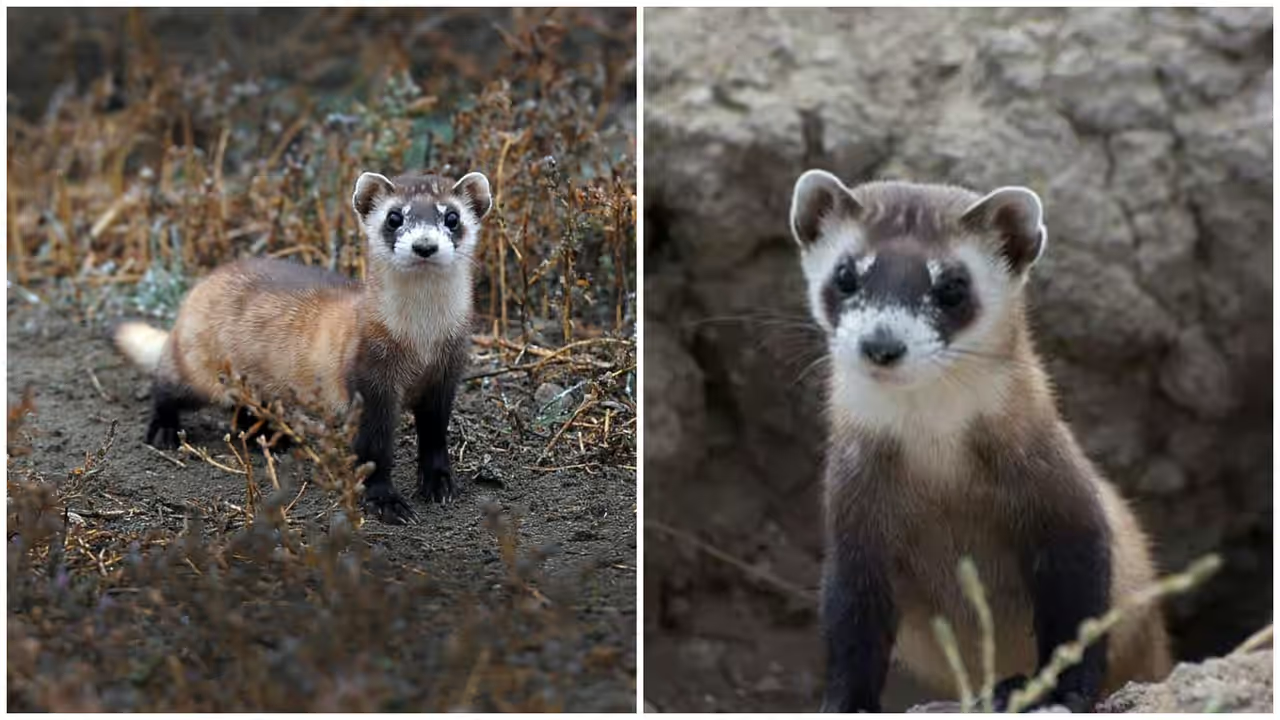
The elusive black-footed ferret, once declared extinct in the wild, has made a remarkable comeback at the Badlands National Park in the US, thanks to decades of painstaking conservation efforts.
The elusive black-footed ferret, once declared extinct in the wild, has made a remarkable comeback at the Badlands National Park in the US, thanks to decades of painstaking conservation efforts. From a mere 18 survivors to a growing population in the wild, the endangered mammal's recovery offers a rare success story in wildlife conservation.
The black-footed ferret's wild population was declared extinct in 1974, leaving wildlife experts fearing that the species had disappeared forever. These tiny, elusive creatures are entirely nocturnal, sleeping for up to 21 hours a day before emerging at night to hunt, feed and care for their young, according to the National Park Service (NPS).
Their survival is closely tied to prairie dogs, which make up the bulk of their diet. However, widespread extermination of prairie dogs by ranchers and farmers severely disrupted the ferrets' food supply, pushing their numbers towards extinction. By 1980, even the captive population was believed to have disappeared, leading scientists to think the species was completely lost.
Related Articles

But an unexpected discovery in 1981 changed the course of their fate.
A farm dog named Shep in Wyoming killed an animal and carried it back to its owners, who subsequently took it to a taxidermist. Recognising the animal as a black-footed ferret, the taxidermist alerted them to its significance. This led to the discovery of a surviving population of around 130 ferrets on the farm, according to the National Park Service.
Wildlife biologists began monitoring the animals closely, but their survival remained precarious. Disease ravaged the population, leaving just 18 of the original 130 ferrets alive by 1987. With the species once again staring at extinction, scientists stepped in and captured the remaining animals, bringing them into captivity for protection and breeding.
Those 18 survivors became the foundation of every black-footed ferret alive today, the NPS said.
Nearly four decades later, conservation efforts have helped the species reclaim parts of its former habitat. After years of breeding and reintroduction programmes across eight US states, Canada and Mexico, black-footed ferret numbers have shown signs of recovery, although the animal remains among the most endangered mammals on Earth.
At Badlands National Park, conservationists introduced 147 black-footed ferrets between 1996 and 1999 in the Conata Basin area. The population gradually flourished, prompting scientists to capture 33 ferrets in 2007 and relocate them to Wind Cave National Park. According to the NPS, around 60 ferrets now live there.
Today, researchers estimate that approximately 120 black-footed ferrets inhabit Badlands National Park, including nearly 80 in the Conata Basin.
However, the road to recovery has been far from smooth.
In 2008, researchers detected sylvatic plague in the Conata Basin, posing another serious threat to the fragile ecosystem. The disease spreads through fleas and can devastate prairie dog colonies, putting black-footed ferrets at risk by threatening their primary food source.
To contain the danger, researchers introduced preventive measures, including vaccinating some ferrets and treating prairie dog burrows with insecticide to control flea populations. These interventions helped reduce the threat to both prairie dogs and their endangered predators.
Given the species' fragile numbers and vulnerability to disease, wildlife biologists continue to closely monitor the Badlands population.
The park is now home to one of the few self-sustaining wild populations of black-footed ferrets, meaning the animals can reproduce naturally without requiring additional ferrets bred in captivity, the NPS said.
Currently, around 280 black-footed ferrets are estimated to live in captivity, while the wild population stands at approximately 200 to 300. However, conservationists believe the species needs a population of nearly 3,000 to achieve full recovery.