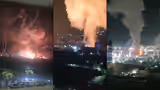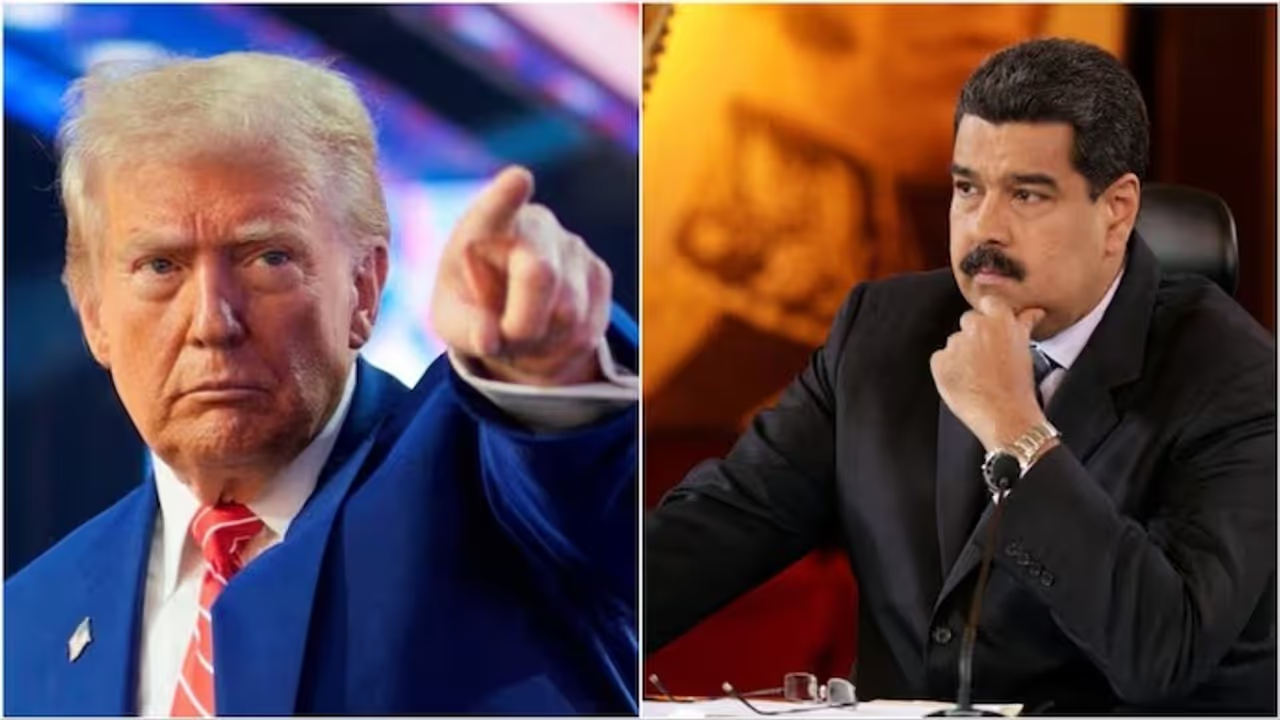
The US conducted a major military operation in Venezuela on January 3, 2026, with Trump announcing the capture of Maduro. The Venezuelan government disputes this claim, demanding proof of life and condemning the strikes as a violation of sovereignty.
On January 3, 2026, the United States carried out a major military operation against Venezuela, marking a dramatic escalation in longstanding tensions between the two countries. According to US President Donald Trump, American forces conducted a “large-scale strike” on Venezuelan territory that resulted in the reported capture of President Nicolás Maduro and his wife, Cilia Flores, who were allegedly taken out of the country soon afterward.
The reported strikes - involving explosions observed in the capital, Caracas, and around key regions such as Miranda, Aragua, and La Guaira - were followed by Trump’s announcement on social media platform Truth Social. He said the operation was conducted “in conjunction with US law enforcement” and framed it as a culmination of mounting pressure on what his administration views as an illegitimate and dangerous regime.
The Venezuelan government has vehemently denied the legality of the strikes and disputed claims of Maduro’s capture, instead demanding “immediate proof of life” for both the president and his wife. Caracas also condemned the US action as a flagrant violation of international law, asserting that the strikes target both civilian and military sites and constitute an attempt to undermine Venezuelan sovereignty.
Background and Context
The US offensive did not occur in isolation but followed months of escalating pressure and prior limited military engagements. Since mid-2025, the United States had deployed significant naval and air forces to the Caribbean region, including the aircraft carrier USS Gerald R. Ford, and conducted military actions against vessels Washington accused of drug trafficking - part of a broader campaign President Trump has described as a fight against narco-terrorism.
Related Articles

Trump’s administration has repeatedly accused Maduro’s government of enabling drug trafficking, designating criminal entities such as the “Cartel de los Soles” as Foreign Terrorist Organizations, despite the latter being disputed by independent analysts and the Venezuelan government. Trump has also linked Venezuela to large-scale migration flows into the United States, arguing that instability and repression in Caracas have driven millions to flee.
Why Now? Motivations and Justifications
According to US authorities, the operation serves multiple stated objectives:
• Countering drug trafficking that officials say fuels the US opioid crisis and regional instability.
• Reducing migrant flows associated with Venezuelan displacement.
• Neutralizing a regime perceived as illegitimate following contested elections.
Critics, however, argue that these justifications mask broader strategic interests, including control over Venezuela’s vast oil reserves and other natural resources, which have long drawn international attention. Some geopolitical analysts contend that the military buildup and actions represent a controversial blend of counter-narcotics policy and geopolitical pressure aimed at regime change.
Venezuela’s Reaction and Regional Impact
In response to the strikes, the Venezuelan government declared a national state of emergency, urging citizens to mobilize against what it terms an imperialist attack. Officials in Caracas assert that the military actions violate the United Nations Charter and threaten peace and stability in Latin America.
The alleged capture of Maduro has triggered uncertainty, with global powers reacting along geopolitical lines. Allies of Caracas, including Russia, Cuba, and Iran, condemned Washington’s actions, while some regional governments called for diplomatic engagement and restraint. International organisations such as the United Nations and the Organization of American States are expected to hold emergency discussions as the situation evolves.
Legal and Ethical Questions
The US military operation raises complex legal and ethical questions. Critics argue that the strikes lack clear congressional authorization and may contravene international norms governing sovereignty and the use of force. Supporters of Trump’s approach have justified the actions under executive powers citing national security imperatives, though details of legal justification remain opaque.
Looking Ahead: What It Means
The 2026 US military action against Venezuela - a bold departure from traditional diplomatic or economic pressure - represents a significant turning point in Western Hemispheric politics. If verified, the reported capture of Maduro could reshape Venezuela’s future governance, regional alliances, and the broader geopolitical landscape. Questions remain about the long-term consequences, including potential civil unrest, refugee flows, impacts on oil markets, and the precedent such intervention sets for international conflict resolution in the 21st century.