
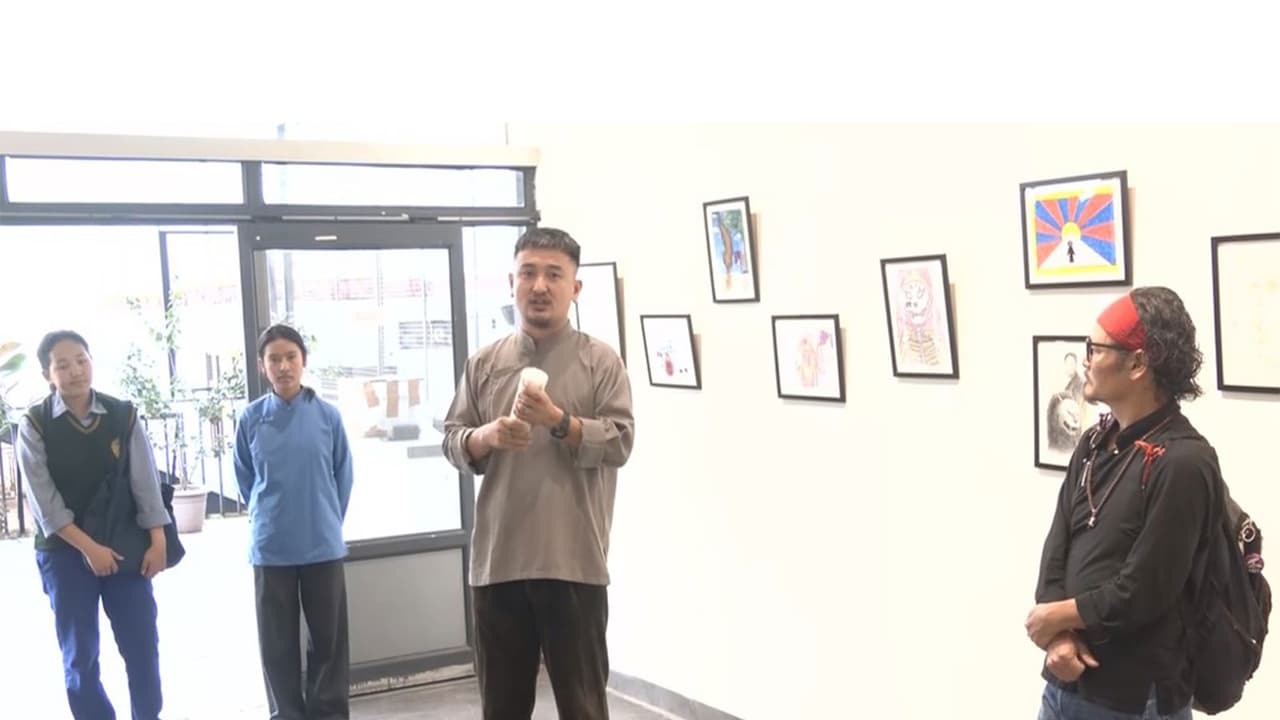
A group of Tibetan students has created a visual tribute of 31 artworks reflecting on the self-immolation of Lobga Rangzen. The exhibition, titled “Our Pawo Pamo: Visual Tribute by Tibetan Youth,” is on display at Dakini House in Dharamshala.
A group of Tibetan students has turned their reflections on the self-immolation of Lobga Rangzen into a visual tribute, with 31 artworks going on public display at an exhibition in McLeod Ganj here. Titled “Our Pawo Pamo: Visual Tribute by Tibetan Youth,” the exhibition opened on Tuesday at Dakini House in Dharamshala and will remain open to the public until mid-October.
The exhibition brings together selected works by students from Upper TCV Dharamshala, Mewoen Tsuglag Petoen School and STS Dholanji, who responded through drawings and visual art to the self-immolation of Lobga Rangzen on July 2, 2026, in front of the United Nations in New York. The exhibition asks a central question: What does “Pawo Pamo”, or martyr, mean to a child?
Art as a Reflection of Loss and Culture
Tenzin, a Class 10 student and one of the participating artists, said her teacher’s request to create a painting on Lobga Rangzen initially made her think of Tibet and the Tibetan national flag. “When my teacher told me that you have to draw something about our martyr Lobga Rangzen, I first thought about our nation and our flag,” Tenzin told ANI.
She said his artwork represents Lobga Rangzen in connection with Tibet and that his death should also be remembered through the way he lived. “I think the end of Lobga Rangzen was not for us to grieve or to be sorrowful about, rather to remember the way he lived,” she said.
Another student, Karma Tsewang, said the incident had been emotionally difficult to witness and influenced her artwork. “I saw the videos of his self-immolation. It was very emotional,” Karma told ANI.
Explaining her painting, Karma said she had depicted Tibet behind Lobga Rangzen and flowers representing heaven. “In our Tibetan culture, if you kill yourself, there is a myth which says you won’t get your human form for at least the next 12 million years,” she said, adding that he viewed Rangzen’s act as being connected to his people and culture. “Killing yourself is a very big step,” Karma said. “I want to request all the world leaders to show their support for us.”
Giving a Platform to the Younger Generation
The exhibition was organised after more than 150 students from the three schools, ranging from Class 5 to Class 12, were invited to create artworks around the theme of Pawo Pamo. From those submissions, 31 artworks were selected for display.
Tashi Nyima, the organiser of the exhibition, said the organisers initially had concerns about discussing self-immolation with children because of the sensitivity of the subject. “When we reached out to schools and asked the kids to draw something on this theme, at that time, we were also a little bit hesitant to speak to children because issues like self-immolation might be sensitive for kids or an emotional topic for them,” Nyima told ANI.
“But then we realised that they are Tibetan kids and they are growing up with these situations. It was not something that they were not aware of,” he said.
According to Nyima, the exhibition was intended to provide young Tibetans with a platform to express how they perceive such events, rather than having the conversation led exclusively by adults. “We have been hearing adults but not much from the child side, so it would be a nice way to show the world how our younger generation feels about it,” he said.
Through their paintings and drawings, the students have presented individual responses to a difficult and deeply personal part of the Tibetan exile experience. (ANI)
(Except for the headline, this story has not been edited by Asianetnews Editorial staff and is published from a syndicated feed.)