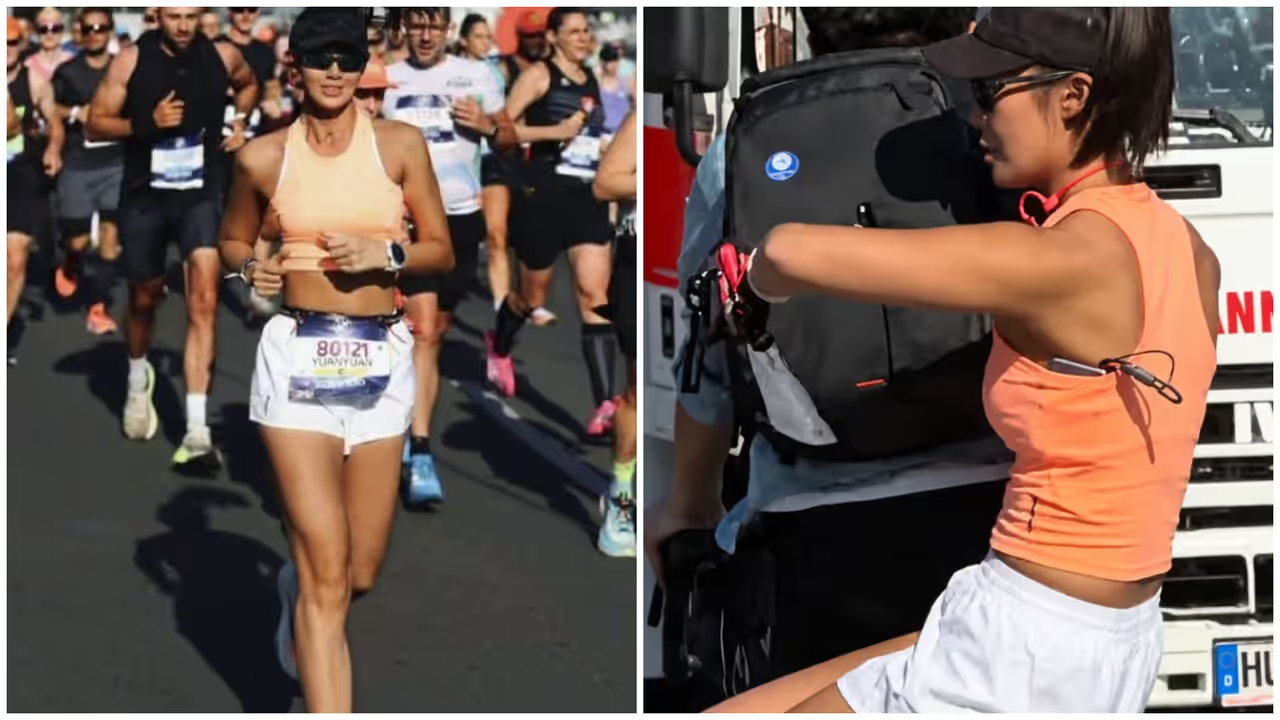
A Chinese fitness influencer has been disqualified from the 2026 Berlin Marathon after photographs allegedly showed her hitching a ride on a bicycle during the 42.2-kilometre race.
A Chinese fitness influencer has been disqualified from the 2026 Berlin Marathon after photographs allegedly showed her hitching a ride on a bicycle during the 42.2-kilometre race. The controversy has also cost her a sponsorship deal, with sportswear brand Brooks confirming that it has terminated its association with the runner.
The incident came to light after the Official Marathon Time Integrity Unit (OMTIU), an Instagram account that flags suspicious race performances, shared photographs of the influencer from the September 27 event. In posts published on October 1, the account pointed out that her fastest recorded time came between the 35-kilometre and 40-kilometre marks, around the time "she was spotted on the back of a bike."
The race bib visible in the photographs was registered to Yuanyuan Sun of China, who initially finished the marathon with an official time of 4:53:46. However, by Wednesday morning, her race results had been updated to reflect her disqualification.
Related Articles

Speaking to CBC News, OMTIU's chief integrity officer said the photograph had been taken by another race participant and subsequently shared with the organisation.
A Berlin Marathon spokesperson told CBC News that they "do not comment publicly on individual persons or specific measures," but explained that participants found guilty of fraud are contacted and disqualified.
"Following a thorough review of each individual case, we decide on appropriate measures and, where necessary, impose further sanctions," the spokesperson said.
Influencer issues apology, admits dishonest behaviour
The influencer, who uses the name Abeeeer on the popular Chinese social media platform Rednote, also known as Xiaohongshu, issued a public apology to her 520,000 followers on Saturday. She admitted violating marathon rules and described her message as a "sincere apology".
Explaining her actions, she said she had been feeling physically unwell during the race. However, she acknowledged that her condition did not justify taking a shortcut.
"My behaviour to take a shortcut was disrespectful to the spirit of the marathon," she wrote in Chinese. "I intentionally concealed this fact during my public sharing after the race. That was a truly dishonest behaviour."
According to multiple media reports, the influencer had previously shared posts claiming to have achieved a personal best (PB) in the marathon. Those posts have since been deleted, leaving her apology as one of the remaining posts related to the Berlin Marathon.
Brooks terminates sponsorship after marathon controversy
The fallout extended beyond the race results, with sportswear company Brooks confirming that it had dropped the influencer following the incident.
In a statement to CBC News on Tuesday, the brand said it had become "aware of the situation involving a Brooks China collaborator and the 2026 Berlin Marathon."
"After verifying the facts, Brooks China terminated its relationship with the individual," Brooks told CBC News in a statement Tuesday. “Brooks believes running should be grounded in integrity, fairness, and respect for competition.”
Marathon cheating: A history of shortcuts and controversies
The 2026 Berlin Marathon attracted more than 56,000 registered runners from 162 countries. Recognised as the flattest course among the Abbott World Marathon Majors, the event is also widely regarded as one of the world's fastest marathon courses. Around 50,000 participants crossed the finish line.
While it remains unclear whether other runners attempted to cut corners this year, course-cutting and other forms of marathon cheating have repeatedly sparked controversy in the sport.
One of the most notorious cases involved Rosie Ruiz, who crossed the finish line first among women at the 1980 Boston Marathon. She was crowned with a laurel wreath, but observers reportedly questioned her performance because she did not appear exhausted.
An investigation later found that Ruiz had joined the race near its end and covered only about the final mile. She had qualified for Boston after reportedly taking the subway for much of the 1979 New York City Marathon.
Another high-profile case emerged in 2011, when Rob Sloan finished third in the gruelling Kielder Marathon in the United Kingdom. He was later exposed for taking a bus for part of the course.
In 2023, Scottish ultramarathon runner Joasia Zakrzewski was stripped of her third-place finish in a 50-mile race after it emerged that she had travelled part of the route in a car.
The same year, the Mexico City Marathon disqualified approximately 11,000 runners for cutting sections of the course. Some participants had allegedly used cars, bicycles and public transport to cover parts of the route.