Bangladesh witnessed fresh political violence after senior NCP leader Motaleb Sikdar was shot in head in Khulna, days after the killing of radical leader Osman Hadi. The attack has raised alarm over law and order ahead of the February 2026 elections
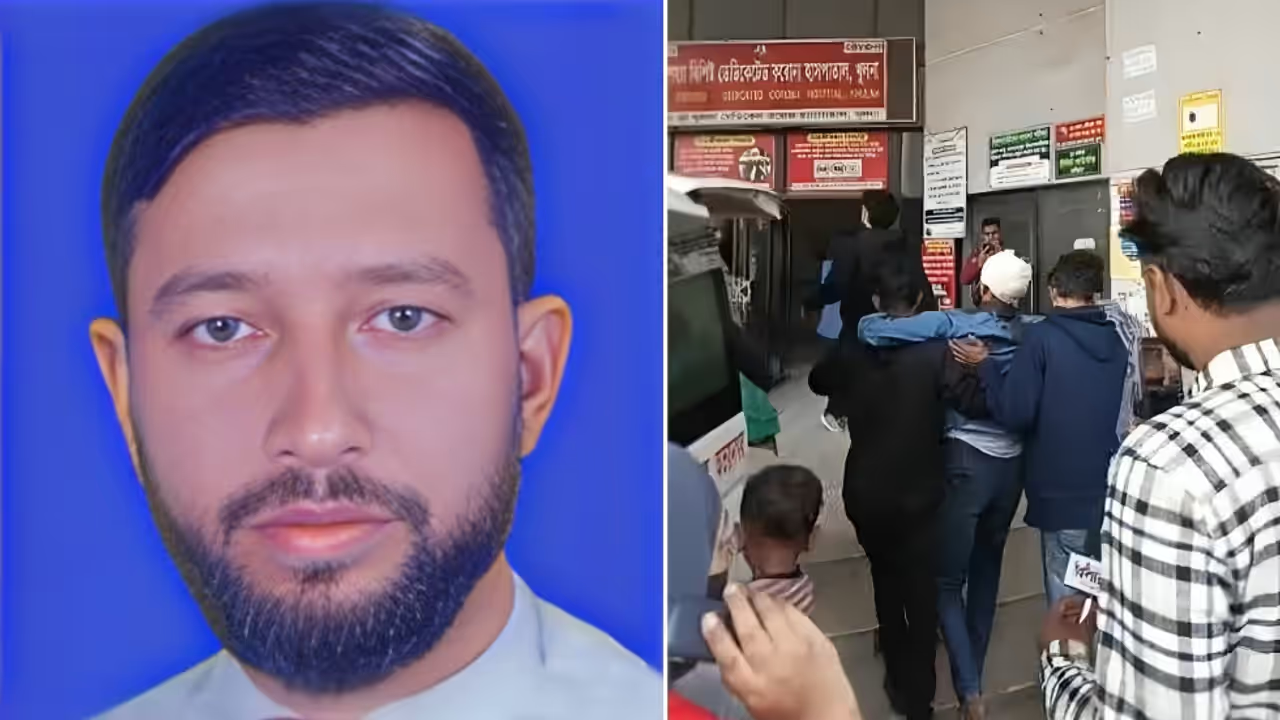
Bangladesh has witnessed another shocking act of political violence just days after the killing of Inqilab Manch spokesperson Sharif Osman Bin Hadi. On Monday, Muhammad Motaleb Sikdar, a senior leader of the student-led National Citizen Party (NCP), was shot in the head by unknown gunmen in Khulna district.
Sikdar survived the attack and is currently undergoing treatment in hospital. The shooting has further heightened fears over law and order, political instability, and safety as the country moves closer to national elections scheduled for February 2026.
The incident comes amid widespread unrest following the death of Osman Hadi, whose killing triggered violent protests across Bangladesh last week.
Related Articles

Who is Motaleb Sikdar
Muhammad Motaleb Sikdar is a central organiser of the National Citizen Party (NCP) and the Khulna divisional convener of its labour wing, Jatiya Sramik Shakti.
According to party officials, Sikdar plays a key role in organising labour movements and political mobilisation in southern Bangladesh. At the time of the attack, he was actively preparing for a divisional labour rally in Khulna, which was scheduled to take place soon.
His shooting marks the second major attack on a political figure linked to recent unrest, raising concerns about targeted violence.
How the shooting unfolded in Khulna
According to Bangladeshi media reports, including Prothom Alo, the shooting took place at around 11:45 am on Monday at a house in the Sonadanga area of Khulna city.
Saif Nawaz, an organiser of the NCP’s Khulna metropolitan unit, confirmed the attack. He said Sikdar was shot while present at the location and sustained a gunshot wound to the left side of his head.
The attackers fled the scene. Their identities and motives remain unknown.
Police confirm attack and medical response
Animesh Mandal, Inspector (Investigation) at Sonadanga Police Station, confirmed the incident, per NDTV's report.
He said Sikdar was first rushed to Khulna Medical College Hospital after the shooting. Doctors later shifted him to City Diagnostic Centre for a CT scan of his head to assess the injury.
Police said Sikdar is currently receiving treatment and further investigation into the shooting is underway. No arrests have been announced so far.
Violence follows killing of Osman Hadi
The shooting comes amid nationwide unrest after the killing of Sharif Osman Hadi, a radical political leader and spokesperson of Inqilab Manch.
Hadi, aged 32, was shot at close range on December 12 while travelling in a rickshaw in Dhaka's Bijoynagar area. Masked gunmen opened fire as he was returning from campaigning for upcoming elections.
After receiving initial treatment in Dhaka, a critically injured Hadi was airlifted to Singapore for advanced medical care. Despite efforts by doctors, he died on December 18.
Who was Osman Hadi
Osman Hadi rose to prominence during Bangladesh's 2024 student uprising, which eventually led to the ouster of former Prime Minister Sheikh Hasina. He was a deeply polarising figure, widely known for his strong anti-India rhetoric and sharp political messaging. His death sent shockwaves across Bangladesh and sparked mass protests by supporters demanding justice.
Protests turn violent after Hadi's death
Following Hadi’s death, large protests erupted across Dhaka and other parts of Bangladesh. While many gatherings began peacefully, several turned violent.
Reports emerged of attacks on media houses and cultural institutions, including two leading newspapers. Multiple waves of protests were reported, especially on Friday, when Hadi's body was brought back to Dhaka.
The unrest raised serious concerns about public safety and the ability of authorities to control crowds during politically sensitive periods.
Journalist warns of law-and-order failure
Senior Bangladeshi journalist Reaz Ahmad, Editor of the Dhaka Tribune, strongly criticised the violence that followed Hadi's death. Speaking to ANI, Ahmad said while public anger and grief were understandable, the violence exposed serious failures by the state.
“Taking that as an excuse, some fringe elements within the massive crowd expressing their grief and sympathies turned extremely violent,” he said.
He stressed that such behaviour should never be tolerated by the state.
Ahmad specifically condemned attacks on media organisations and cultural offices, calling them a 'really bad example' for the country. He said the government could have prevented the situation with better planning and pre-emptive security measures.
“The government would have done a better job had there been pre-emptive measures; we could definitely avoid such developments,” he said.
Press freedom at risk ahead of elections
With Bangladesh's general election scheduled for February 12, Ahmad warned that attacks on the press at this stage could have serious consequences.
He said such violence risks spreading fear among journalists and could weaken freedom of expression during the election period. “If such attacks are meant to actually infect fear among the free press advocates, to some extent the attackers thought that they had been successful,” he said.
However, Ahmad added that strong public support for free media must be matched by firm government action.
Ahmad urged authorities to identify and punish those responsible for the violence. He said only strong and visible action would reassure journalists and citizens alike.
"The state should not tolerate it," he said. “Denouncement is everywhere, but the government has to actually take the law and order situation under complete grip.”
Funeral of Hadi draws large crowds
Osman Hadi’s funeral prayers were held on Saturday and drew a large number of supporters. In line with his family’s wishes, Hadi was buried beside the grave of national poet Kazi Nazrul Islam, a symbolic resting place that further highlighted his influence among supporters.
The violence comes as Bangladesh prepares for national elections in February 2026, with political tensions already running high. Reports of violent protests and attacks on Hindu minorities have added to concerns about security and social harmony.
Bangladesh’s interim chief, Nobel Laureate Muhammad Yunus, who is known to share close ties with the student-led NCP, has been pushing for closer relations with Pakistan, while distancing Bangladesh from India.
Radical Islamic elements within the NCP, which emerged from the violent protests that followed Sheikh Hasina’s ouster last year, have continued to make provocative anti-India statements.
After the attack on Hadi, an NCP leader claimed Dhaka would shelter forces hostile to India and help cut off India's 'Seven Sisters', referring to the country’s northeastern states.
"Seven Sisters will be separated from India," NCP leader Hasnat Abdullah said at a protest rally.
India rejects allegations
India firmly rejected the allegations, with the Ministry of External Affairs dismissing claims that India backed those accused of violence.
“We expect that the interim government of Bangladesh will take all necessary measures for ensuring internal law and order, including for the purpose of holding peaceful elections,” the ministry said.
The shooting of Motaleb Sikdar has deepened fears that Bangladesh is entering a dangerous phase of political violence ahead of crucial elections. As attacks on leaders, journalists, and institutions increase, pressure is mounting on authorities to restore order, protect democratic values, and ensure that the coming polls take place without fear or bloodshed.
(With ANI inputs)