Cambridge Dictionary has named 'human' its Word of the Year 2026, reflecting growing debate about people's identity and value as AI becomes more capable. The dictionary has noted the rising use of terms such as 'human-written' and 'human-made'.
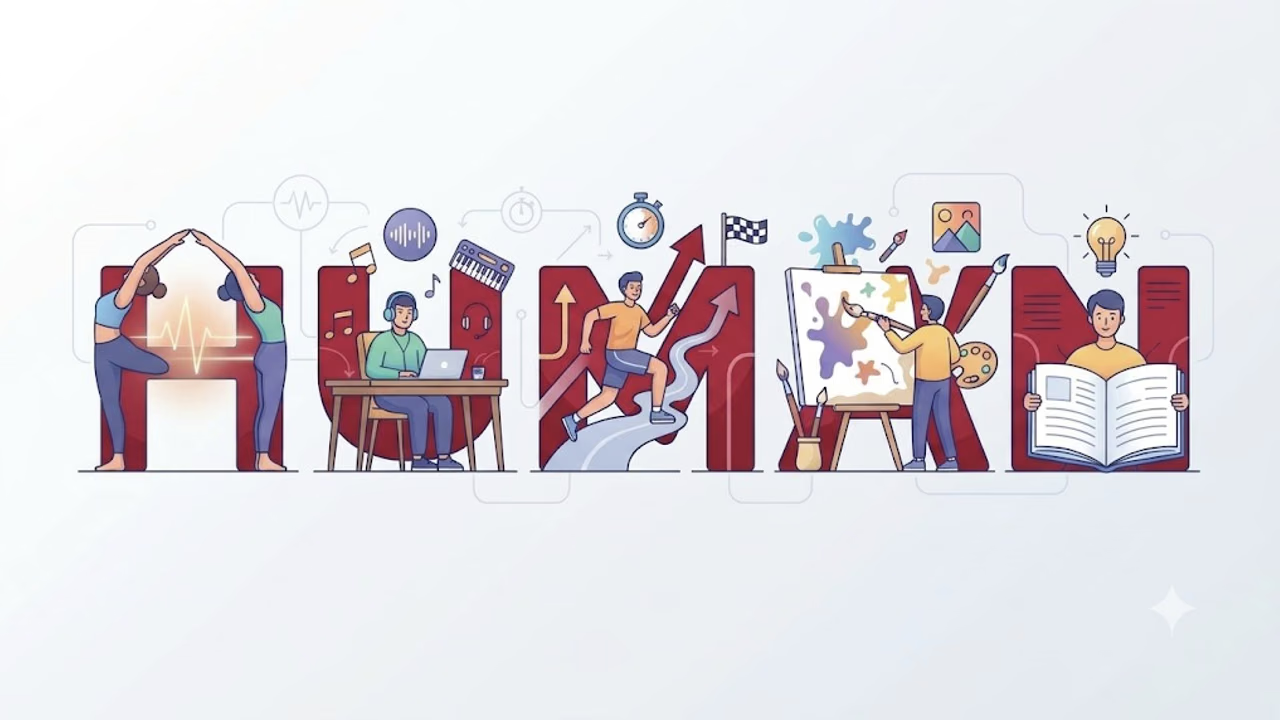
A handwritten letter, a song composed by a person, a painting created by an artist, a photograph captured without artificial intelligence or a story written from someone's own imagination - all of this has always been described as human creations. But in a world where machines can increasingly produce similar work, the word 'human' is beginning to carry a different significance.
The Cambridge Dictionary has named 'human' its Word of the Year for 2026, reflecting growing public debate about what separates people from increasingly capable artificial intelligence (AI) systems. The choice comes at a time when AI tools are being used to write, create images, produce music, answer questions and perform tasks that once required human involvement. As the technology becomes part of everyday life, people are also asking what they might lose by relying on it too much.
Why has Cambridge Dictionary chosen 'human'?
Cambridge Dictionary defines 'human' as having the qualities, faults and feelings that people have, as opposed to gods, animals or machines.
Related Articles

The word itself is not new, obviously. What has changed is the way people increasingly use it to distinguish something created by a person from something produced by AI.
The dictionary has observed a rise in expressions such as 'human-written', 'human-generated' and 'human-made'. These terms are becoming useful ways of telling people that a piece of writing, an image or an object has been created by a person rather than an artificial intelligence system.
This shift in language is significant. Until recently, people rarely needed to specify that a book was written by a human or that a piece of artwork was made by a person. Human creation was generally the default. With AI now capable of producing convincing content, that distinction is becoming more important.
Cambridge lexicographer Colin McIntosh said the renewed interest in what it means to be human had captured the mood of the year.
He also pointed to concerns about what people could lose by outsourcing their thinking to machines, including their ability to create, reason and make decisions independently.
When AI can write, paint and imitate people, what remains uniquely human?
One of the biggest questions surrounding AI is whether technology can reproduce the qualities that make human expression meaningful.
AI can generate a poem, but can it understand the personal experience behind the words? It can produce a painting in seconds, but does that give it the same relationship with the subject as an artist who has spent years developing a style? It can imitate a voice, but that does not mean the person has actually spoken those words.
These questions have become more pressing as AI-generated images, videos and audio become increasingly realistic.
The problem is not limited to creative work. Deepfakes can imitate real people's faces and voices, making it harder to distinguish genuine recordings from fabricated ones. Actors and musicians have also raised concerns about their work and identities being used to create AI-generated copies without permission.
Cambridge highlighted the concerns raised by public figures, including actors Scarlett Johansson and Cate Blanchett, as well as musicians and authors who have challenged the use of human-created work to train AI systems.
Actor Matthew McConaughey and singer Taylor Swift have also taken steps to protect aspects of their voices and images against unauthorised digital reproduction.
The growing use of labels such as ‘human-authored’ reflects a related concern: people want to know whether the work they are reading, watching or listening to comes from an actual person.
The growing appeal of doing things without screens
Interestingly, the focus on being human is also reflected in people's interest in activities that do not involve digital technology.
Cambridge included ‘analogue’ among its other Word of the Year contenders. The word traditionally refers to technology that is not digital, but it is increasingly being used to describe screen-free experiences.
Reading a printed book, knitting, listening to vinyl records or spending time on an activity without looking at a screen are all examples of the broader analogue lifestyle.
This interest suggests that even as technology becomes more advanced, some people are looking for ways to slow down and reconnect with simple experiences.
Other shortlisted words included ‘agent’, referring to an AI system that can operate with a degree of independence and make decisions without constant human control, and ‘wholesome’, which describes something good for a person's physical, moral or emotional well-being. 'Chic' was also among the words listed in the shortlist.
The inclusion of ‘agent’ is particularly interesting because it reflects another major change in AI. The technology is moving beyond answering questions and generating content towards systems that can carry out more complicated tasks with less direct human involvement.
Is the world beginning to value the human touch differently?
The choice of ‘human’ is not necessarily a rejection of AI. Artificial intelligence can help people work faster, explore ideas, improve services and solve problems. Its usefulness is already visible across education, healthcare, business and creative industries.
However, the growing debate is about how much control people should hand over to machines and which activities should continue to involve human judgement.
A machine may be able to produce an answer quickly, but people still need to decide whether that answer is fair, accurate or appropriate. Technology can assist with creative work, but questions about originality, ownership and responsibility remain.
University of Cambridge experts have also highlighted the importance of deciding what society wants to preserve as AI develops. The future of the technology, they argue, is not simply something that must happen in one particular way; people and institutions still have choices to make.
That may be the deeper meaning behind Cambridge Dictionary's selection.
The word ‘human’ has always described people. But in 2026, it has also become a way of asking what people want to protect about themselves.
As machines become better at doing things that once seemed uniquely human, the value of creativity, emotion, judgement and genuine connection is receiving fresh attention. The question is no longer just what AI can do. It is also what people want to keep doing for themselves.