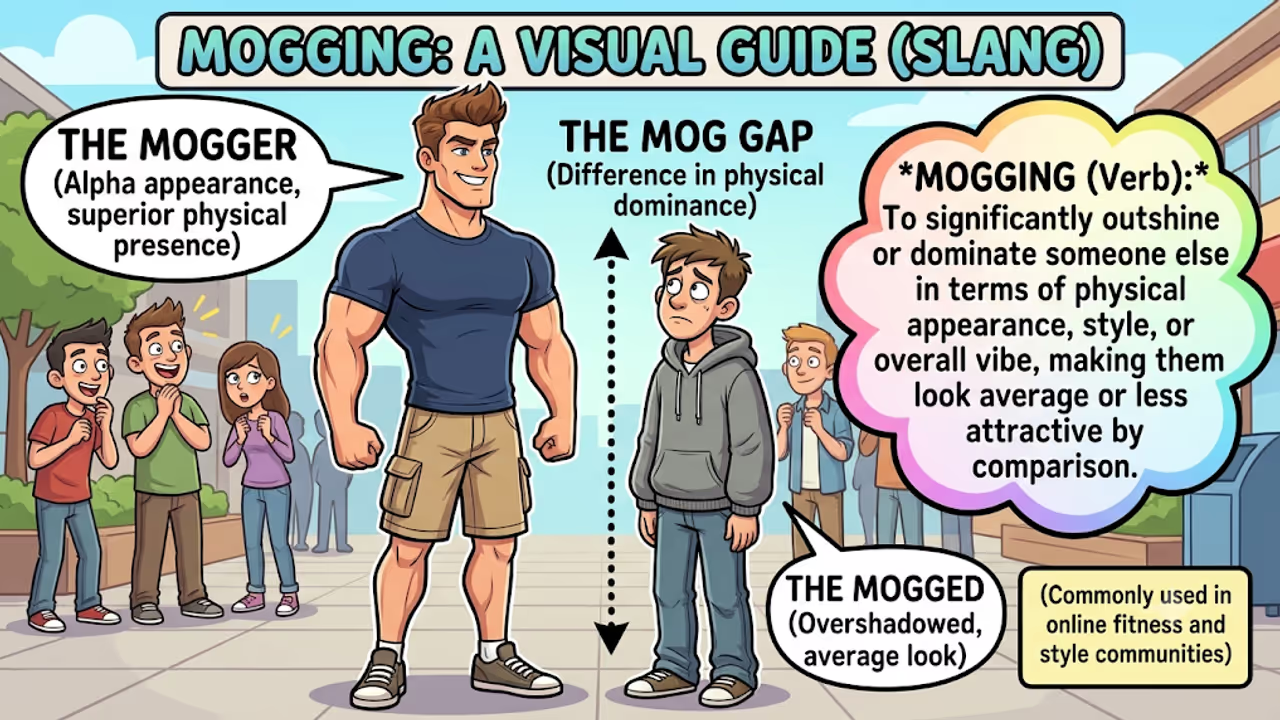
Collins Dictionary has named 'mogging' its Word of the Year for 2026. Popular among Gen Z and Gen Alpha, the slang term means outshining or outperforming someone or something. The word's recorded usage reportedly increased by 210% in 2026.
KNOW
Collins Dictionary has named 'mogging' its Word of the Year for 2026, bringing an internet slang expression associated with physical appearance, confidence and social status into the spotlight. The term, increasingly used by Gen Z and Gen Alpha, describes the act of outshining, outperforming or making someone or something appear less impressive by comparison. While the word was initially associated with male-dominated online communities and discussions about physical dominance, its meaning has considerably expanded. Younger internet users now use it in playful and ironic conversations about almost anything, from fashion and fitness to sports, music, food, technology and everyday achievements.
Announced on November 3, the selection reflects how internet culture continues to influence everyday English. What once referred largely to comparisons between men's physical appearances has evolved into a flexible expression for describing anything that manages to steal the show.
But what exactly does mogging mean, where did it originate, and how can you use it correctly in everyday conversations?
Related Articles

What does mogging mean?
According to Collins Dictionary, 'mogging' is a slang noun that means the act of outshining or outperforming someone or something.
In simple terms, if someone does something considerably better than another person, they can be said to have mogged them. The person or thing being outperformed is described as having been mogged.
The comparison can involve physical appearance, clothing, confidence, fitness, wealth, talent, intelligence or performance. It is no longer restricted to comparing two people's looks.
For example, imagine two friends attending a wedding. Both arrive dressed for the occasion, but one wears an exceptionally stylish outfit that attracts everyone's attention. The other might jokingly say, "You completely mogged me tonight."

Similarly, a brilliant singer can mog the other performers at a concert, a restaurant's dessert can mog its main course and a new smartphone can mog an older model.
The central idea remains the same: one person or thing stands out so much that the other looks less impressive in comparison.
Why has Collins chosen mogging as its Word of the Year 2026?
Collins selects its Word of the Year based on language trends and evidence of changing word usage. Its lexicographers monitor how expressions appear across different sources, including newspapers, websites and social media.
According to reports, the recorded use of 'mogging' increased by 210% in 2026. The expression has moved beyond specialist online communities and become increasingly visible in everyday conversations, particularly among younger generations.
Collins managing director Alex Beecroft said the selection demonstrated how each generation leaves its mark on language. He described mogging as an example of how Gen Z and Gen Alpha have adopted an expression and transformed it into humorous slang.
The choice does not mean that everyone is expected to know or use the word. Rather, it recognises a noticeable change in how people communicate, particularly online, where expressions can spread quickly and acquire new meanings.

Collins' language research draws on its 27-billion-word corpus, a large collection of written and spoken language material used to examine how English evolves. However, an increase in recorded usage should not be confused with a survey showing how many people use the expression in their daily lives.
Where did the word mogging come from?
Although mogging has become popular among younger internet users in 2026, the expression has been around for several years.
Collins traces its origin to the slang noun 'mog', meaning a dominant male. The word is believed to be a shortened form of AMOG, an acronym for "alpha male of the group".

The expression reportedly emerged around 2016 in bodybuilding culture, where men compared their physical size, muscular development and overall appearance. Someone who appeared physically stronger or more dominant than the others could be described as an AMOG.
The term later spread through online communities associated with the so-called manosphere. This is a broad network of internet forums, websites and social media groups discussing masculinity, relationships and male status. Some of these communities promote misogynistic ideas and rigid hierarchies based on physical attractiveness and dominance.
In those earlier settings, mogging often carried a more competitive and sometimes hostile meaning. It was used to suggest that one man was physically or socially superior to another.
Over time, however, the expression moved into wider internet culture. Younger users began applying it to situations that had little to do with physical appearance or male dominance.
Today, someone can be mogged by a friend's cooking, a colleague's presentation or even a particularly impressive photograph.
The original associations have not disappeared entirely, particularly in appearance-focused online communities. However, the broader use of the word is often humorous, exaggerated or self-deprecating.
Is mogging a noun or a verb?
Collins lists "mogging" as a noun, defining it as the act of outshining or outperforming someone or something.
However, the expression is also commonly used in different grammatical forms in everyday online conversations.
Mog: Used as a verb to describe outshining someone. For example, "She mogs everyone in the gym."
Mogging: Used as a noun or as a verb form. For example, “His performance was pure mogging.”
Mogged: Used when someone has been outperformed or overshadowed. For example, "I got mogged by my younger brother."
The expression can also be attached to other words to describe a particular kind of comparison. Terms such as "stylemogging" and "carmogging" can be used to describe situations in which someone's style or car outshines another's.
The grammar is relatively straightforward. If someone or something is doing the outshining, they are mogging. If they are on the receiving end, they have been mogged.
How to use mogging in sentences: 6 examples with meanings
Mogging has become popular partly because it can be used in different situations without changing its basic meaning. Here are six everyday examples that explain how the word works.
1. When someone looks better than everyone else
Imagine attending a party where everyone has dressed well, but one person arrives in an exceptionally stylish outfit.
Example: "Priya was mogging everyone at the party with that stunning black dress."
Meaning: Priya's appearance and outfit stood out so much that everyone else looked less impressive by comparison.
2. When a friend performs better in sports
Suppose two friends play badminton. One manages to win every rally with powerful shots and impressive footwork.
Example: "Rahul completely mogged me on the badminton court today."
Meaning: Rahul played much better and clearly outperformed his friend.
3. When someone's food is better than yours
Imagine two colleagues bringing homemade cakes to the office. One has baked a beautifully decorated chocolate cake, while the other's attempt has not turned out quite as expected.
Example: "Her chocolate cake mogged mine. I am never bringing my baking to work again!"
Meaning: Her cake was considerably better, making the other person's effort look less impressive.
4. When a colleague steals the show at work
During an office presentation, several employees share their ideas, but one colleague delivers an exceptionally impressive presentation.
Example: "Ananya mogged the entire team with that brilliant presentation."
Meaning: Ananya's performance was so impressive that it overshadowed the contributions of the other team members.
5. When a new product outperforms an older one
A technology company launches a smartphone with a better camera, longer battery life and improved features than its previous model.
Example: "The new phone absolutely mogs its predecessor."
Meaning: The latest model is significantly better than the older version.
6. When someone jokingly admits defeat
Two friends share photographs from their holidays. One posts ordinary beach pictures, while the other shares stunning photographs of mountains, waterfalls and sunsets.
Example: "I thought my holiday pictures were good until I saw yours. I have been completely mogged!"
Meaning: The speaker admits, in a humorous way, that the other person's photographs are much more impressive.
These examples show that mogging does not always have to be an insult. It can express admiration, friendly competition, playful embarrassment or even self-deprecating humour.
Is mogging always about physical appearance?
No. Although the expression originally gained attention through comparisons involving physical appearance and dominance, its current meaning is much broader.
In appearance-focused online conversations, mogging is often used to compare someone's height, facial features, physique, fitness or overall attractiveness with another person's.
However, younger users have extended the expression to almost every kind of competition.For instance:
Fashion: Someone wearing a particularly impressive outfit can mog everyone else at an event.
Fitness: A person lifting heavier weights or displaying greater physical strength can mog others at the gym.
Entertainment: A singer delivering an outstanding performance can mog the other artists on stage.
Food: A restaurant's dessert can mog its main course if it turns out to be the highlight of the meal.
Technology: A new laptop with better features and performance can mog an older model.
Lifestyle: Someone's travel experiences, home renovation or personal achievements can be described as mogging others.
The important distinction is that mogging involves a comparison. Simply doing something well is not necessarily mogging. The expression becomes relevant when someone's performance or appearance makes another person or thing seem less impressive.
Is mogging the same as looksmaxxing?
Although the two expressions are often associated with the same internet culture, they do not mean the same thing.
Looksmaxxing refers to efforts to improve or maximise one's physical appearance. These efforts can range from ordinary grooming, skincare, exercise and dressing well to more extreme appearance-related practices promoted by certain online communities.
Mogging, on the other hand, describes the act of outshining or outperforming someone through comparison.
For example, a person following a fitness routine and improving their appearance could be described as looksmaxxing. If that person subsequently appears more physically impressive than someone else, the comparison might be described as mogging.
The distinction is simple: looksmaxxing is about improving one's appearance, while mogging is about being ahead of someone else in a comparison.
The two expressions have also become part of a wider collection of internet slang centred on self-improvement, appearance and social status.
Interestingly, Dictionary.com selected 'maxxing' as its Word of the Year for 2026, announced on October 27. The word refers to the practice of maximising or optimising something, and is used in expressions such as looksmaxxing.
Does mogging have a negative meaning?
The meaning depends largely on the situation and the way the word is used.
Among friends, saying someone has mogged everyone at a party can be a compliment. It may simply mean that the person looked particularly good or attracted attention.
Similarly, someone saying they were mogged by a friend's cooking or sporting performance may be making a light-hearted admission that the other person did something better.
However, the word can also be used to mock, embarrass or humiliate someone.
This is particularly relevant when the comparison involves physical appearance, body size, facial features or attractiveness. Repeatedly telling someone that another person has mogged them can create unnecessary competition and affect their confidence.
Its earlier associations with online communities that ranked men according to physical dominance and attractiveness also explain why the term can carry a harsher meaning in certain conversations.
Therefore, understanding the context is important. A friendly joke between two people is different from using the same expression to deliberately make someone feel inferior.
The popularity of slangs amongst Gen Z and Gen Alpha
The popularity of mogging reflects a wider trend in which younger generations take expressions from online communities and give them new meanings.
Social media platforms allow slang to travel quickly between countries, age groups and communities. A word that initially has a specific meaning in a small online group can gradually become part of everyday conversations.
Mogging is an example of this process. Its earlier association with physical dominance has expanded into a general expression for outshining someone or something.
The word's popularity also reflects how internet conversations often turn ordinary situations into exaggerated competitions. A beautifully prepared meal, an impressive outfit or a successful presentation can all become opportunities to declare that someone has been mogged.