Tech giants are rolling out layered security — from selfie age scans to behaviour tracking — to block under-16s under Australia’s new social media ban, but accuracy fears, privacy issues and teen workarounds loom.
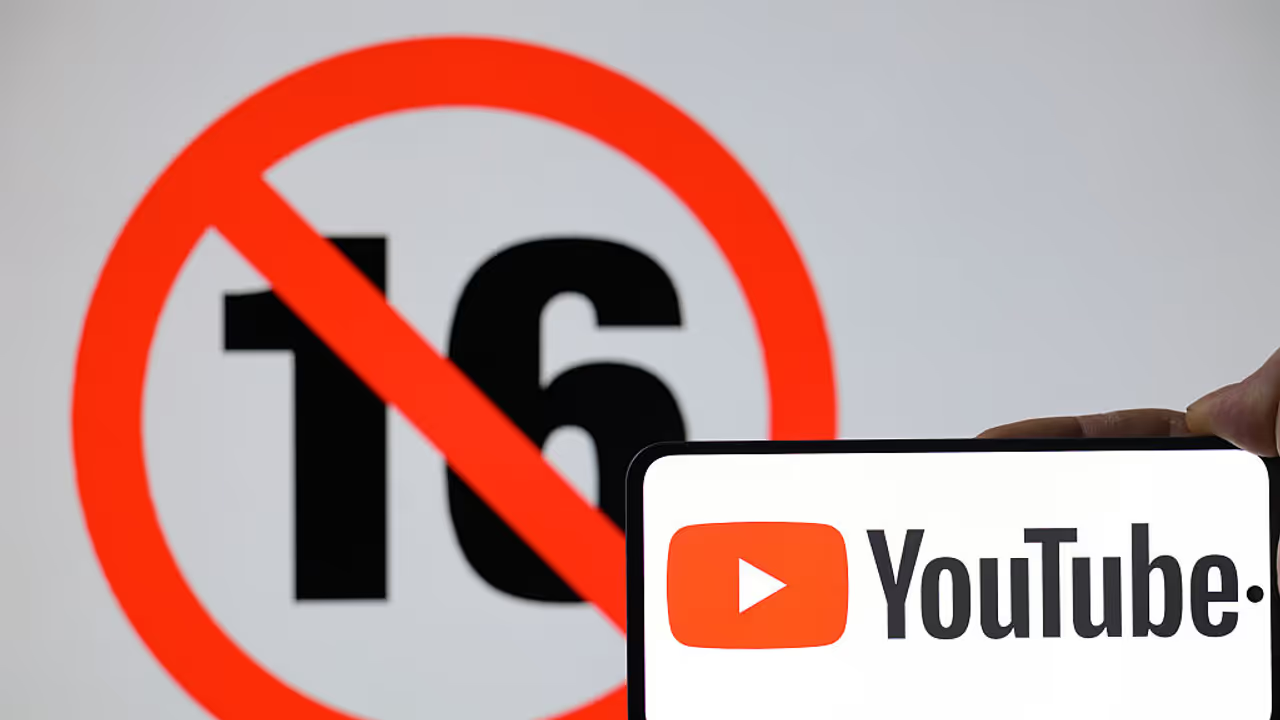
Tech giants will apply multiple layers of security to weed out young users under Australia's world-first ban on social media for under-16s. If they fail to take "reasonable steps" to block young teens, the firms behind platforms such as Instagram, TikTok and YouTube face hefty fines.
Here are the main methods they're turning to as the law takes effect Wednesday:
ID please
It sounds simple: scan your passport, driver's licence or other official ID to prove you are aged 16 or over.
Related Articles

But beyond the potential for teens to use a parent or older sibling's ID, this raises privacy concerns that could scare off people legally allowed to hold an account.
So Australia has told social media platforms they cannot require users to show a government ID -- even if a dispute arises over someone's age.
Some platforms are employing third-party services to make the process smoother for users who choose to certify their date of birth this way.
For example, Snapchat account holders can prove their age through an Australian bank account, or by providing ID to the Singapore-based age verification service k-ID.
"The documents you submit will only be used to verify your age," Snapchat's parent company Snap says.
"Snap will only collect a 'yes/no' result on whether someone is above the minimum age threshold," it explains.
Selfie time
Snapchat users can also take a selfie that k-ID will use to estimate their age -- another verification technology now in the spotlight.
Meta, which owns Instagram and Facebook, has tasked a different company, the London startup Yoti, to handle its ID and selfie age checks.
Over time, "the algorithm got very good at looking at patterns and working out, 'this face with these patterns looks like a 17-year-old or a 28-year-old'", Yoti CEO Robin Tombs told AFP.
Yoti's AI can estimate someone's age within a minute.
The firm, which TikTok also uses for age checks, says its tool should know if the person behind the camera is real, and not a photo or video.
Yoti removes all data after digitally analysing a face, Tombs said.
But there are concerns over false results if the selfie-taker is very close to 16 years old, or finds new ways to fool the system.
Behaviour patterns
Not every Australian user will have to prove their age -- only those suspected of holding an underage account.
Meta has already started deactivating accounts based on information such as the age given when they were created.
With so much data at their fingertips, social media platforms have several other ways of estimating a user's age.
These range from the content consumed -- a teen is more likely to search for gaming tips than how to descale a showerhead, for instance -- to a quieter period during the school day.
Birthday greetings from friends that include someone's age could also be a giveaway, or if a user's email address has been used in the past for typically grown-up tasks.
Such signals are already used by social media companies to target their online advertising.
But here, too, there are privacy and accuracy concerns.
‘Waterfall’
Australia's eSafety Commissioner, Julie Inman Grant, has said that using "a waterfall of effective techniques and tools" can help avoid errors and mitigate privacy worries.
The country expects rebellious teens will do their best to skirt the laws, with platforms expected to devise their own means to stop this.
"Of course, no solution is likely to be 100 percent effective all of the time," the internet safety watchdog has said.
Andy Lulham of the age-check tech company Verifymy said there would be challenges.
"Age estimation methods may not always successfully pass every user, especially those who have just turned 16 but don't have -- or want to use -- identification," he said.
“In those cases, a responsible adult may be required to vouch for a child's eligibility.”
(Except for the headline, this story has not been edited by Asianet Newsable English staff and is published from a syndicated feed.)