
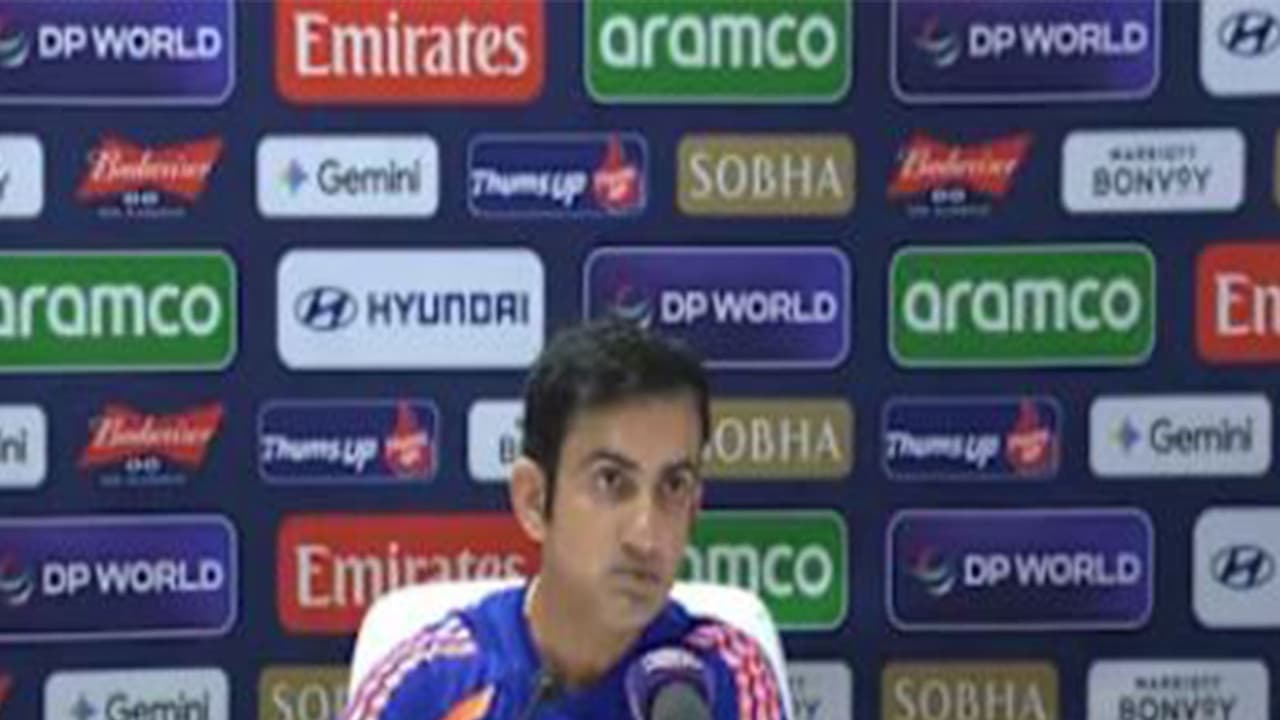
Head coach Gautam Gambhir attributed India's adjusted batting tempo in the T20 World Cup to the lack of dew, contrasting it with bilateral series. He praised the team for adapting to the situational pressure and challenges of the tournament.
Following India's win over West Indies in the final Super Eight clash of T20 World Cup for the last semifinal slot, head coach Gautam Gambhir said that lack of dew during their World Cup campaign so far as compared to bilateral series has led to their players not scoring on sky-high strike rates, which had become a key part of Men in Blue's batting approach leading up to the tournament.
Team India continued its fine run in the T20 World Cup, making it to the semifinals with wins over Zimbabwe and West Indies after a brief, but humiliating stutter against South Africa in Super Eights. One thing that has stood out about this tournament is how the Men in Blue have batted with different tempos throughout the tournament. In their seven-match run so far, they have crossed the 200-run mark only twice. While there were expectations of them touching the 250-300 run mark in the tournament, they could only do so once, scoring 256/4 against Zimbabwe.
Gambhir on Batting Approach and World Cup Pressure
Speaking during the post-match presser, he pointed out how bilaterals and World Cups differ in terms of challenge, pressure, competitiveness and the time in hand to stage a comeback. He also said that, keeping in mind the lack of dew throughout the WC campaign, the team played as per the situation and did their job at that really well.
"One thing is very clear that the bilateral are very different to World Cups. The pressure is different, the competition is different, obviously the stakes are much higher as well, bilaterals you got the time to make a comeback, but in World Cups you don't have a time to make a comeback and more importantly - yes people can talk about it that they expect us to play the same brand of cricket what we played in the bilaterals as well. But you can imagine the pressure the boys go through, especially most of the games are must win games as well. And sometimes wickets can be tricky as well," he said.
"During the bilaterlas as well - there were a lot of dew in the second innings as well, but we did not see a lot of dew during this World Cup campaign. So I felt that it was not only about the strike rate, it is about reading the game properly and obviously reading the situation as well. And that is something that is going to be important and the guys did that really well. Even today you saw they were chasing 195. We never felt that we were out of the game. Never ever did we felt in 20 overs that the chase was away from us. So the guys kept in control. Yes, there were times in bilateral where we could chase the target in 16, 17 overs, but this is World Cup. And the pressure is different, and the quality is different as well," he added.
On Jasprit Bumrah's Strategic Use
Gambhir also opened up on different strategies of using star pacer Jasprit Bumrah, who went from getting plenty of powerplay bowling during the Asia Cup last year to being utilised a lot during the death overs in this tournament. In this match too, he got only one over in the powerplay, and rest three came in the second half of the innings. Gambhir said that this is down to the opposition and where their "firepower" lies and with West Indies having a lot of such fiery batters in their middle order, tIndia needed Bumrah to bowl during the middle and death overs. Spinner Axar Patel sent down two overs in the powerplay, conceding 15 runs and Hardik (10 runs in solitary powerplay over) chipped in with one over in the powerplay, with Arshdeep Singh bowling two as well.
"And I thought Hardik (Pandya) did a really good job because sometimes bowling against these guys on this kind of a wicket, your fifth bowler, actually can always be under pressure. Hardik and Axar, I thought, controlled the game for us because those eight overs were very crucial. We knew that Arsh, Bumrah and Varun were always about to bowl their four overs. So I thought that for me today I think the most important thing was how Hardik and how Axar bowled. Yes, we can keep talking about other three bowlers but that is the reason why we felt that Bumrah was important in the middle. So every time we have a big over, we can go back to Bumrah and try and control the game. Because you don't want in a T20 game two back-to-back big overs as well. That can take the game away from you. So for me, I think Bumrah is a banker and we'll continue to use him in different ways," he concluded.
Match Summary: India vs West Indies
Coming to the match, India won the toss and elected to field first.
West Indies Innings
Roston Chase (40 in 25 balls, with five fours and a six) and skipper Shai Hope (32 in 33 balls, with three fours and a six) put on an opening stand of 68 runs for first wicket, but WI slipped to 119/4 in 14.1 overs, despite a fiery cameo by Shimron Hetmyer (27 in 12 balls, with a four and two sixes). It was the pair of Jason Holder (37* in 22 balls, with two fours and three sixes) and Powell (34* in 19 balls, with three fours and two sixes) who put on a fiery stand of 76 runs in 35 balls, taking WI to 195/4 in 20 overs. Jasprit Bumrah (2/36 in four overs) was India's leading bowler, with Varun Chakaravarthy and Hardik Pandya dropping a spell of 1/40 in four overs each.
India's Run-Chase
In the run-chase, India was reduced to 41/2 within the powerplay. It was a 58-run stand between Samson and Suryakumar Yadav (18), which brought the chase back on track. Then Sanju went on to stitch partnerships with Tilak Varma (27 in 15 balls, with four boundaries and a six), Hardik Pandya (17) and Shivam Dube (8*), taking India to a five-wicket win. (ANI)
(Except for the headline, this story has not been edited by Asianet Newsable English staff and is published from a syndicated feed.)