Shubman Gill’s technical overhaul has boosted his Test game but blunted his T20 firepower, leaving India’s young vice-captain juggling formats, pressure, and the hunt for powerplay dominance.
Shubman Gill finds himself at a fascinating — and demanding — juncture in his career. The gifted opener, celebrated for his immaculate stroke-making and calm authority, is now navigating a tricky shift across formats that has subtly reshaped his batting identity. As India looks toward its next all-format leader, Gill is learning that evolution in one format can quietly unsettle another.
A Test Giant, A T20 Puzzle
Gill’s Test renaissance has been nothing short of remarkable. His first series as Test captain produced a tally of 754 runs, firmly establishing him as the team’s modern-day anchor. Yet, in the shortest format, the same refined technique hasn’t produced fireworks.
Despite being elevated to India’s T20I vice-captaincy — a clear nod toward long-term leadership — Gill’s numbers in 2025 tell a different story. Across 13 T20Is, he has scored 263 runs off 183 balls, striking at 143+, but managing only four sixes, just two of which came in the powerplay.
Related Articles

And comparisons are inevitable. Beside him, close friend and opening partner Abhishek Sharma has exploded with 773 runs in 18 matches, striking at 188.5 with 48 sixes.
Where Abhishek is thriving in India’s “attack-at-all-costs” T20 blueprint, Gill seems caught between instinct and adaptation.
Walking Into Sanju Samson’s Space
Gill has also been shoehorned into a role Sanju Samson was thriving in just a season ago, when he notched three international hundreds. The shift may be strategic for Indian cricket’s future, but it adds another layer of pressure — stepping into a spot previously occupied by a fully established T20 performer.
The result? Gill is learning how difficult it is to be a Test technician one week and a powerplay aggressor the next.
The Technical Shift Behind the Contrast
A former NCA coach, who has also been involved with IPL batting groups, elaborated on the core of Gill’s challenge — the change in his stance and bat path.
“When Gill burst into the international scene in 2019 till the last Border-Gavaskar Trophy, if one revisits most of his flamboyant knocks in white ball cricket, one is likely to witness that his bat is angled towards third slip or gull from where it is coming down and meeting the ball,” he was quoted as saying in a PTI report on conditions of anonymity.
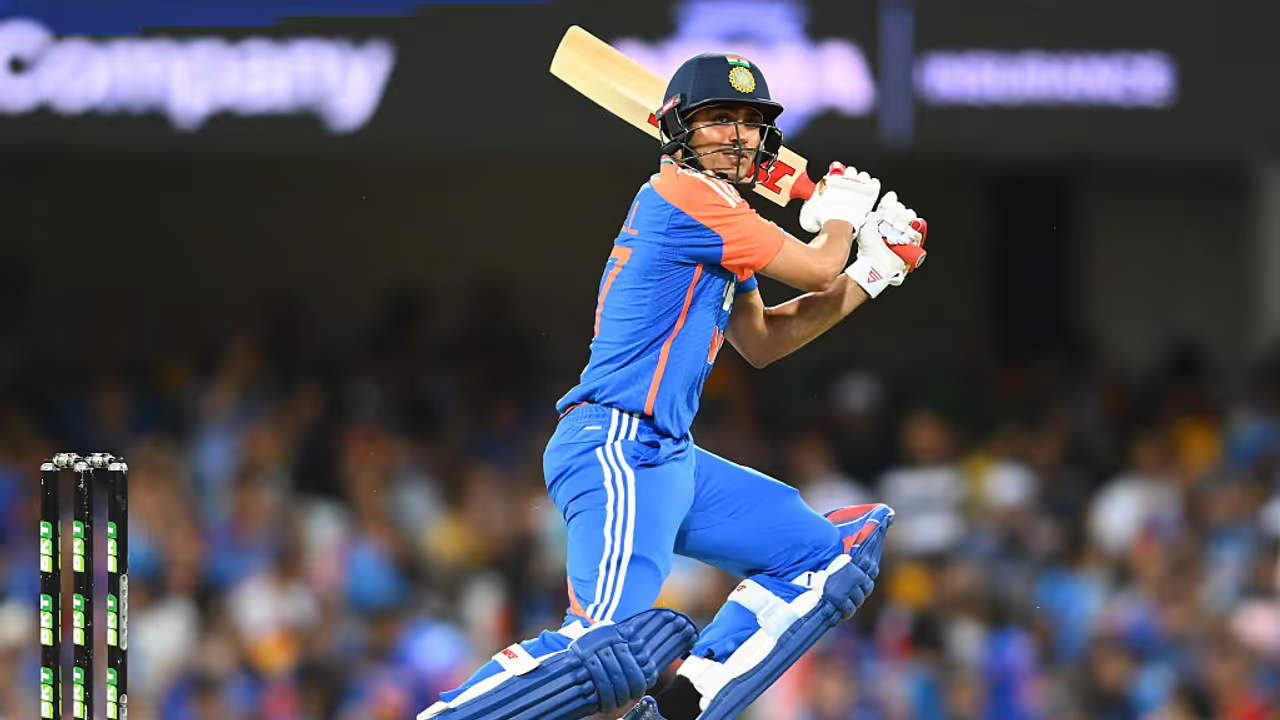
That slightly open, angled bat gave Gill easy access to horizontal-bat strokes — his pull shot in particular.
“A stance like that always helps to play shots square off the wicket, especially the horizontal bat shot like pull and Gill is as good a puller as one would find in world cricket.”
But that very setup caused him trouble in red-ball cricket. Balls seamed in, trapped him on the pads or breached his defence.
So Gill corrected it. And he corrected it well.
“Playing straight is a virtue that always pays dividends in Test cricket as a straight bat-path enables you to play inside the ‘V’. So the scoring shots will include the straight shots, cover drives, off drives and on-drives. But with that stance, you cannot easily play the pull-shot or the slashes over point. It is not impossible but difficult as then your body alignment also changes.”
It’s this recalibration — essential for Tests — that has subtly cost him fluency in T20s.
Why T20 Powerplays Expose the Gap
Modern T20 fast bowlers seldom pitch full in the powerplay. Even at 135 kmph and above, they persist with a “back-of-length” zone — around 8 metres from the stumps — precisely where horizontal-bat strokes are most effective.
With Gill’s straighter bat flow, those instinctive pulls and cuts become harder to access, especially when he is transitioning fresh out of ODI or Test cricket.
For that length he keeps encountering in the Powerplay, Gill may need to return to his horizontal-bat strokes. Switching between these technical tweaks across formats is ultimately a mental challenge.
He doesn’t lack the skill — his struggle is in toggling between two different muscle memories within short intervals.
Nine Matches to Find the Switch
With only nine T20Is left before the World Cup, head coach Gautam Gambhir will want Gill back in the groove — not by altering his technique again, but by reawakening the natural, fearless ball-striker within him.
He has conquered the classical Test template. He has thrived in ODIs with a blend of finesse and aggression.
Now he must rediscover the T20 instinct that first made him a rising star.
The coming weeks may not just shape his World Cup campaign — they might define the version of Shubman Gill India sees for the next decade.