
Florida Governor Ron DeSantis rode in a robotaxi at the SunTrax testing facility and highlighted the vehicle’s ability to navigate "all hazards."
- The Governor was touring the SunTrax testing facility in Auburndale.
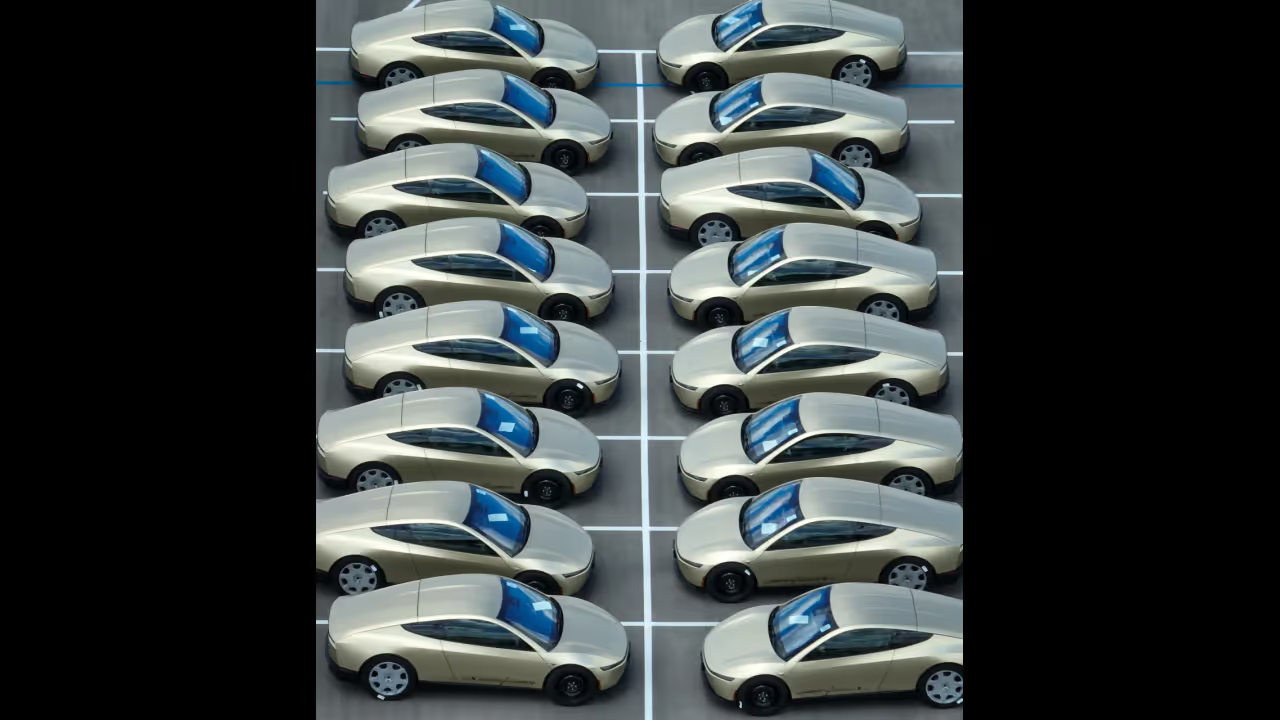
- The Cybercab is Tesla’s purpose-built robotaxi — a two-seat electric vehicle designed from the ground up for unsupervised autonomy.
- Tesla has described the early ramp for Cybercab as a slow “S-curve” expected to accelerate later this year, with a long-term target of up to 2 million units annually.
Florida Governor Ron DeSantis offered a clear endorsement of Tesla’s Cybercab while touring the SunTrax testing facility in Auburndale, highlighting the vehicle’s potential as autonomous technology advances in the state.
DeSantis Praises Design
Speaking at the high-speed test track, DeSantis pointed to a gold Cybercab on display and described the Tesla design in straightforward terms. “Cybercab comes out of Tesla. You go in there and you just sit. You have a screen. There’s no steering wheel, no pedals. Clearly these things could be very beneficial,” he said, as shown in the footage by Florida's Voice.
“We took a ride on a robotaxi on the Suntrax course and it successfully navigated all hazards — a kid running into the street, a crash with police stopping traffic, a Model S cutting us off, etc. Impressive!,” DeSantis also said in a post on X.
Safety Takes Center Stage
The governor stressed that safety remains the top priority before any wider rollout. “You don’t want to be in an autonomous vehicle and it drives you into a ditch. That would not be good,” DeSantis added.
He called SunTrax “the only high-speed autonomous vehicle test track in the United States,” adding that it can simulate interstate speeds, rain, crowded urban settings, pedestrian crossings, hills and other real-world conditions. Companies including Tesla, Waymo and Beep are actively testing there, he said, with Waymo already offering fully autonomous rides in select Florida markets.
Florida has some of the most permissive autonomous vehicle regulations in the United States. Under Florida Statute 316.85, a licensed human operator is not required to operate a fully autonomous vehicle, and such vehicles may legally drive on public roads whether or not a person is present inside.
Cybercab Plans And Timeline
The Cybercab is Tesla’s purpose-built robotaxi — a two-seat electric vehicle designed from the ground up for unsupervised autonomy. It features scissor doors, no steering wheel or pedals, and relies entirely on the company’s vision-based Full Self-Driving system.
Unveiled as a concept in October 2024, the vehicle entered pilot production at Gigafactory Texas in February 2026, with continuous production beginning in April. Tesla has described the early ramp as a slow “S-curve” expected to accelerate later this year, with a long-term target of up to 2 million units annually across multiple factories once capacity is fully online.
The company aims for a price under $30,000 and has indicated that material revenue from the Cybercab is unlikely before 2027, as unsupervised operation and broader robotaxi deployment still depend on further software validation.
Currently, Tesla operates its Model Y vehicles as robotaxis. The Cybercab is expected to ramp up the company’s fleet, which operates in Austin, Dallas, Houston, Miami, Orlando, and Tampa.
How Did TSLA Retail Traders React?
On Stocktwits, retail sentiment around TSLA stock stayed within the ‘bearish’ territory over the past 24 hours, while message volume remained at ‘low’ levels.
TSLA stock has fallen 26% year-to-date.
For updates and corrections, email newsroom[at]stocktwits[dot]com.<
