
During an interview with CNBC, Bret Taylor said that everyday use of frontier models shows they have a significant advantage over open-weight models.
- Taylor said that not every token is equal; what also matters is how well the models are coded to deliver the responses users are looking for.
- He added that it does not matter how cheaply open-weight models can be trained; what matters is how efficient they are for end users.
- Taylor also downplayed concerns about the use of AI models delivering adequate returns on investment.
OpenAI Chairman Bret Taylor on Monday downplayed the cost advantage that open-weight models offer users, saying that token efficiency matters more.
During an interview with CNBC, Taylor said that everyday use of frontier models shows they have a significant advantage over open-weight models in terms of efficiency.
“Token efficiency, compute efficiency, is something that I think the frontier labs are exceptional [at],” he said.
Not Every Token Is Equal, Says Taylor
Taylor said that not every token is equal; what also matters is how well the models are coded to deliver the responses users are looking for.
“If you’ve used a really advanced model like [GPT] 5.6 from OpenAI, you’ll know, ‘actually, wow, they’re coded right,’ so it’s a lot better than the previous model,” he said, while touting OpenAI as well as rival Anthropic’s models over the wave of open-weight models coming from China.
Taylor added that it does not matter how cheaply open-weight models can be trained; what matters is how efficient they are for end users.
“At the end of the day, it's going to be how efficient your inference is. And I think the frontier labs are still far ahead here, and that's really where the value is going to accrue,” he added.
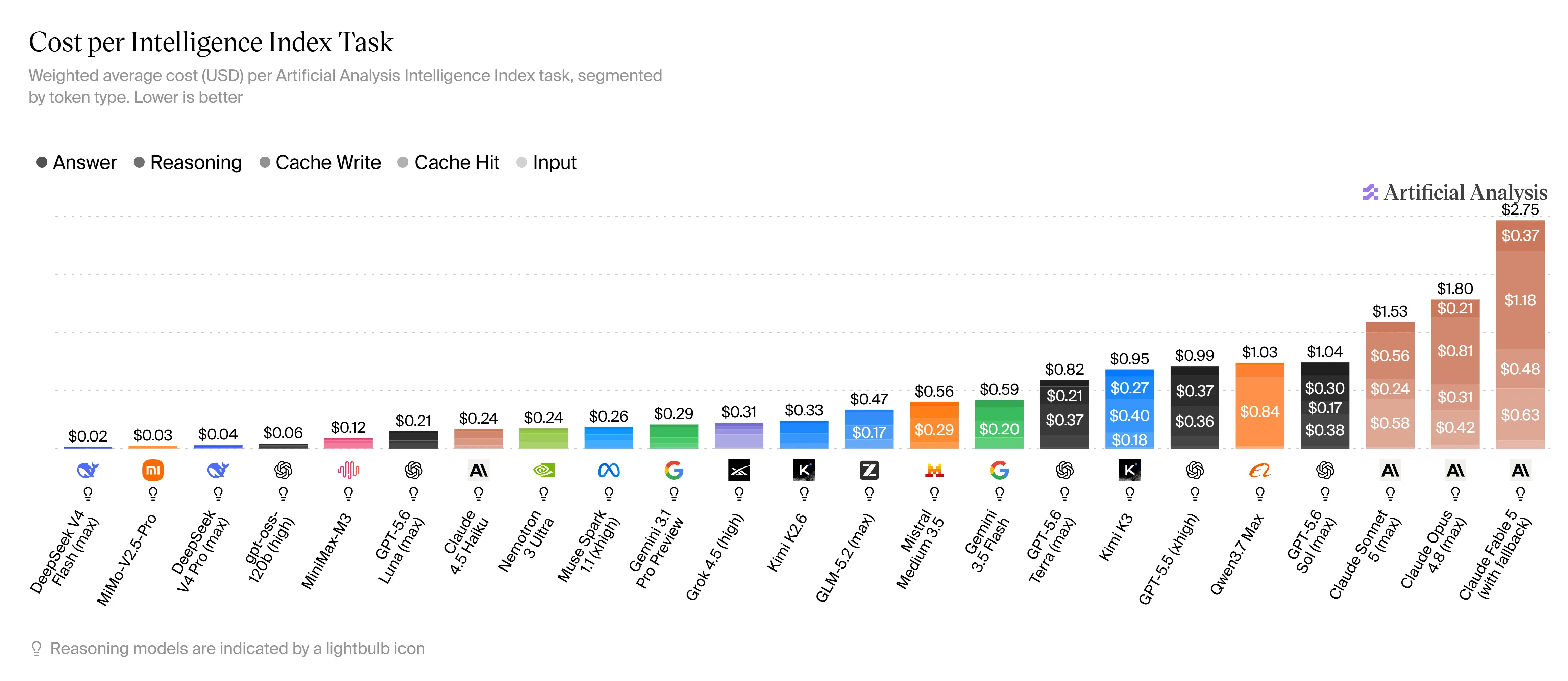
According to data from Artificial Analysis, Kimi K3 costs $0.95 per Intelligence Index Task, while OpenAI’s GPT 5.6 Sol (max) costs $1.04, and Anthropic’s Claude Fable 5 (with fallback) costs $2.75.
Taylor Downplays ROI Concerns From AI Model Use
Taylor also downplayed concerns about AI models delivering adequate returns on investment, saying he believes the world is moving toward paying for outcomes rather than focusing on token costs.
“Last year, we made AI agents that help companies drive revenue and drive customer service. But our customers don’t pay per token,” he added.
Taylor also touted the services of his startup, Sierra, which provides customer service solutions to businesses. He said that businesses pay the company on a per-outcome basis, which in Sierra’s case is loan origination or pre-authorization for medical procedures.
“If you're an insurance company and you're doing actuary work, you want it to be great. I think the U.S. labs need... for every price, performance, latency cost... they need to have the best model available. I think that's more likely than not, because it turns out that just having open weights isn't actually the main thing driving many of those costs,” he added.
Kimi K3 Launch Has The Internet Buzzing
Taylor’s comments come after Chinese AI model developer Moonshot AI launched the Kimi K3 model, taking the internet by storm.
“While its overall performance still trails the most powerful proprietary models, Claude Fable 5 and GPT 5.6 Sol, Kimi K3 demonstrated frontier-level performance across our evaluation suite, consistently outperforming other tested models,” the company said in its announcement.
Moonshot touted that Kimi K3 is the world’s first open-weight model to reach 2.8 trillion parameters.
OpenAI’s Head of Strategic Futures, Dean W Ball, praised Kimi K3 as a “very good model” in a post on X, while expressing surprise that the Chinese government is allowing models like these to be open-sourced.
The iShares U.S. Technology ETF (IYW) is up 34% year-to-date, while the Global X Artificial Intelligence & Technology ETF (AIQ) is up 32%.
For updates and corrections, email newsroom[at]stocktwits[dot]com.<
