On the leadership question, Barclays believes the board “did the right thing” by ending consideration of Huang’s return.
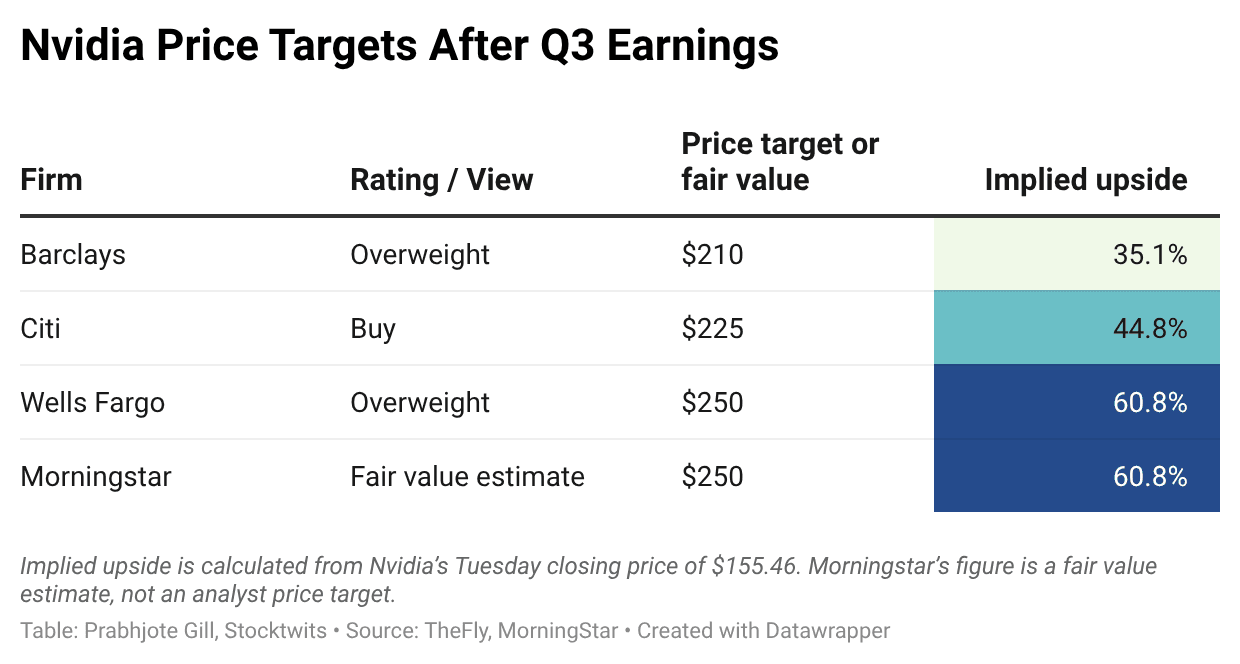
- Wells Fargo lowered its price target to $250 from $300 but maintained an ‘Overweight’ rating, citing Nvidia’s results, higher growth outlook and supply chain execution.
- Morningstar retained a $250 fair value estimate but flagged leadership, competition, and regulatory risks.
- Citi cautioned that Nvidia’s more selective approach to financing AI infrastructure projects could slow growth for some neocloud operators.
Wall Street analysts remained broadly positive on Nvidia (NVDA) after its third-quarter results, with Barclays saying the report addressed two major investor concerns: whether Jensen Huang’s departure would affect the company’s growth outlook and whether he could eventually return.
Barclays analyst Tom O’Malley said Nvidia’s results offered reassurance on both fronts, according to a note to investors cited by TheFly.
The company’s decision to raise its fiscal 2028 growth outlook to 75% year over year, from 70%, addressed concerns that demand from China had been masking weakness elsewhere. O’Malley said the increase showed that “this wasn’t a shell game with China soaking up excess demand (like many had called out over the past week).”
On the leadership question, Barclays believes the board “did the right thing” by ending consideration of Huang’s return, according to the note. The firm said it was “feeling more positive” on Nvidia following the earnings call, although the longer-term leadership situation “remains in limbo.”
The firm kept an ‘Overweight’ rating on Nvidia with a $210 price target. NVDA stock was up 4% in pre-market trade and among the top trending tickers on Stocktwits at the time of writing.
Nvidia Earnings Reinforce Bullish Analyst Views
Nvidia reported revenue of $115.8 billion, up 103% from a year earlier and beating analyst estimates of $108.7 billion, according to Koyfin. It guided to $130 billion for the January quarter and raised its growth outlook to 75% from 70%.
Citi said the results reinforced its investment thesis that demand “remains very strong.” The firm added that supply constraints are easing and that Nvidia’s new management team appears confident enough in its outlook to raise long-term growth expectations.
However, Citi cautioned that Nvidia’s more selective approach to financing AI infrastructure projects could slow growth for some neocloud operators. The firm maintained its ‘Buy’ rating and $225 price target.
Meanwhile, Wells Fargo lowered its price target to $250 from $300 while retaining an ‘Overweight’ rating. The firm said Nvidia delivered solid results and guidance, with the increase in its fiscal 2028 revenue growth outlook particularly notable given the higher base.
Although near-term headline risks could persist, Wells Fargo said it remains positive on Nvidia’s broad product portfolio and supply chain execution. The firm also pointed to accelerating share repurchases.
China Restrictions, CEO Transition Remain Key Risks
Morningstar analyst Brian Colello said Nvidia’s results and guidance “signal to us that all is well, at least in the near term,” even as the CEO search continues.
Huang resigned last week, leaving Chief Financial Officer Colette Kress as interim CEO. Nvidia’s board has hired a consultant to help identify a permanent successor.
The China question has also remained a source of uncertainty for investors. Morningstar said new U.S. restrictions introduced this week could prevent Nvidia from selling chips into Southeast Asian countries that may have supported Chinese AI workloads.
Nvidia anticipates “no problem in selling this gear to other customers,” Morningstar said. The research firm noted that Nvidia sold $2.4 billion of licensed H200 chips into Chinese data centers during the quarter, an amount it considered “immaterial.” It expects no data center revenue directly from Chinese customers in the fourth quarter or beyond.
Demand For Nvidia Chips Remains Intact
Colello also pointed to several indicators of continued demand. Nvidia’s order backlog has grown to $2.5 trillion from $2 trillion a quarter earlier, while GPU rental prices have continued to rise. Blackwell rental prices are up 60% from their introductory levels, while older Hopper GPUs have risen 100%.
He said that demand for AI tokens, which measure units of AI output, has climbed 3,400% from a year earlier on OpenRouter. “We think this abnormal pricing curve for depreciating GPUs suggests that AI remains severely compute constrained,” Colello wrote.
The firm raised its estimate for Nvidia’s implied calendar 2027 revenue to $740 billion from $700 billion, representing annual growth of 75%. It retained its $250 fair value estimate, wide moat rating, and ‘Very High Uncertainty’ rating, citing the leadership transition, the scale of the AI infrastructure buildout, and U.S.-China regulatory risks.
Based on its fair value estimate, Morningstar sees Nvidia trading at 26 times adjusted earnings for fiscal 2027 and 14.5 times for fiscal 2028.
Analyst Price Targets Point To Up To 61% Upside
Despite the risks, analyst price targets and Morningstar’s fair value estimate remain well above Nvidia’s Tuesday closing price of $155.46.
How Is Retail Feeling About NVDA Stock?
On Stocktwits, retail sentiment around Nvidia remained in ‘extremely bullish’ territory over the past day, accompanied by chatter at ‘extremely high’ levels.
However, some traders questioned whether the post-earnings rally could hold. While one celebrated the stock’s sharp move after the results, others warned that investors could use any further gains to sell.
View this Stocktwits post
View this Stocktwits post
NVDA stock has lost 17% this year, with the bulk of the drawdown coming after reports of Huang’s affair with the alleged Chinese spy.
Read also: Jensen Huang Says He Would Be ‘Honored’ To Return To Nvidia If Board Decides It Is In Shareholders’ Interest
For updates and corrections, email newsroom[at]stocktwits[dot]com.<