
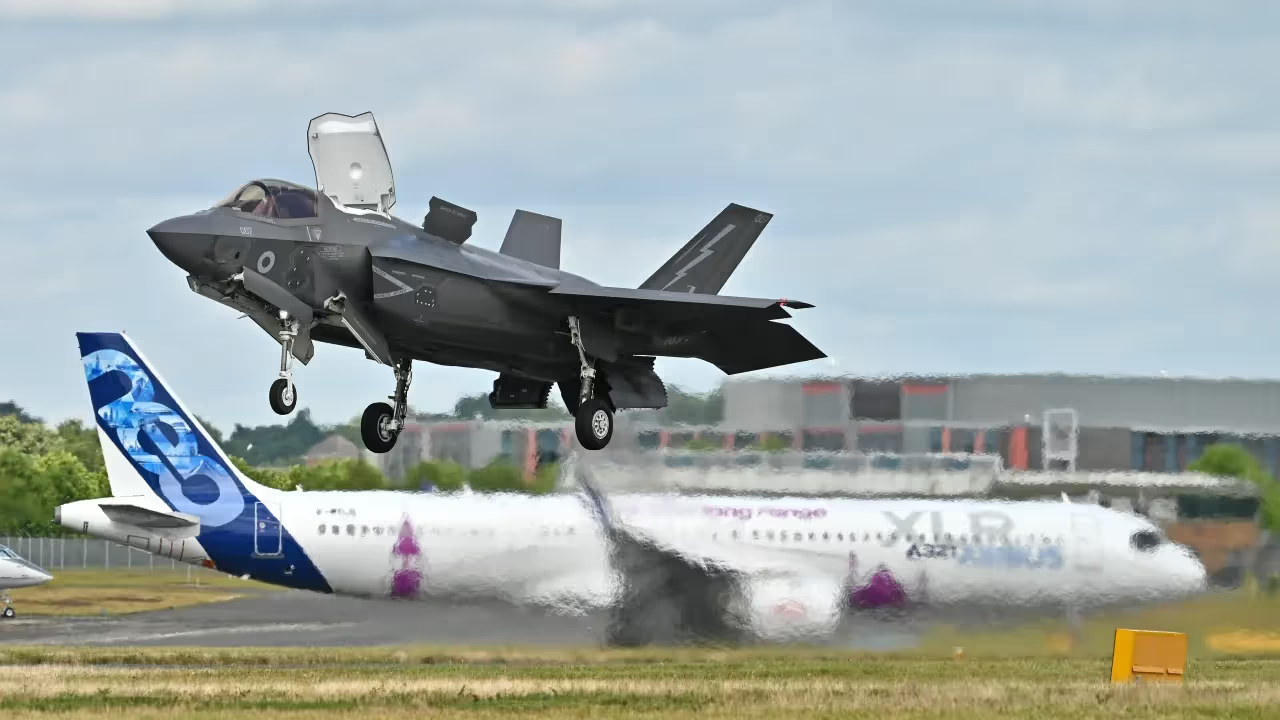
Despite booming demand, supply chain issues continue to plague operations.
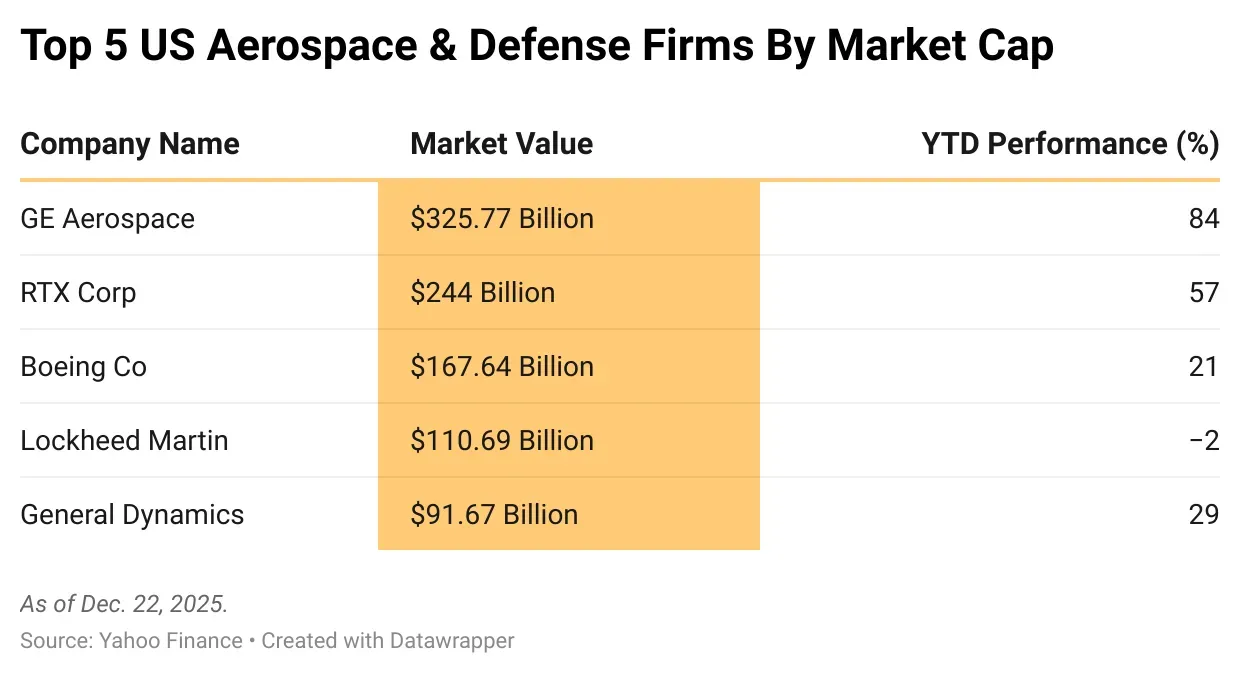
As 2025 comes to a close, the US aerospace and defense sector remains at the heart of global aviation demand and government capital outlay. From aircraft engines and business jets, missiles, and space systems, five companies-GE Aerospace, RTX, Boeing, Lockheed Martin, and General Dynamics continue to be the dominant forces.
However, ongoing supply-chain constraints, labor negotiations, and certification timelines continued to influence the operational performance of these firms.
Stocktwits takes a look at the top five US aerospace and defense companies according to their market capitalization:
GE Aerospace
Market Cap: $325.77 Billion
YTD: 84.2%
Formed after the three-way split of GE in 2023, GE Aerospace supplies jet and turboprop engines and integrated propulsion systems for commercial, military, business, and general aviation aircraft.
In 2025, GE Aerospace announced another strong quarterly performance, with orders and revenue up year over year, and raised its full-year guidance. The company announced plans to invest almost $1 billion in U.S. manufacturing facilities to expand production capacity and employment. GE Aerospace also lifted its profit forecast for 2025 on robust aftermarket demand, though delays in engine production remained an industry-wide headache.
RTX Corporation
Market Cap: $244 Billion
YTD: 57.3%
RTX was formed in April 2020 through the combination of Raytheon and United Technologies' aerospace businesses. The company's platform portfolio includes aircraft engines from Pratt & Whitney, avionics and systems from Collins Aerospace, and defense platforms under the Raytheon brand.
In 2025, RTX highlighted its diversified aerospace-and-defense product line serving both government and commercial customers. The company won a $1.6 billion sustainment contract for the F135 engines that power Lockheed Martin's F-35 fighter jets. Stock performance capped a record high late in the year as investor confidence was supported by strong defense demand and backlog.
The Boeing Company
Market Cap: $167.64 Billion
YTD: 21%
Founded in 1916, Boeing designs, produces, and modifies commercial airplanes, defense, space, and security systems, and provides related customer services worldwide. The company and its European rival, Airbus, virtually run a duopoly in commercial aviation.
In 2025, Boeing continued with defense deliveries, including progress on B-52 modernization and KC-46A tanker programs. The company completed the acquisition of Spirit AeroSystems, looking to improve production control and quality across its manufacturing base.
Boeing also developed work in digital aviation and uncrewed aircraft systems. Production schedules were, however, disrupted by labor strikes, and its production of its best-selling jet 737 Max remained capped at 38 for most of the year. The company remained under regulatory scrutiny over safety and quality concerns stemming from its earlier mishaps.
Lockheed Martin
Market Cap: $110.69 Billion
YTD: - 2.4%
Lockheed Martin came into being in 1995, although its corporate roots date back to the early 20th century. The core products are military aircraft, missile systems, space technologies, and advanced mission systems.
In 2025, Lockheed Martin reported successful flight tests of extended-range missile systems while announcing expanded partnerships with allied nations. The company also opened a new hypersonic weapons facility, underscoring its investment in next-generation defense technologies.
This was in addition to a multi-billion-dollar satellite contract the company had with the U.S. Space Development Agency, further sealing its lead in military space infrastructure. Yet, large-scale programs, such as delays in F-35 jet deliveries, continued to affect cash flow.
General Dynamics
Market Cap: $91.67 Billion
YTD: 28.8%
General Dynamics is engaged in business aviation, combat vehicles, shipbuilding, and communications systems. Founded in 1952, its Gulfstream division competes globally in the business jet market.
In 2025, the company reported segment revenue and earnings growth supported by strong demand in aerospace and defense. Gulfstream received FAA and EASA certifications for the G800 business jet, giving a green light for customer deliveries after repeated delays.
The company also won international defense contracts, including vehicle programs in Europe. In the first part of the year, however, General Dynamics faced delivery difficulties due to engine supply constraints and certification delays.
For updates and corrections, email newsroom[at]stocktwits[dot]com.<
