
White House crypto adviser Patrick Witt is negotiating with Senate Democrats on ethics language that could restrict Trump-family crypto ventures, according to Politico.
- Democrats want federal officials, including the president and members of Congress, to be barred from sponsoring, endorsing, or issuing digital assets.
- Some Republicans and Democrats questioned whether Witt has the authority to finalize a deal without President Trump's approval.
- Senate Republicans are targeting a late-July vote on the CLARITY Act, though ethics provisions and several other policy disputes remain unresolved.
White House crypto adviser Patrick Witt is reportedly negotiating with Senate Democrats over ethics provisions that could restrict President Donald Trump's crypto businesses, as lawmakers work to finalize the Digital Asset Market Clarity Act (CLARITY Act.)

According to a Politico report on Tuesday, the negotiations have emerged as a central sticking point in talks surrounding the crypto market-structure legislation. Democrats are pushing for language that would bar federal officials from sponsoring, endorsing, or issuing digital assets, a provision that could affect Trump-linked ventures, including the Official Trump (TRUMP) memecoin and World Liberty Financial (WLFI).
The politically sensitive negotiations have placed Witt, executive director of the President's Council of Advisors for Digital Assets, at the center of efforts to bridge differences between Senate Democrats, Republican lawmakers, and the White House.
Questions Over Witt's Authority
Some lawmakers from both parties questioned whether Witt has the authority to finalize any agreement without Trump's direct approval. "I don't think he has any authority to make a deal," Sen. John Kennedy (R-La.) told Politico. "I think the only person who can make that deal is President Trump."
Democrats voiced similar concerns. Sen. Adam Schiff (D-Calif.), who has participated in the negotiations, told Politico that even if lawmakers reached an agreement with Witt, there remained uncertainty over whether the White House would ultimately accept it.
The White House defended Witt's role. Press secretary Karoline Leavitt told Politico that advancing American leadership in digital assets remains a priority for the administration and described Witt as an important contributor to the effort. Several pro-crypto lawmakers, including Sen. Cynthia Lummis (R-Wyo.), Sen. Tim Scott (R-S.C.), and former White House crypto and AI adviser David Sacks, also praised Witt's work in discussions.
Republicans Push For July Vote
According to Politico, negotiations have continued despite several setbacks, including recent disagreements over how much authority state attorneys general should have to enforce the ethics provisions.
Republicans are aiming to move the CLARITY Act to the Senate floor before the August recess. Senators are scheduled to return from the July 4 recess on July 17, with a late-July vote viewed as the current target window if negotiations remain on track.
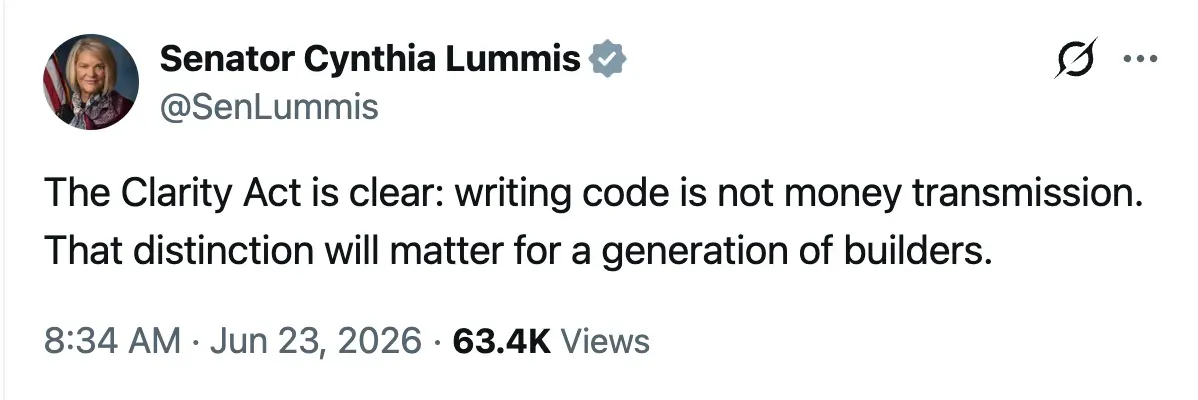
Separately, Lummis highlighted one of the bill's core policy goals in a post on X Tuesday, writing: "The Clarity Act is clear: writing code is not money transmission. That distinction will matter for a generation of builders."
Lawmakers still need to resolve several issues beyond ethics language, including decentralized finance (DeFi) liability provisions, stablecoin yield restrictions, and concerns raised by the Senate Agriculture Committee. Any final vote would also require bipartisan support to clear the Senate's 60-vote threshold, and no formal vote date has been announced.
The ethics debate comes as the Trump family's exposure to digital assets has expanded significantly through ventures like WLFI and the TRUMP memecoin.
That growing involvement has intensified scrutiny from Democrats, who argue that lawmakers should address potential conflicts of interest before advancing sweeping crypto legislation. Republicans, meanwhile, continue to push for passage of the CLARITY Act, arguing the bill would establish long-sought regulatory rules for the US digital-asset industry.
Read also: Fed's Waller Says Stablecoins, Tokenization Are Opening New Dollar Channels Beyond Banks
For updates and corrections, email newsroom[at]stocktwits[dot]com<
