
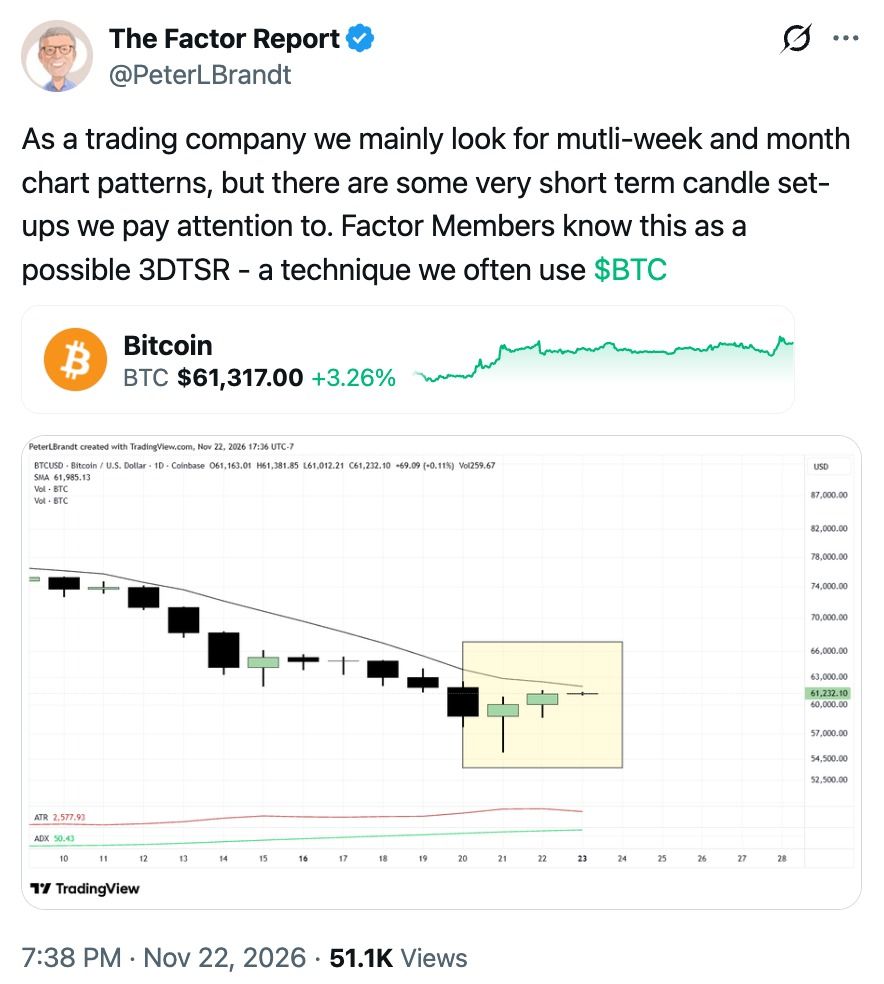
Peter Brandt flagged a possible short-term setup on Bitcoin's daily chart.
- U.S. spot Bitcoin ETFs have lost a net $4.14 billion in November, the second-biggest monthly outflow of 2026.
- The funds logged four straight days of outflows totaling about $1.8 billion.
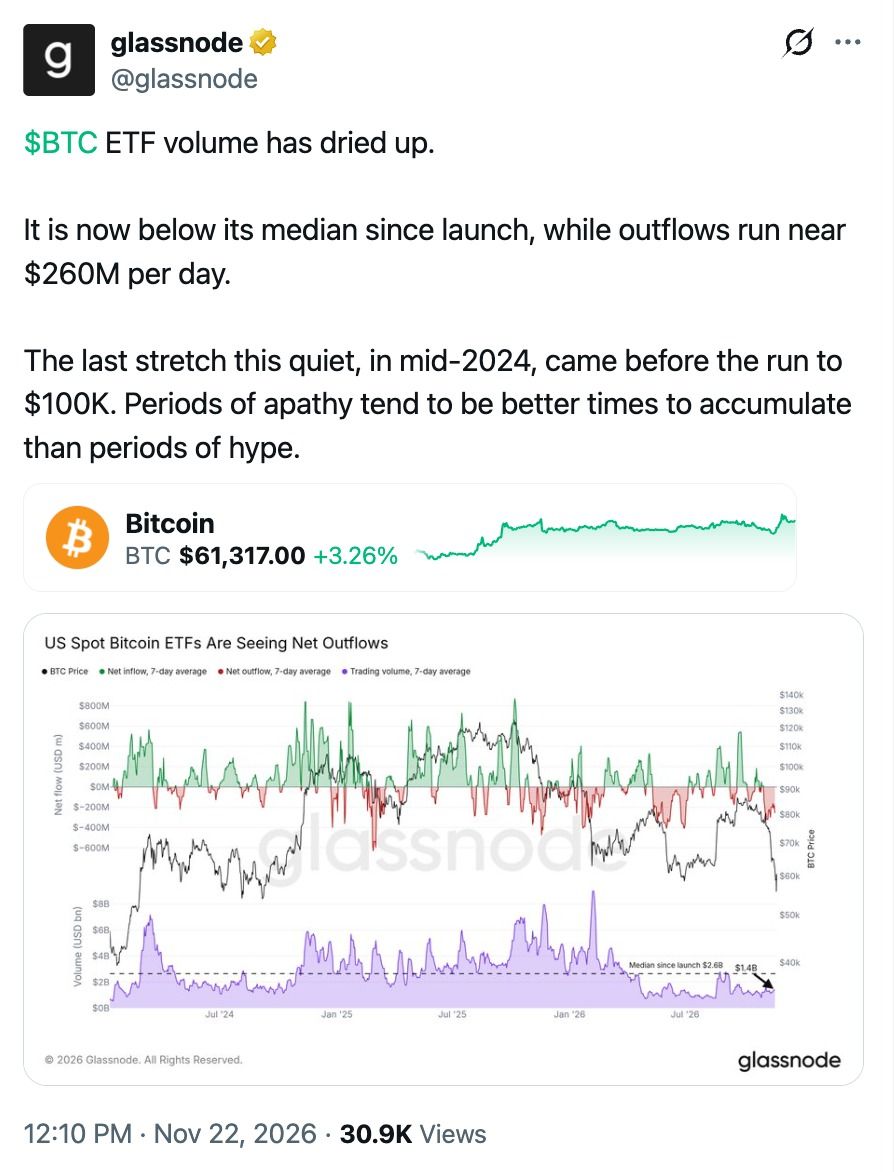
- Glassnode said ETF trading volume has fallen below its median since launch.
Bitcoin (BTC) was on course for its worst November since 2018 after U.S. spot Bitcoin exchange-traded funds (ETFs) shed over $4 billion this month, even as the cryptocurrency surged back above $60,000 on Sunday.
The cryptocurrency has fallen more than 20% in November, on track for the worst month for Bitcoin since 2018, when it crashed more than 36%, according to data from Coinglass. Bitcoin would need to regain the $87,500 level, where it started 2026, to erase its year-to-date losses. That’s roughly 44% higher than current levels.
Bitcoin was trading at $61,230, up over 3% in the past 24 hours. The token, however, was still down nearly 25% over the past 30 days.
On Stocktwits, retail sentiment around Bitcoin moved to ‘bullish’ from ‘neutral’ while chatter around it stayed at ‘high’ levels over the past day.
Why Was November Brutal For Bitcoin?
Bitcoin dropped below $60,000 for the first time since July on Friday, with tech stocks pulling down wider markets. The decline also liquidated some $1.53 billion worth of leveraged crypto bets, mostly longs.
The Crypto Fear & Greed Index was at 18 in the "Extreme Fear" zone, last seen in February of 2026. The index last reached a similar level in 2022, before 2026. The monthly slide was accompanied by steady selling in the U.S. ETFs that track Bitcoin.
ETF Outflows
The monthly slide came alongside steady selling in the U.S. Bitcoin ETFs.
U.S. spot Bitcoin ETFs saw net outflows of $4.14 billion in November, the second-biggest monthly outflow this year after $4.51 billion in June, according to SoSoValue data. The funds saw outflows for four straight sessions through Nov. 20, totaling about $1.8 billion.
The last session was the biggest of the month at $669.16 million. Of that, $544.73 million was BlackRock's iShares Bitcoin Trust (IBIT).
"Periods of apathy tend to be better times to accumulate than periods of hype," Glassnode wrote. Some traders were also watching the charts for signs that selling may be slowing down.
What Does BTC's Short-Term Setup Look Like?
Veteran trader Peter Brandt highlighted a short-term pattern on Bitcoin's daily chart. He said his firm typically searched for patterns that played out over weeks or months. Still, "there are some very short-term candle set-ups we pay attention to," he wrote on X.
Bitcoin has been down over 30% so far this year. Even if Bitcoin bounces back in November, it has a difficult path ahead to save its year.
For updates and corrections, email newsroom[at]stocktwits[dot]com<