
B. Riley said investors are overlooking the potential benefits of AST SpaceMobile developing its own launch capabilities.
- B. Riley upgraded the satellite communications company to ‘Buy’ from ‘Neutral,’ according to The Fly.
- On Wednesday, William Blair reiterated its ‘Market Perform’ rating on ASTS after ULA’s preliminary findings eased BE-4 engine concerns.
- AST SpaceMobile is expected to use Blue Origin’s rockets with BE-4 engines next year.
AST SpaceMobile (ASTS) received an upgrade from B. Riley, which raised its rating to ‘Buy’ from ‘Neutral’ on Wednesday, stating that the shares have already priced in concerns over the company’s capital commitment, satellite deployment delays, and its rocket development partnership with Firefly Aerospace (FLY).
ASTS stock was up about 8% at the time of writing and on track for a first gain in six sessions. It has declined more than 39% over the past one month as of Wednesday’s close.
B. Riley Sees 73% Upside Potential
According to The Fly, B. Riley maintained its $48 price target on ASTS, implying a 73% upside from current levels. However, it is still well short of the 12-month consensus estimate of $63.35, according to Koyfin.
The firm now sees a more attractive risk-reward balance and believes investors are overlooking the potential benefits of developing its own launch capabilities, as well as “other positive catalysts.”
FireFly Partnership In Spotlight
B. Riley’s comments on AST SpaceMobile developing its own launch capabilities follow the company's announcement that it plans to develop its reusable Blacklift rocket, using Firefly’s Miranda and Vira engines, targeting launches starting in late 2028. On Tuesday, AST issued 10 million shares to Firefly under the agreement.
The partnership aims to reduce AST’s dependence on external launch providers and give it greater control over satellite deployments.
ULA’s Initial Findings Ease Engine Concerns
On Wednesday, William Blair reiterated its ‘Market Perform’ rating on ASTS after United Launch Alliance (ULA) said that preliminary findings from its November 15 Vulcan rocket launch failure, which destroyed 40 Amazon Leo satellites, pointed to inadequate fuel supply rather than performance of the BE-4 engines. The BE-4 rocket engine is developed by Blue Origin.
The findings are crucial because AST SpaceMobile expects to launch three BlueBird satellites aboard Blue Origin’s New Glenn rocket in early 2027. New Glenn uses the same BE-4 engine model as Vulcan.
However, the investigation remains ongoing under Federal Aviation Administration (FAA) oversight, ULA said.
Retail Sees Long-Term Opportunity
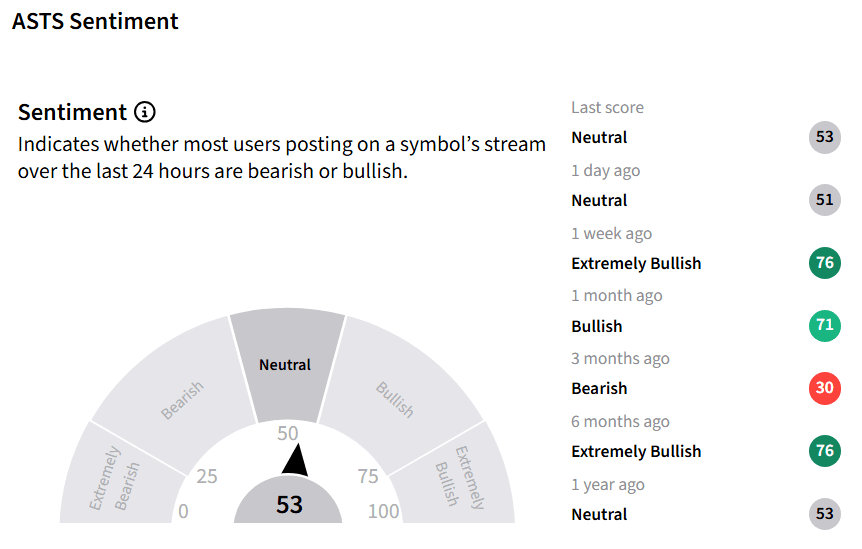
Retail sentiment surrounding ASTS on Stocktwits remained ‘neutral’ over the past 24 hours, amid a 78% jump in message volumes.
One user believes ASTS is “going to be a great opportunity for long-term investors.”
View this Stocktwits post
ASTS shares have been under heavy selling pressure this year, tanking more than 61%.
Also read: Redwire Wins Fourth Contract This Month — RDW Signs New $15M Satellite Panel Order
For updates and corrections, email newsroom[at]stocktwits[dot]com<









