
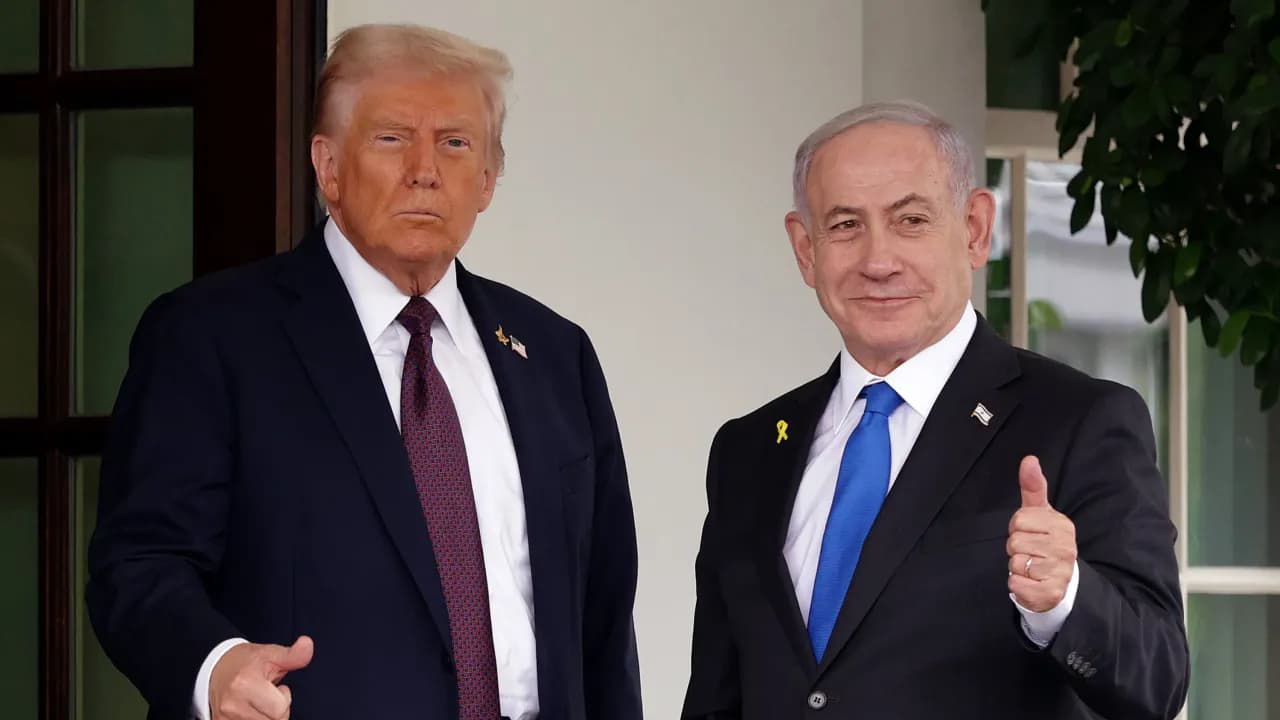
Trump reportedly told Netanyahu to refrain from retaliating against Iran’s missile attack, warning Israel to step back as diplomacy with Tehran approaches a critical moment.
- Iran reportedly fired missiles after Israel targeted a Hezbollah position in Beirut earlier in the day.
- Israeli forces had been preparing an expanded set of strikes before the operation was called off.
- A senior U.S. official said coordination gaps emerged around advance notification of the Beirut strike.
President Donald Trump reportedly told Israeli Prime Minister Benjamin Netanyahu not to retaliate against Iran’s missile attack, according to a senior U.S. official and an Israeli source familiar with the call. The call was issued amid rising tensions following Iran’s response to an earlier Israeli strike in Beirut.
Trump’s ‘You Better Be Careful’ Warning
Trump reportedly told Netanyahu that if Israel went back to war with Iran, it might find itself on its own. “I said, ‘Bibi, you better be careful, or you will be on your own very soon,’” Trump told Axios. He also said he warned the Israeli leader directly, stressing the risks of escalation while negotiations with Tehran were still underway, according to the Axios report.
The tensions escalated after Israel struck a Hezbollah target in Beirut on Sunday, an action Iran responded to with missile fire toward Israel. A senior U.S. official said the administration did not give a “green light” to the Beirut strike, highlighting coordination gaps between Washington and Jerusalem, reported Axios.
An Israeli source said the IDF had notified CENTCOM ahead of the Beirut strike, but not the White House, a move that reportedly frustrated the Trump administration.
Trump Says Iran Deal Is Close
Trump reportedly told Netanyahu during a call that the U.S. was “close to doing something good in terms of a deal” with Iran. Netanyahu initially pushed back but ultimately “pseudo agreed” to stand down if Iran did not carry out further attacks.
Trump added that either a deal would come within days or circumstances could shift toward direct action. After the call, Netanyahu instructed senior military commanders to cancel a planned major wave of strikes on Iran.
A senior U.S. official said the call was notably calmer than a previous tense exchange between the two leaders, adding that Trump did not raise his voice.
“We are in a moment in time — that why jeopardize a potential deal when you are in the fourth quarter? The president thinks that we have been in this thing for three months — now is the time to end this thing,” the U.S. official added, according to Axios.
SPY, QQQ, DIA Mixed Amid Middle East Tensions
U.S. equities tracking major benchmark indexes ended mixed on Monday, as investors weighed geopolitical tensions.
The SPDR S&P 500 ETF (SPY), which tracks the S&P 500 index, slipped 0.05% in after-hours trading after ending the regular session 0.23% higher. The Invesco QQQ Trust ETF (QQQ) also gave up part of its gains, falling 0.15% after-hours after finishing the session up 1.56%. The SPDR Dow Jones Industrial Average ETF Trust (DIA) ended the regular session down 0.15% and extended losses further in after-hours trading, slipping another 0.07% at the time of writing.
Retail sentiment on Stocktwits was mixed, with SPY being ‘bullish,’ DIA ‘bearish’ and QQQ holding a ‘neutral’ stance.
For updates and corrections, email newsroom[at]stocktwits[dot]com.<
