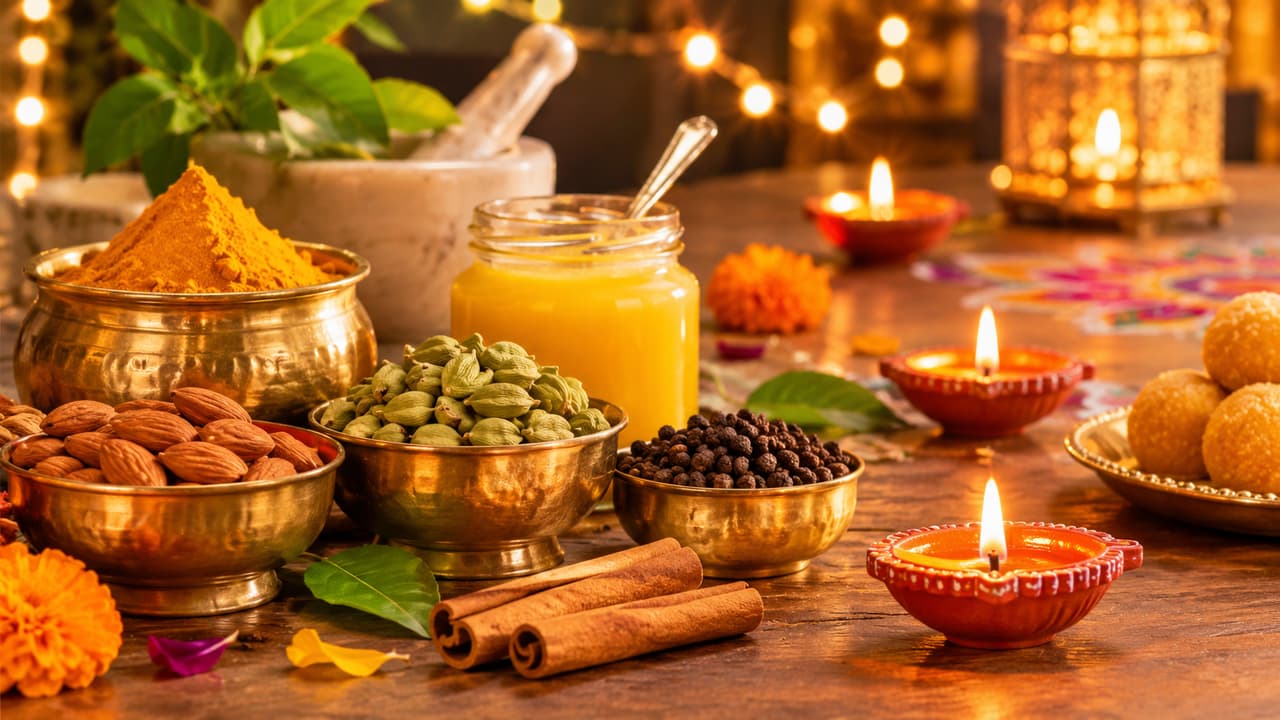
Learn about Ayurvedic ingredients you would find in a traditional Diwali kitchen, such as ghee, turmeric, cardamom and other spices. Discover how they bring more flavour, tradition and mindfulness into your cooking.
As evenings turn cooler in many parts of India around Diwali, the festive kitchen fills with the scent of ghee, toasted nuts and cardamom. Ayurveda offers a way to understand why some of these ingredients suit the season. Its seasonal approach, called ritucharya, asks us to consider the weather, our appetite and how comfortably we digest what we eat.
In Hemanta, or early winter, classical Ayurvedic texts describe agni, the capacity to digest food, as stronger. They favour more substantial meals to sustain strength in colder weather. Ghee and sesame feature in this seasonal advice. The weather around Diwali varies across India, so a cooler evening and a good appetite are more useful guides to the richness of a meal than the festival date alone.
Ghee illustrates the idea well. Ayurveda values its richness in a season when more nourishing foods are traditionally favoured. In a besan laddoo, ghee gives roasted gram flour its aroma and helps it hold together. It is also rich in saturated fat, so quantity matters when several dishes contain it. A little ghee in a cumin tadka can flavour a whole bowl of moong dal.
Related Articles

Turmeric plays a different part. In Ayurveda, haldi is traditionally described as bitter, pungent and warming. A pinch in dal, poha or vegetables brings its earthy flavour to the savoury dishes that share the table with richer sweets. Its place in the festive meal is much the same as in everyday cooking. It is a spice used in small amounts to season food.
Sesame, or til, brings together the seasonal and culinary ideas. Its natural oils give til laddoos their richness, while toasting brings out their nutty flavour. Almonds and cashews add crunch, along with unsaturated fats, some protein and fibre. A spoonful of chopped nuts can add texture to a whole bowl of kheer. Jaggery gives til chikki its deep flavour and helps bind the seeds, and it still counts as added sugar in the recipe.
An Ayurvedic idea worth bringing to the festive table is matra, or the right quantity for the person and the meal. If lunch already includes several rich dishes, a small piece of your favourite mithai may be enough. At home, the same principle helps the cook. A pinch of haldi, a spoonful of ghee or a scattering of toasted nuts can bring out the character of a dish without weighing down the meal.
-This article is authored By Dr. Shrikanth Acharya, Assistant Professor of Dravyaguna Vigyana, SDM College of Ayurveda & Hospital, Hassan