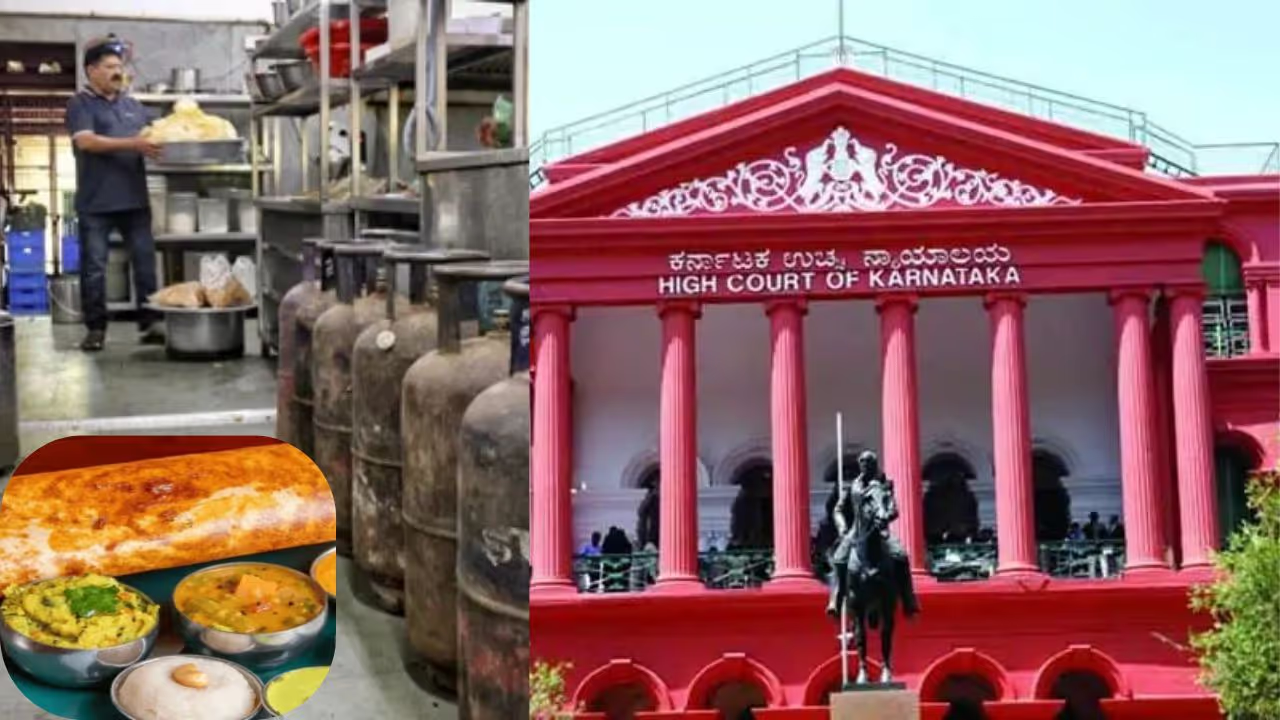
The Karnataka High Court dismissed a plea by the Hotel Association over the LPG shortage in Bengaluru, citing global supply disruptions due to international conflicts. Hotels will see no immediate relief as the government continues to manage the crisis.
Hotels in Bengaluru will have to wait longer for relief from the ongoing commercial LPG cylinder shortage, as the Karnataka High Court has dismissed a petition filed by the Bangalore Hotel Association. The court observed that issues linked to international conflicts and import-export disruptions fall beyond its jurisdiction, offering no immediate respite to the hospitality sector, which is already grappling with supply constraints.
What Was the Hotel Association’s Argument?
Representing the association, advocate K Satish Bhat highlighted a significant disparity in LPG supply across states.
“Neighbouring Tamil Nadu receives around 8,500 commercial cylinders per day, and Kerala about 4,200, whereas Karnataka is receiving only around 1,000 cylinders,” he told the court.
Bhat argued that the distribution does not align with the government’s own guidelines, pushing the hotel industry into a severe crisis. He also informed the court that discussions with a state government minister were scheduled to address the issue.
What the Centre’s Counsel Said?
Solicitor General Tushar Mehta, appearing for the central government, stated that LPG supply is largely dependent on imports and is not entirely within the government’s control.
“Our country does not produce sufficient crude oil and LPG; we depend on imports,” he said.
He further explained that the ongoing international conflict has led to frequent disruptions in supply chains, with conditions changing on a daily basis.
He added, “Even if the Hotel Association were to send its own vessel to a conflict zone such as the Strait of Hormuz, it would still face significant challenges in securing LPG.”
He assured the court that India remains in a relatively better position compared to several other countries and that the government is working continuously to improve allocation.
Related Articles

The High Court’s Final Order
After hearing both sides, the single-judge bench of Justice Sachin Shankar Magadum delivered its order at 2:30 pm. The court observed that disruptions in global trade are a natural consequence of international conflicts and fall outside the scope of judicial intervention.
“When there is an international conflict, disruptions in imports and exports are inevitable. The court cannot issue directions or interfere in such complex and diplomatic matters,” the bench stated.
No Immediate Relief for Hotels
Taking note of the Solicitor General’s assurances and the ongoing discussions with the state government, the court concluded that no judicial intervention was required at this stage and dismissed the petition.
The bench also advised stakeholders to place trust in the government’s efforts to resolve the issue. For now, this means that hoteliers in Bengaluru will not receive any immediate relief, and the resolution of the crisis will depend on administrative and diplomatic measures.