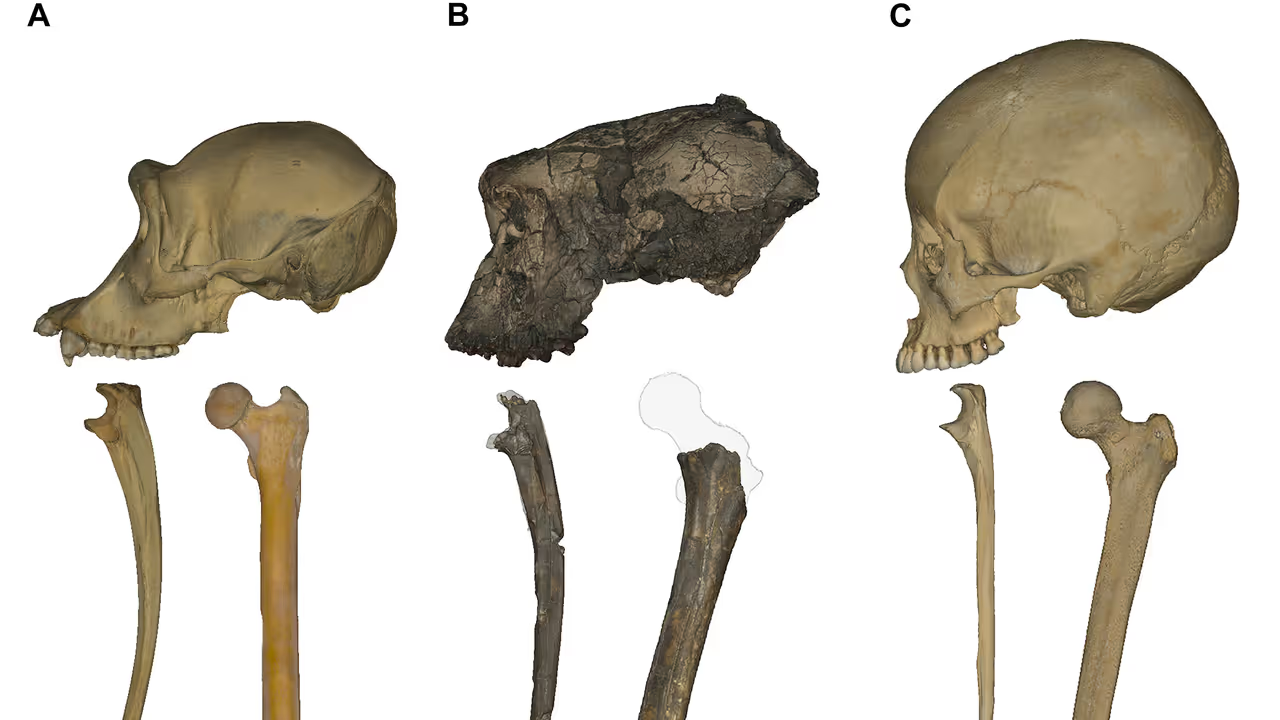
Scientists suggest a 7 million year old ape like species, Sahelanthropus tchadensis, may be humanity’s earliest ancestor to walk upright. New bone analysis reveals key features linked to bipedal movement, reshaping human evolution timelines.
For millions of years, one simple question has puzzled scientists: when did our ancestors first stand up and walk on two legs? New research suggests the answer may reach further back in time than previously believed—nearly seven million years ago.
A small, ape like species known as Sahelanthropus tchadensis is now emerging as the strongest contender for humankind’s earliest known ancestor to walk upright. Once dismissed as just another ancient ape, fresh analysis of its bones paints a very different picture.
Fossil Clues Hidden in the Bones
The fossilised remains of Sahelanthropus tchadensis were discovered in Chad’s Djurab Desert in 2001, including a remarkably preserved skull nicknamed Toumaï. Early clues came from the skull itself the opening where the spine connects sits underneath the head, not behind it, hinting at upright posture.
Related Articles

Now, researchers have gone further. By analysing limb bones using modern imaging techniques, scientists identified a femoral tubercle, a structure critical for upright walking. This feature anchors the iliofemoral ligament, the strongest ligament in the human body, which prevents the torso from tipping backward while standing or walking.
Additional signs strengthen the case: a natural twist in the thigh bone that aligns the legs forward and muscle attachment patterns similar to early humans, helping stabilize the hips during movement.
A Bipedal Ape Between Two Worlds
According to the researchers, Sahelanthropus was not fully human like. It likely had a chimpanzee sized brain and still spent considerable time in trees, climbing for food and safety. But on the ground, it could walk upright making it a crucial transitional species.
This supports the idea that bipedalism evolved gradually, not overnight. Early hominins may have switched between walking on two legs and climbing, adapting to changing environments rather than abandoning arboreal life entirely.
The findings also suggest that humans may have begun walking upright soon after splitting from the lineage leading to modern chimpanzees and bonobos, reshaping long-held evolutionary timelines.
Debate Still Walks On
Not everyone is convinced. Some experts argue that skull muscle markings suggest four legged movement, keeping the debate alive. Still, the growing anatomical evidence is difficult to ignore.
The study was published in the peer-reviewed journal Science Advances, adding significant weight to the claim that humanity’s upright journey began far earlier than once believed.