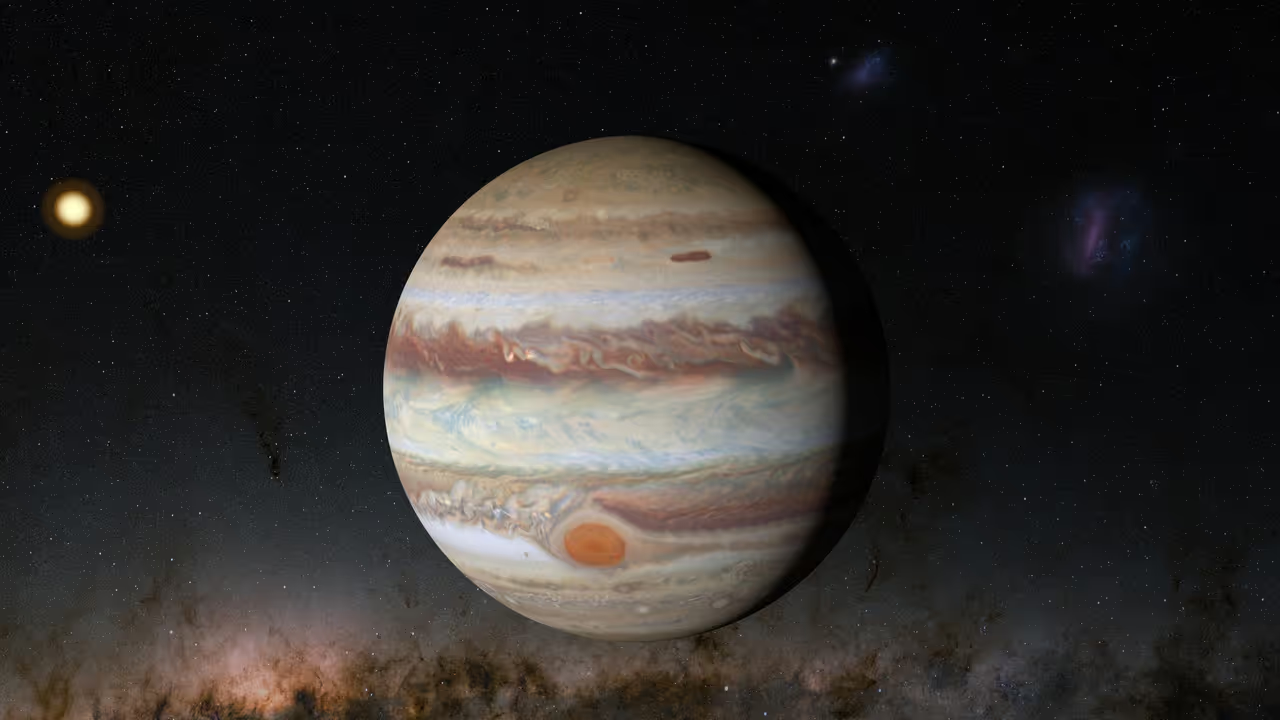
Simulations reveal that Jupiter’s rapid early growth disrupted the young solar system, creating rings that delayed planetesimal formation. These zones match chondrite meteorite origins and explain why Earth and other rocky planets stayed near 1 AU.
New research suggests that Jupiter wasn’t just a giant planet in its early years — it was a cosmic force that reshaped the entire solar system. Scientists at Rice University used advanced simulations to show that Jupiter’s rapid early growth stirred the protoplanetary disk so intensely that it created rings and wide gaps around the young Sun.
Cosmic Barriers That Delayed the Birth of Meteorites
These newly formed bands acted like barriers, slowing the flow of gas and dust and delaying the creation of many solid bodies. This helps explain a long-standing mystery: why some primitive meteorites, especially chondrites, formed millions of years later than the very first materials in the solar system.
Dust ‘Traffic Jams’ That Built Second-Generation Planetesimals
The researchers found that Jupiter’s strong gravitational influence created “traffic jams” of dust. Instead of drifting into the Sun, these particles collected in dense zones where they gradually merged into planetesimals — the building blocks of planets. These late-forming planetesimals match the age and chemistry of the chondrite meteorites that often fall to Earth today.
Related Articles

Chondrites are among science’s most precious time capsules. They preserve ancient solar system dust and tiny molten droplets called chondrules, offering rare clues about the environment that existed nearly 4.5 billion years ago. Until now, scientists struggled to understand why many chondrites seemed to form so late. This new research points to Jupiter as the key.
How Jupiter Protected the Inner Planets from Spiraling Inward
The study also reveals how Jupiter shaped the paths of the inner planets. By disrupting the inward flow of gas, it prevented early Earth, Venus, and Mars from migrating toward the Sun — a common fate for young planets in many other star systems. Thanks to Jupiter’s early interference, the rocky planets remained near 1 AU, where Earth ultimately became habitable.
These findings mirror the ringed patterns astronomers now see in young star systems using the ALMA telescope, suggesting that our solar system’s early chaos wasn’t unusual — just written on a much grander scale. Jupiter’s youthful growth left a signature that survives today, locked inside meteorites that still land on Earth.