Did you know a real-life mineral like Superman’s kryptonite exists? Discovered in Serbia, jadarite is rich in lithium and boron—critical for green energy. Learn how this unique mineral could power the future of clean technology.
KNOW
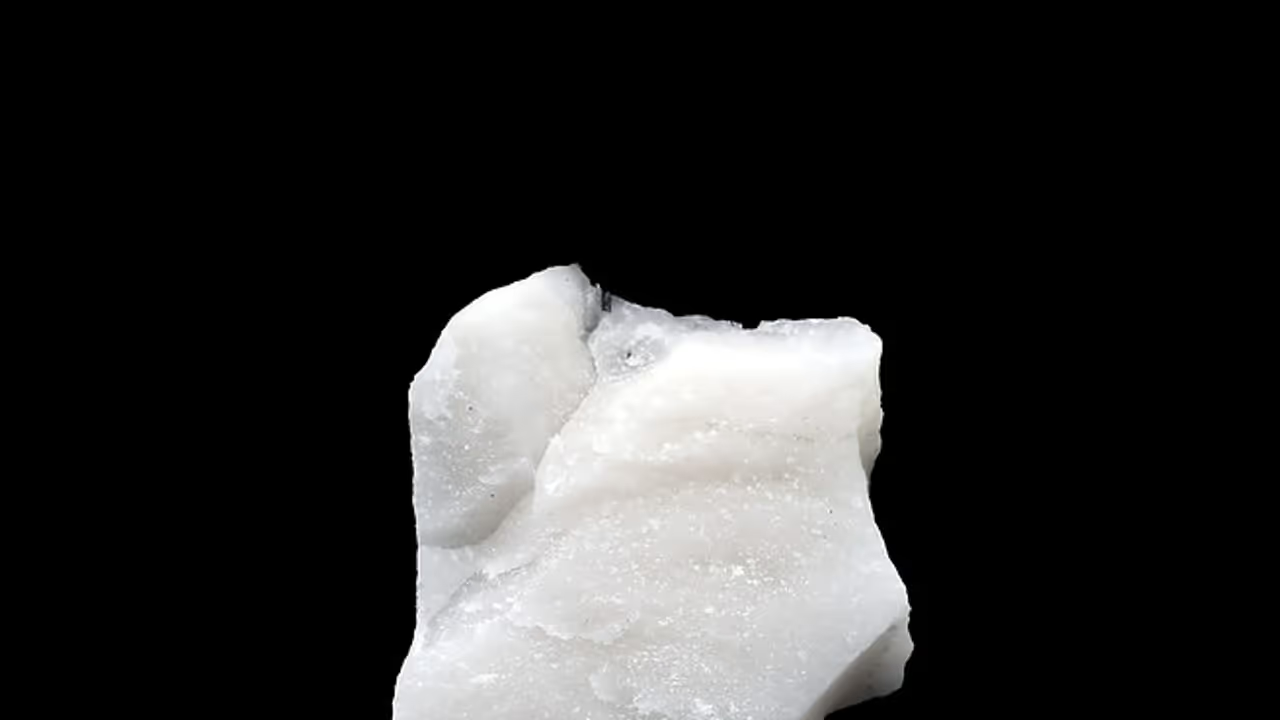
In the heart of Serbia’s Jadar Valley, a mineral discovery once compared to Superman’s fictional kryptonite is now taking center stage in a very real-world mission—powering the global shift to green energy. Named Jadarite, this dull white mineral has sparked scientific interest for its chemical properties and its potential to fuel the renewable energy revolution, particularly through its rich lithium and boron content.
What Is Jadarite?
Jadarite was first discovered in 2004 by geologists from mining company Rio Tinto during exploration work in Serbia. The mineral was unusual enough that it did not match any known mineral at the time. After detailed studies by the Natural History Museum in London and the National Research Council of Canada, jadarite was officially recognised as a new mineral in 2006.
Related Articles

Chemically, jadarite is a sodium lithium boron silicate hydroxide, with the formula LiNaSiB₃O₇(OH). Interestingly, this matches the description of “kryptonite” used in the 2006 film Superman Returns, making headlines for the coincidence. Unlike the glowing green crystal of comic books, real jadarite is dull white but fluoresces a pinkish-orange under ultraviolet light.
Why Is Jadarite Important?
While jadarite doesn’t have any superpowers, its potential is very real—particularly due to its lithium and boron content. These two elements are critical for energy storage and high-tech applications:
- Lithium is essential for making rechargeable batteries used in electric vehicles, smartphones, laptops, and grid-scale energy storage systems.
- Boron is used in glass production, ceramics, and as a neutron absorber in nuclear reactors.
Australia’s Nuclear Science and Technology Organisation (ANSTO), part of the Australian Critical Minerals R\&D Hub, sees jadarite as a potential game-changer. According to ANSTO scientist Dr. Michael Page, the Jadar deposit in Serbia is one of the largest known sources of lithium globally.
"While lacking any supernatural powers, the real jadarite has great potential as an important source of lithium and boron," Dr. Page explained. "This makes it very relevant to the future of clean energy."
Australia’s Role in Critical Minerals
Australia is rapidly becoming a leader in critical mineral research and development. ANSTO, along with CSIRO and Geoscience Australia, is working through the Critical Minerals R\&D Hub to help industries better utilise new and emerging mineral resources like jadarite.
ANSTO has already developed methods to produce battery-grade lithium chemicals from several lithium-rich minerals, including spodumene, lepidolite, and now, jadarite. These processing innovations are vital to ensuring that Australia—and the world—can access secure and sustainable supplies of critical minerals.
Jadarite may not be able to stop superheroes, but it could help power the clean technologies of the future. As countries around the globe race to reduce their dependence on fossil fuels, minerals like jadarite offer real promise for advancing renewable energy storage and electric mobility.
Discovered in Serbia but relevant globally, jadarite is a reminder that sometimes, science fiction and real-world science aren't that far apart.
Sources:
CSIRO (2025, July 28). The real-life Kryptonite found in Serbia—and why it could power the future.
ANSTO (2025). Critical Minerals Research and Development for Australia.