Learn how global warming is intensifying El Niño, risking 'climate whiplash' with severe floods and droughts. A new study warns of a Pacific tipping point by 2060.
Scientists are warning that El Niño, a natural climate pattern marked by the warming of the central and eastern Pacific Ocean, is likely to become stronger as global temperatures continue to rise. A new study suggests that these events could significantly impact weather patterns worldwide, leading to more intense floods, severe storms, and prolonged droughts.
El Niño is part of a cycle known as the El Niño–Southern Oscillation (ENSO), which alternates between warm El Niño phases and cooler La Niña phases. These changes influence weather patterns globally. Currently, strong ENSO events happen roughly every two to seven years, but they are difficult to forecast with certainty. The study was published in Nature Communicaitons.
Climate Whiplash Risks
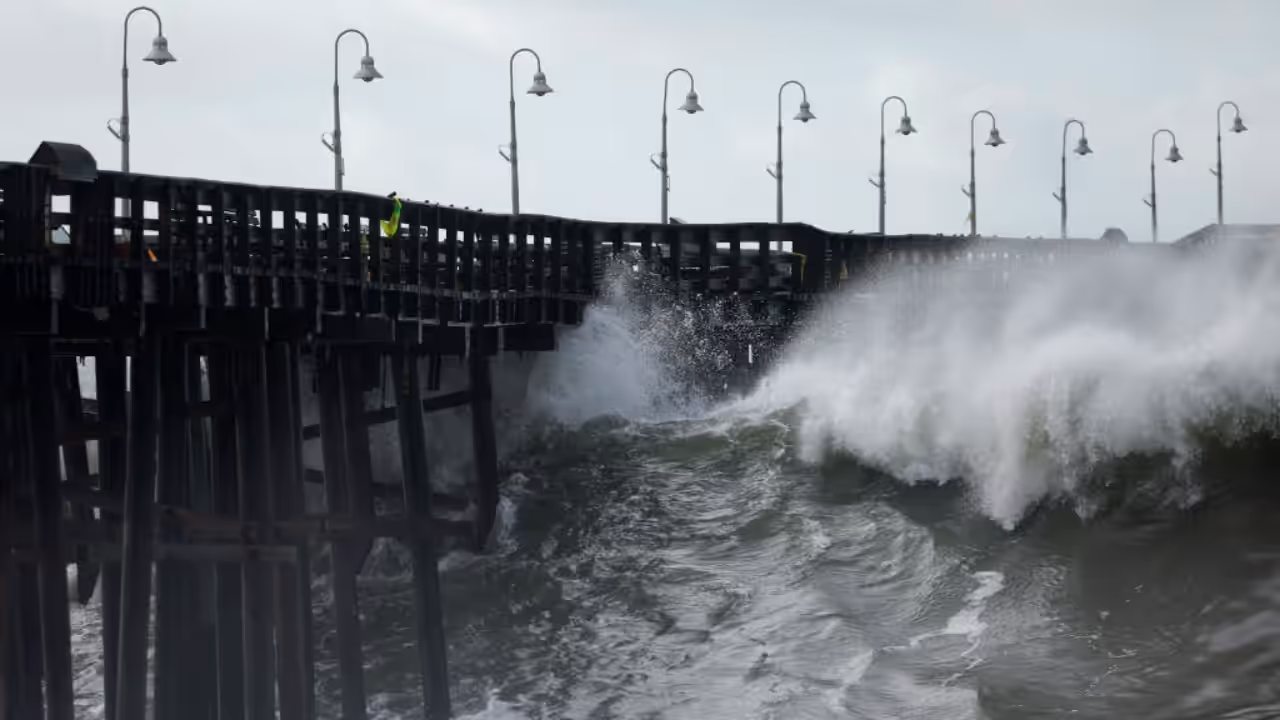
The researchers suggest that by mid-century, intense El Niño events may occur more regularly, possibly every two to five years. While this could allow some areas to prepare better, the events themselves are expected to be more powerful. This could lead to what scientists refer to as “climate whiplash,” a pattern of extreme rainfall followed by severe droughts. For example, El Niño years often result in heavy winter rains in California, increased droughts in Australia, and higher wildfire risks in Southeast Asia. In contrast, La Niña years bring cooler Pacific waters, which can lead to stronger Atlantic hurricanes.
Related Articles

Global warming, driven by human activities, is making most aspects of Earth's climate more unpredictable. However, this study suggests that ENSO might change in a different way. As greenhouse gases warm the planet, the Pacific Ocean becomes more responsive to interactions between air and sea, making El Niño conditions easier to trigger and less likely to be suppressed. This implies that the climate system may become more consistent but also more extreme.
Pacific Tipping Point
A team of experts from South Korea, the United States, Germany, and Ireland used detailed climate models covering the period from 1950 to 2100. Their findings indicate that around 2060, the Pacific may reach a “tipping point,” shifting ENSO into a new, more intense and more regular pattern.
Dr Malte Stuecker, the lead author from the University of Hawaii Manoa, explains that as the climate warms, the tropical Pacific could transition from a relatively stable state to one where large El Niño swings become the norm.
This transformation is likely to have effects that extend beyond the Pacific. As ENSO becomes more forceful, other major climate patterns may start to synchronize with it, including the North Atlantic Oscillation, which influences European weather, and the Tropical North Atlantic Mode, which affects rainfall and hurricane activity in the Caribbean.
Wider System Impacts
This is concerning because many regions are influenced by multiple weather systems at once. Currently, these patterns operate independently, sometimes countering each other. However, if they start to align later this century, some areas could face multiple climate impacts simultaneously. This could also mean that El Niño could have a greater influence on regions that have not previously experienced its effects strongly, including parts of Europe.
Dr Axel Timmermann of Pusan National University warns that such synchronisation could lead to sharper variations in rainfall in places like southern California and the Iberian Peninsula, increasing the likelihood of climate whiplash.
Drought-Flood Cycle
During extended dry periods, soil hardens and vegetation dies or burns, reducing the land's ability to absorb water. When heavy rainfall eventually occurs, water runs off quickly, leading to destructive floods. These floods can damage rivers, reservoirs, and other water systems, making it harder to store water for the next drought.
A recent WaterAid report identified Hangzhou in China, Jakarta in Indonesia, and Dallas in the United States as cities already facing some of the most severe climate whiplash. If El Niño events become more frequent and extreme, this problem is likely to worsen.
Dr Timmermann emphasizes that the study highlights the need for global planning to address increasingly unpredictable climate extremes and their broader impacts on ecosystems, agriculture, and water supplies.