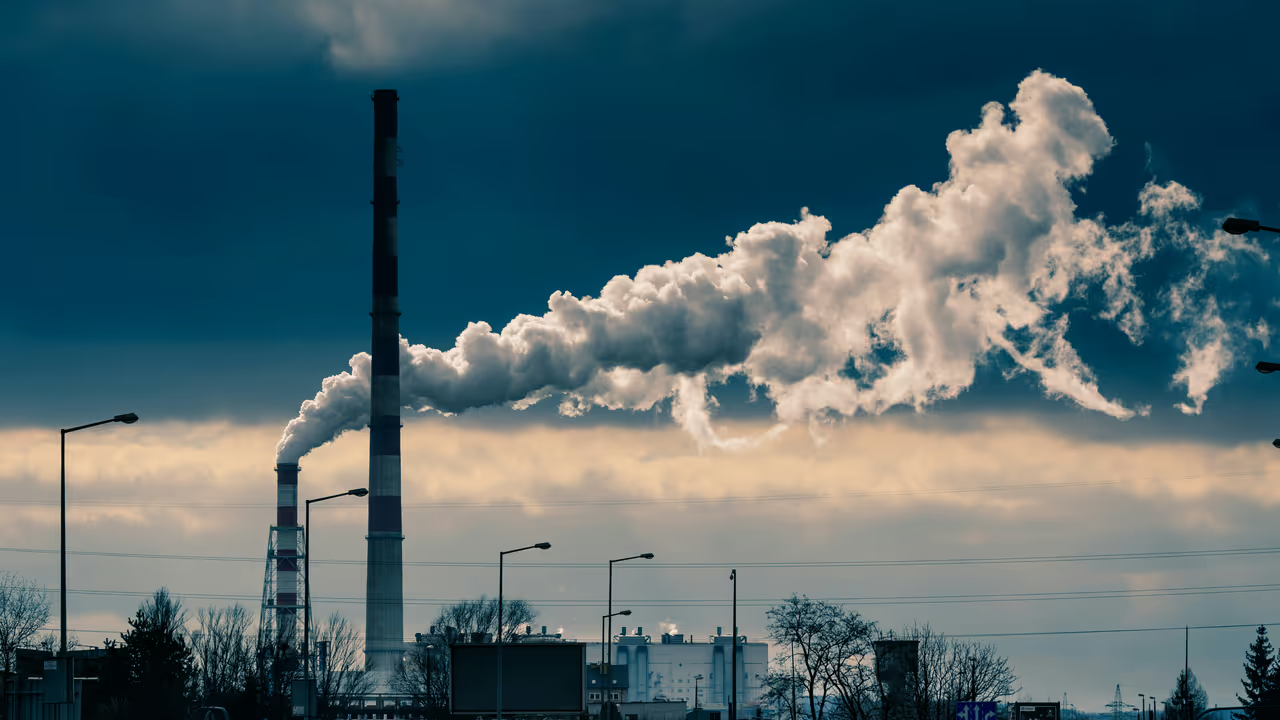
A growing climate strategy is attracting major corporations, investors and policymakers seeking faster results. The approach targets overlooked emissions sources with immediate economic and environmental implications.
Superpollutants are emerging as a major focus in climate discussions as businesses and policymakers increasingly look for faster ways to slow warming while longer-term decarbonisation efforts continue.
The issue gained fresh attention during Climate Week New York, where governments, industry leaders and corporate representatives met to discuss practical measures for reducing these highly potent pollutants. The gathering also saw the launch of a new Superpollutant Roadmap aimed at helping companies address emissions across operations, supply chains, financing decisions and policy engagement.
Corporate interest has already begun translating into financial commitments. Earlier this year, companies including Amazon, Google, JPMorgan Chase, Salesforce and Workday pledged a combined $100 million to support efforts targeting superpollutants through 2030.
Related Articles

These pollutants contribute significantly to near-term warming that is already affecting supply chains, agricultural productivity, energy systems and workplace conditions. Unlike some climate solutions that require decades of transformation, many superpollutant emissions can be reduced using technologies that are already available.
Superpollutants include methane, black carbon, tropospheric ozone, nitrous oxide and high-warming refrigerant gases. Although they receive less public attention than carbon dioxide, they have an outsized influence on rising global temperatures. Many remain in the atmosphere for shorter periods, yet together account for nearly half of current warming.
The opportunity lies in speed. While deep reductions in carbon dioxide remain critical for long-term climate goals, cutting superpollutants offers an additional pathway for limiting temperatures over the coming decades. Measures targeting methane emissions alone could avoid around 0.2 degrees Celsius of warming by 2050.
That reality is increasingly shaping climate strategies. Rather than relying on a single approach, policymakers and businesses are being encouraged to pursue two parallel tracks: advancing clean energy, electrification and fossil-fuel transition efforts while simultaneously cutting superpollutant emissions.
Practical solutions already exist across key sectors
Methane illustrates how much progress could be achieved with existing technology. The gas has contributed nearly 30 per cent of the increase in global average temperatures since the Industrial Revolution. Yet the International Energy Agency has reported no indication that methane emissions from fossil-fuel operations are declining.
According to the same analysis, about 70 per cent of methane emissions from fossil-fuel activities could be reduced using currently available technologies. More than 35 million metric tons annually could be avoided at no net cost based on 2025 energy prices.
Available measures include detecting and repairing leaks, replacing equipment that releases methane, recovering gas that would otherwise escape and ending routine venting and flaring. These actions also provide energy-security benefits, with cuts from oil and gas operations potentially making around 200 billion cubic metres of additional gas available to markets each year.
New monitoring tools are helping identify where interventions can deliver the biggest impact. Satellites, aircraft, fixed sensors and artificial intelligence can increasingly trace emissions to specific sources. Climate TRACE estimates that the highest-emitting 10 per cent of monitored landfills account for 70 per cent of methane emissions from waste, providing valuable information for governments, businesses and investors.
Agriculture presents another opportunity. In rice cultivation, alternate wetting and drying replaces continual flooding with cycles of drainage and reflooding. The practice can reduce methane emissions by 30 to 70 per cent while maintaining yields and lowering water use.
Meanwhile, rapidly growing demand for cooling is bringing attention to refrigerant gases. Air-conditioning demand is projected to more than triple by 2050, increasing the importance of preventing refrigerant leaks, shifting to lower-warming alternatives and recovering gases when equipment reaches the end of its operational life.
Some superpollutants also pose direct public-health risks. Black carbon, generated through incomplete combustion from sources such as diesel engines, cookstoves, wildfires and biomass burning, is associated with heart and lung disease as well as premature death.
Supporters of stronger action argue that technological solutions and policy tools already exist. Proposed measures include stricter methane monitoring, leak-detection requirements, limits on routine venting and flaring, standards for refrigerants and support for cleaner agricultural and waste-management practices.
The growing focus on superpollutants reflects a broader recognition that reducing warming does not depend on a single solution. While the transition to a lower-carbon economy will take time, many of the measures needed to curb these powerful pollutants can be implemented immediately, offering a faster route to slowing climate impacts already being felt around the world.